
 7 months ago
30
7 months ago
30

Natalie ShermanBusiness reporter

 SimpleImages via Getty
After a dramatic 2025, when US President Donald Trump's tariff announcements sent the dollar tumbling, traders of the currency were expecting a quieter year.
Recent weeks have shattered that complacency.
The dollar dropped to its lowest point in four years on Tuesday against a basket of currencies, hitting multi-year lows against the Euro and the pound as it fell 3% in roughly a week.
That slide has since slowed down, but analysts say the reprieve is likely to be temporary.
"Most people would think the dollar should, could, and would weaken further this year," said Chris Turner, global head of financial market research at ING. "The jury's out on the timing but less so on the direction."
A weaker dollar reduces purchasing power for Americans - something overseas travellers know all too well. If that carries on, analysts say it risks fuelling inflation inside the US, as Americans face higher prices for imports.
The falls have also raised bigger questions about whether the dollar's status as the world's go-to currency - which for decades has helped keep borrowing costs in the US relatively low - might be under threat.
So what is driving down the dollar and what does it mean?
What has happened to the dollar?
The dollar has been coming off a more than a decade of strength, with especially sharp gains between 2020 and 2022, when America's post-pandemic growth and relatively high interest rates drove investor demand for the currency.
This month, the dollar slid further as tension grew between the US and Europe over Greenland.
And the losses continued this week, amid speculation that the US might be considering actions that would weaken the dollar further, including selling dollars along with with Japan to help boost the yen, which was facing its own sell-off.
Why is the dollar falling?
Analysts say say the dollar's downturn is in part a sign of market concern about the Trump administration's policies.
"In my opinion, what markets are reacting to is just sort of the haphazard nature of policy in this administration - the escalation, de-escalation," said Robin Brooks, senior fellow at the Brookings Institution and former FX strategist at Goldman Sachs, pointing to similarities between the backlash over tariffs and Greenland.
The dollar's decline "is a reflection, basically, of markets saying this kind of chaotic back and forth hurts the US more than anyone else," he said.
 Bloomberg via Getty Images
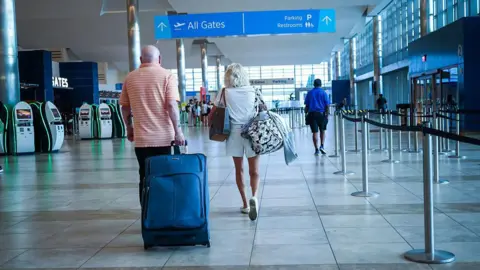
The dollar's decline means Americans travelling overseas will see their money stretch less
While markets had appeared unfazed by bubbling geopolitical issues headed into the year, the rapid escalation in trade tensions over Greenland changed that, said Thierry Wizman, global foreign exchange and interest rate strategist at Macquarie.
"I think that's unnerved people," he said, noting that not only has the dollar dropped this month, bets that the currency will be hit by future swings have risen too.
There are other factors, such increased investment opportunities overseas, and, in the recent days, the sell-off in the Japanese bond market.
That sell-off has led to some traders unwinding bets aimed at taking advantage of differences in value between the yen and the dollar.
Comments by US Treasury Secretary Scott Bessent denying that the US had intervened to help Japan helped stabilise the dollar this week.
But analysts said there was still uncertainty about what the Trump administration might do next.
Where is the money going? Is this 'sell America'?
The shift from the dollar has helped to fuel a surge in the price of gold, sending its price doubling over the last year, as investors seek a low-risk place to put their money.
And though other national currencies appeared to get little boost from redirected funds last year, there are signs that could be starting to change.
The Euro and pound were among the currencies to see their values leap against the dollar this month, while eleven of the 19 emerging market currencies tracked by Oxford Economics also gained more than 1%.
 Bloomberg via Getty Images
However, Turner of ING said he thought markets were still well way from a "full 'sell America' narrative", noting that the sell-off action has been largely limited to the dollar.
He and others noted that the US stock market is still hovering around record highs, while moves in the market for US government debt have been relatively contained.
Still, ING is expecting the dollar to fall another 4% to 5% this year, as growth prospects outside of the US improve.
Does Trump actually want a weaker US dollar?
For now, the dollar's falls remain small enough that the impact for American consumers is likely to amount to "noise", Brooks said.
But what happens next will depend in part on US economic performance and how quickly the US central bank will lower interest rates.
Trump has mounted an intense campaign for lower interest rates more quickly and is expected to install someone more sympathetic to those demands to lead the bank in the next few months.
If rates do fall, that might lower the dollar further as investors chase higher returns elsewhere.
But the White House could see that as a good thing, as Trump and other White House officials have previously welcomed the idea of a weaker dollar, which can help make US exports more competitive.
"It doesn't sound good, but you make a hell of a lot more money with a weaker dollar... than you do with a strong dollar," Trump said in July. This week, asked about the falls, he said he thought the currency was "doing great".
Brooks said a sustained drop in the dollar's value could help boost US firms - but warned that the pay-off might be limited if it happens for the "wrong reasons".
If it's the market rendering a verdict on poor policies, he warned "that is probably a very important signal".


