
 8 months ago
38
8 months ago
38

Patrick Fee, Niall Glynnand Brendan Hughes,BBC News NI

 Getty Images
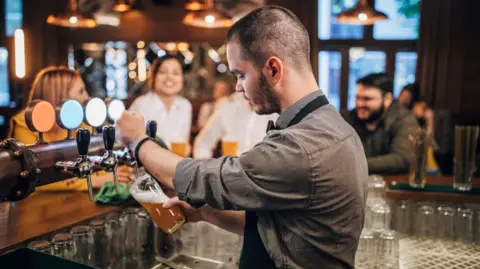
Pub owners said any rates bills increases would be hard to adsorb
Finance Minister John O'Dowd has announced a pause in the process which would have seen large rates increases for many in the hospitality sector.
O'Dowd defended the overall revaluation process as essential in ensuring fairness in the rates system, but said that this pause was focused on allowing "local businesses to thrive".
Welcoming the decision, Hospitality Ulster's Colin Neill said it was a "relief" and could have been the "death knell" for the industry.
 Pacemaker
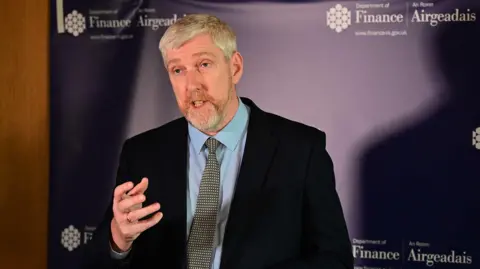
Finance Minister John O'Dowd said he had "listened carefully" to concerns
Next year's business rates will now be calculated using the current valuation meaning any change in rates bills will now be much smaller for many businesses.
The finance minister said local businesses were "the backbone of our local economy".
"I have listened carefully over this last number of days to the concerns raised by some businesses - particularly those in the pubs, hotels and hospitality sector - about the impact that Reval 2026 could have on their businesses," O'Dowd said.
"Therefore I think it is only right and proper that I stop the process at this stage and allow that stage for engagement with those businesses and others to set out a way forward which will deliver a fair and equitable rates process."
What has the reaction been?
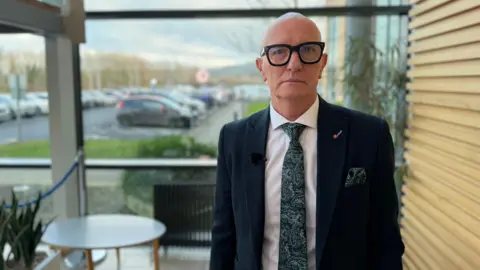
Colin Neill had said the plan would have been the "death knell for the industry"
Hospitality Ulster, which had warned Reval 2026 would be the "ruination of the hospitality industry" welcomed the decision.
Its chief executive, Colin Neill, said it was a "relief that the minister has listened to the people who are both a cornerstone of our economy".
"Hospitality's opposition to Reval 2026 has never been based on an unwillingness to contribute our fair share to rates revenue," Neill added.
He explained they had objected because "what was proposed was not fair and would have been the death knell for our industry".
The business organisation NI Chamber also welcomed the decision with its chief executive Suzanne Wylie saying they would "continue to press for a transparent and sustainable approach" to rates.
Democratic Unionist Party (DUP) finance spokesperson Diane Forsythe welcomed O'Dowd's announcement, saying it represents "not just a change in policy but also of tone".
She said the minister was now in "listening mode" but that the process raised "serious questions about the minister's judgement in allowing things to progress to this stage".
On Wednesday, O'Dowd's Sinn Féin colleague, First Minister Michelle O'Neill, acknowledged many pubs and restaurants were "getting it tight".
Inflation, post-Covid customer numbers, staff shortages were all major challenges faced by pubs and restaurants in the last few years.
Some owners and staff feared that potential rates increases could be the final straw.
Published last week, a draft list of property valuations showed a marked increase for some businesses.
Those figures had meant some businesses were likely to see thousands of pounds in extra bills from 1 April.
Why did pubs and restaurants fear they were in line for bigger rates bills?
The possibility of increased rates bills came after an exercise called Reval 2026, carried out by Stormont's Land and Property Services (LPS).
More than 75,000 non-domestic properties were revalued as part of a new list used in calculating business rates - an annual property tax that helps fund public services.
The draft revaluations, which will be used to calculate rates from 1 April, showed an 85% increase in the total value of hotels, while pubs have risen 47%.
Sharon Gallagher, chief executive of LPS, told a Stormont committee on Wednesday that calculating rates bills was "not about winners and losers".
She said many pubs and hotels had received temporary Covid allowances to reflect suppressed trading, but their removal was a "necessary part of restoring fairness and consistency" across LPS rates valuations.
What did pubs and restaurants say about Reval 2026?
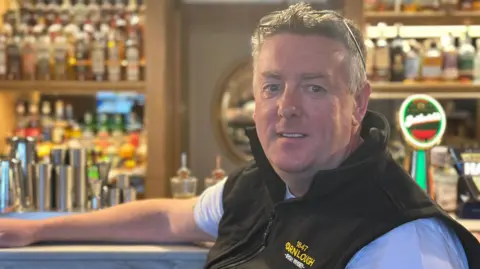
Adrian McLaughlin said a rates rise would have a major impact on his hotel business
Adrian McLaughlin, manager of Carnlough's Harbour View Hotel, said it would be very difficult to absorb any rates bill increase.
The best way, he said, would be by additional sales or by cost reductions - but it's much harder to cut costs in 2026.
"They're much harder to come by because of National Insurance increases, utilities increases and the cost of goods.
"So, it's becoming very, very, difficult for us to find the space to accommodate large, incremental increases like this."
Colin Johnston, chief executive of the Galgorm Collection, estimated that the Galgorm resort's rates bill was set to go up from £585,000 to almost £1.5m - about £66,000 a month extra.
Before the pause was announced, Canavan's in Ballygawley, in County Tyrone, took to social media to air its frustration about the revaluation.
"Your pint has increased in price by 92%.
"Your room for the night is now nearly double the price it was yesterday, for no apparent reason.
"You wouldn't accept those price increases from us, but this is the hand which we have been dealt."
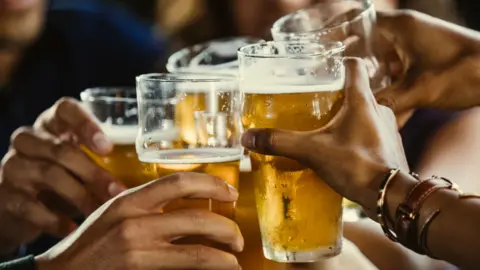
What might it have meant for the price of a pint?
 AFP via Getty Images
The owner of The Bridge House in Park said it's "too expensive" to go into a bar
The rates valaution increases were not across the board - they would have affected some bars and restaurants. But for those affected, it could have led to price hikes.
Gavin Bates, owner of Ryan's Bar in Belfast, said its rates would go up £33,000 for the year under the revaluation.
"It's huge on our business, we haven't budgeted for it.
"We've got supplier pricing coming and we are already looking at putting a small increase on our drinks."
Pearse Deeney, owner of The Bridge House in Park, County Londonderry, said they would have looked at putting up prices, not long after a previous increase also due to drink supplier costs going up.
He told BBC Radio Foyle's North West Today programme that customers were already fed up.
"It's too expensive to go into a bar now, that's just the way it is," Deeney said, adding that he believed people would be put off going out for a drink.


