
 4 months ago
44
4 months ago
44


 Alamy
Alamy
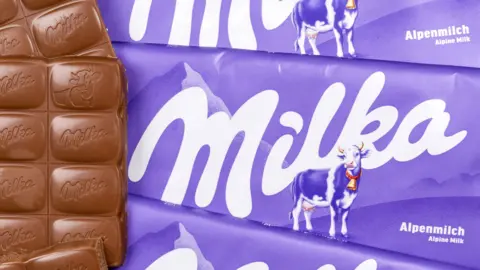
The weight of Milka's Alpenmilch bar shrank from 100g to 90g earning it the title of "rip-off packaging 2025"
In a landmark German case targeting chocolate "shrinkflation", a court has found that the manufacturer of Milka's classic Alpine Milk bar cheated consumers and broke competition law.
Cutting back on the amount of chocolate while having the same kind of wrapper meant that customers were being misled, Bremen regional court ruled.
The three-week court case was brought by Hamburg's consumer protection office (VZHH), which accused manufacturer Mondelēz of deceiving consumers by cutting the weight of the "Alpenmilch" bar from 100g to 90g.
Reacting to the ruling Mondelēz told the BBC it was "taking the decision of the court seriously" and would "look at it in detail now".
Manufacturers have often resorted to shrinkflation because of rising costs, reducing the size or content of a product in an attempt to maintain the same price. The practice transcends borders. In the UK, consumer group Which? has called it a "sneaky" tactic.
According to Which? chocolate prices have increased due to the global rise in the cost of cocoa after poor harvests in West Africa.
Mondelēz argued that it had informed German consumers about the change on its website and social media channels, and pointed to the rising costs in its supply chains: "As a consequence in the last years we decided to adjust the weight of several Milka-bars."
Last year, German consumers were not satisfied with the company's explanation and voted the Milka Alpenmilch bar "rip-off packaging of the year 2025".
Although the bar's weight had been reduced, there was no noticeable change in its purple wrapping. The new bar was a millimetre thinner, and the price went up from €1.49 (£1.30) to €1.99 (£1.70) at the beginning of 2025.
Mondelēz had maintained that the lower weight was clearly visible on its packaging and denied the allegations made by the Hamburg consumer group. The company's lawyer argued in court that chocolate bars in the past had a fluctuating weight between 81-100g depending on the product.
The district court in Bremen ruled that, taken in isolation, keeping the same wrapping was not at issue, but the deception lay in the discrepancy between the actual contents compared with the "visually conveyed expectation" of a product known to consumers for years.
The court said that to eliminate that deception a "clear, understandable and easily perceptible notice on the wrapper was necessary".
The ruling was significant, it added, as "there is a risk of repetition". The verdict is not yet legally binding, as the company has a month to appeal.
The shrinkflation fight between consumer groups and chocolate manufacturers in Germany is not limited to Milka and its purple packaging.
Another iconic German chocolate bar, Ritter Sport, has changed the weight of some of its flavours, while keeping its distinctive, square shape.
Until the start of May 2026, Ritter Sport's chocolate bars had weighed 100g, but now three of its varieties weigh just 75g.
Although the three products appear just as big, they are thinner. Ritter Sport has noticeably changed the packaging and marketed the lighter bars as a new range. The price has remained the same and Ritter Sport has said that "consumers prefer the thinner bars".
Nevertheless, the Ritter Sport bars do also appear on the Hamburg VZHH consumer group's list of "rip-off packaging". The group added 77 products to it in 2025 alone.
It is not just chocolate that has fallen victim to shrinkflation.
Toothpaste, oats and instant coffee have all suffered the same fate.
But Which? says inflation in chocolate prices has been particularly high - rising 14.6% in the year to August 2025.


