
 4 months ago
45
4 months ago
45

33 minutes ago
Lily Jamali,North America Technology correspondentand Kali Hays,Technology reporter

 Reuters
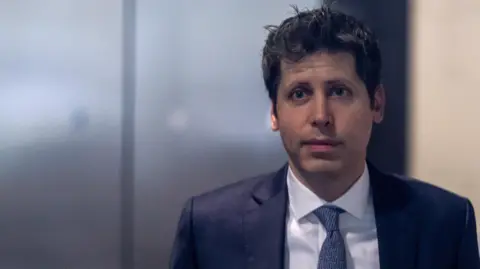
OpenAI CEO Sam Altman
Elon Musk tried to take control of OpenAI, even suggesting it could pass to his children when he dies, Sam Altman said on Tuesday.
Altman is co-founder and chief executive of the artificial intelligence (AI) company behind ChatGPT. He is being sued by Musk, who accuses him of having "looted a charity" given OpenAI began as a non-profit.
Appearing before a federal jury in Oakland, California, Altman said Musk not only backed the idea of OpenAI becoming a for-profit business, he wanted control of it for the long-run.
"A particularly hair-raising moment was when my cofounders asked, 'If you have control, what happens when you die?' He said something like '...maybe it should pass to my children.'"
The alleged comments from Musk came as the billionaire was trying to get more control of OpenAI after it was founded in 2015, and had floated several ways of gaining it.
As well as wanting more seats on OpenAI's board and to become its chief executive, Altman said Musk suggested OpenAI become a subsidiary of Tesla, his electric vehicle company.
The overarching goal for OpenAI was getting "more money faster", Altman said on Tuesday, recalling conversations that involved Musk about the company restructuring to become a more traditional for-profit entity.
Musk allegedly felt he should be in charge of such a company, in part because of his fame as a business person who could help OpenAI get financial backing.
"If I make one tweet about this, it's instantly worth a ton," Altman recalled Musk saying.
But Altman said he, as well as OpenAI co-founders Greg Brockman and Ilya Sutskever, decided handing Musk such control in exchange for more or easier financing would not help OpenAI's mission or its pursuit of artificial general intelligence, or AGI.
"I was extremely uncomfortable with it," Altman said. "One of the reasons we started OpenAI was because we didn't think any one person should be in control of AGI."
AGI is loosely defined in the tech and AI community as an AI tool or model that becomes so capable and "intelligent" that it outperforms humans on most tasks.
Ultimately, Musk left OpenAI in early 2018 and stopped his quarterly donations of $5 million to the company.
Altman described as "burned into my memory" an email from Musk in which he said OpenAI "had a zero percent chance, not a one percent chance, of success" without him.
When Altman offered Musk the option of investing in OpenAI when it formed a for-profit subsidiary in 2019, Musk declined.
"He said no because he would no longer invest in any startups he didn't control," Altman said.


