1 hour ago
2
1 hour ago
2

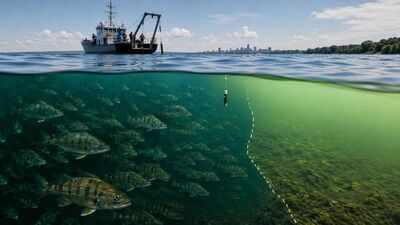
Lake Erie can look deceptively uniform from the surface. Beneath it, however, temperature, oxygen and nutrients divide the water into shifting layers, creating habitats that can change over surprisingly short distances.
During the warmer months, parts of the lake’s deeper water can become depleted of dissolved oxygen, forming seasonal hypoxic zones that restrict where fish can remain. Scientists studying Lake Erie expected those conditions to alter how fish species used the water and interacted with one another. What they observed was less straightforward. Rather than simply retreating from oxygen-poor water, fish often gathered along the boundary of the hypoxic zone, occupying the narrow area where oxygenated and depleted waters met.
That behaviour matters because it changes how scientists interpret fish distributions, food-web interactions and even fisheries data.
How Lake Erie hypoxia changes fish habitat and food webs
As per the US Geological Survey project, climate-related environmental changes could reshape aquatic food webs across the Great Lakes. Lake Erie was used as a representative system because it combines strong nutrient gradients, seasonal hypoxia and fish communities containing species adapted to different temperature conditions.
The project examined fish communities, their distribution, available prey, diets and biochemical indicators across areas with different nutrient levels.
The researchers also compared years in which rainfall, winter ice cover and thermal stratification varied considerably.The expectation was that periods of thermal stratification and low oxygen would produce clearer changes in dietary overlap and interactions between selected fish species.
That was not what the observations showed. Instead, the USGS report states that the team found “fish tended to aggregate at the edges of hypoxia”. The seemingly small detail has a practical consequence: a fish population can appear more concentrated in a particular area not necessarily because the population itself has changed, but because environmental conditions have compressed its usable habitat.
Why the edges of hypoxic zones matter to Lake Erie fish
Hypoxia is often described as a dead zone, which can give the impression of a fixed patch of water that fish simply avoid.
Lake Erie is more complicated. The position and intensity of low-oxygen water can shift, while the boundary between oxygen-rich and oxygen-poor conditions can be surprisingly dynamic. Earlier work associated with the same research programme found that dissolved oxygen near the edge of the hypoxic zone could move from normal conditions to anoxic conditions and back again within hours.
The team used high-resolution instruments recording oxygen and temperature at short intervals to capture these changes.For a fish, that boundary is therefore not necessarily an invisible wall. It can represent a narrow strip of usable habitat, with conditions changing as the water column shifts. Later research on Lake Erie yellow perch reinforced the importance of this pattern, reporting that fish could aggregate around both the horizontal and vertical edges of hypoxic water. When oxygen-poor conditions were present, fish generally moved towards better-oxygenated water, but they did not necessarily move far away from the hypoxic zone.That distinction helps explain why the original result surprised the researchers. The fish were not simply choosing between “safe” and “unsafe” water on opposite sides of a line. Their movements were responding to a changing three-dimensional environment in which temperature, oxygen and habitat availability were interacting.
How climate change could affect fish communities in the Great Lakes
The project was designed around a broader question: how might climate change affect the way fish communities use the Great Lakes? Warmer conditions can alter thermal stratification, while changes in rainfall and nutrient inputs can influence the processes that contribute to oxygen depletion.
In Lake Erie, these factors intersect with an already complex food web in which cold- and cool-water fish occupy overlapping but changing habitats.
The researchers therefore collected information not just on where fish were found, but also on prey availability, diets and biochemical tracers that could reveal aspects of food-web structure.The important point is that a climate-driven change in habitat does not necessarily have to begin with a species disappearing from the lake.
Fish may first redistribute themselves within the available water. That can bring species closer together in some places and separate them in others, changing access to prey and altering the apparent structure of the community. According to the report by USGS, some relatively straightforward indicators could be incorporated into existing monitoring programmes to track short-term changes in fish communities, while other measurements would be more useful for following longer-term ecological shifts.
This makes the edge of hypoxia an unusually informative place to watch. It is where environmental stress and usable habitat meet. If the position of that boundary changes, the distribution of fish can change with it, even without an immediate change in the number of fish in the lake.
Why fish gathering near hypoxic zones can change catch rates
There is a less obvious consequence to fish gathering around hypoxic boundaries: fishing surveys can be affected by the same movement.
If fish become concentrated into smaller areas, fishing gear may encounter them more frequently than it would if they were spread evenly through the lake. That can make a population seem larger or more abundant in survey data than it actually is. The USGS project specifically identified potential changes in catch efficiency as a consequence of fish aggregating near hypoxic edges.This issue was also observed in yellow perch, with increased catch rates reported in both commercial trap nets and scientific trawl surveys under some hypoxic conditions.
The study linked this to the aggregation of fish along the horizontal and vertical margins of the hypoxic zone. Such “habitat compression” can make fish easier for fishing gear to encounter, complicating assumptions used in stock assessments about catchability being relatively consistent across space.The implications have already reached management. The USGS project contributed to an interim decision rule for handling data collected during hypoxic events in yellow perch stock assessment.
Its observations of how the hypoxic zone varied in space and time also helped the US Environmental Protection Agency modify its sampling approach for measuring the central basin’s hypoxic area. The study sites later contributed to wider food-web monitoring under the binational Coordinated Science and Monitoring Initiative.What began as an attempt to understand climate effects on Great Lakes food webs therefore exposed something more immediate: fish do not always respond to environmental stress by simply leaving an affected area. In Lake Erie, some instead gather along its moving boundary. That narrow zone can influence where fish feed, how communities are distributed and how easily fisheries detect them. As climate, nutrients, temperature and oxygen continue to interact, understanding those shifting edges may be just as important as measuring the size of the low-oxygen zone itself.