1 hour ago
1
1 hour ago
1

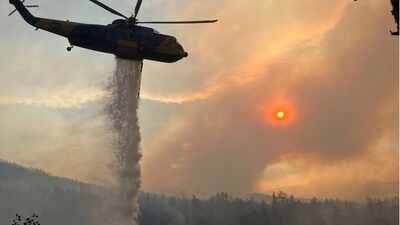
A helicopter drops water on the Bald Range wildfire near Summerland, British Columbia, Canada. (Photo: Reuters)
British Columbia's prolonged drought is increasing the risk of new wildfires as Okanagan Lake falls to its lowest level since provincial monitoring began, officials said Tuesday.The province had 102 active wildfires, while the Bald Range fire near Okanagan Lake had forced about 20,000 people to evacuate and placed another 10,000 on alert. An 80-year-old woman died while trying to flee the fire near Summerland.Officials warned that dry lightning could trigger more fires across the Central and Southern Interior, where months of limited rainfall and low snowpack have left forests and other vegetation exceptionally dry.
Dry lightning adds to fire danger
Forests Minister Ravi Parmar said the risk of lightning-caused fires was high, warning that new fires could take hold and spread quickly in the hot, dry conditions.Dry lightning occurs when thunderstorms produce lightning but little rain reaches the ground. Such strikes can ignite vegetation without enough rainfall to dampen surrounding fuels.British Columbia has already experienced several waves of lightning-driven fires this summer.
More than 2,400 lightning strikes across the Southeast Fire Centre between July 15 and 18 were followed by 38 new wildfires.A separate storm later in July produced nearly 34,000 lightning strikes across southern British Columbia. By July 24, 90 wildfires were active and 25 evacuation orders were in place.The BC Wildfire Service had forecast July and August to be the busiest period of the season and warned that firefighting could become increasingly difficult in parts of the Central and Southern Interior.Long-term rainfall shortages have pushed the Okanagan, Chilcotin, Lower Thompson, Vancouver Island and northeastern British Columbia into above-average drought conditions. Parts of the Southern Interior also entered spring with below-normal snowpack.Snowpack provides seasonal water storage, replenishing rivers, lakes, groundwater and soil as it melts. Reduced snowpack means less water reaches the landscape before peak summer temperatures.Fire officials also monitor the Drought Code, which measures moisture levels in deep forest fuels such as logs and organic material. Higher readings indicate drier fuels that can support deeper-burning fires and make suppression more difficult.
Bald Range fire expands rapidly
The Bald Range fire has shown how quickly a wildfire can grow under such conditions.The blaze expanded to about 50 sq km within three hours on Friday and reached about 156 sq km by Monday.
It continued to spread in some areas overnight into Tuesday despite relatively calm winds, with firefighters blaming extremely dry conditions for its continued growth.By Tuesday, 193 firefighters were battling the blaze, including 100 personnel from Mexico. Authorities had arranged about 1,600 hotel rooms and 1,000 group-lodging spaces for evacuees.The province declared a state of emergency on Saturday as the fire threatened Summerland, Peachland and surrounding communities.
Summerland also lost power and later issued a boil-water notice after untreated water entered its water system during the emergency.The cause of the fire remains under investigation. Police are examining possible criminal involvement, though authorities have not said it was deliberately started.The region has faced similarly severe fire conditions in the past. During the 2023 Grouse Complex, prolonged drought, high temperatures, low humidity and limited rainfall left fuels extremely dry.
The fires burned 15,076 hectares, forced 30,700 people to evacuate and destroyed 303 structures.
Okanagan Lake reaches record low
The drought is also putting growing pressure on water supplies across the Okanagan.Water Minister Randene Neill said some of the province's worst wildfires were burning in areas affected by severe drought, citing weak snowpack and below-normal rainfall as key factors.Neill said Okanagan Lake had reached its lowest level since provincial monitoring began.The warning signs appeared weeks before the latest wildfire emergency. The lake received only about one-third of its normal spring recharge, while its seasonal drawdown began in early June, about a month earlier than usual.On July 1, the lake recorded its lowest level for that date since 1992. Levels later fell to their lowest point since monitoring began.Groundwater levels have also fallen sharply. Of 31 observation wells monitored in the Okanagan on July 14, 14 were at their lowest recorded levels for that time of year, while another 10 were below or well below normal.By mid-July, every monitored city in the Okanagan had received less than half its normal precipitation for the period. Several communities had tightened water restrictions, including Stage 3 measures in parts of the North and Central Okanagan.
Drought could carry into next fire season
Officials are warning that the water crisis could extend beyond the current summer.Persistent drought is expected to continue through the season in the Okanagan and other parts of British Columbia.
The wildfire service has said some areas will require substantial rainfall to eliminate accumulated moisture deficits.The amount of rain in autumn and snowfall over winter will determine whether lakes, streams, groundwater and soils can recover before the next wildfire season.Neill warned that without sufficient recharge, British Columbia could enter the next fire season in worse condition than it began this year and urged residents and other water users to conserve supplies.