52 minutes ago
1
52 minutes ago
1

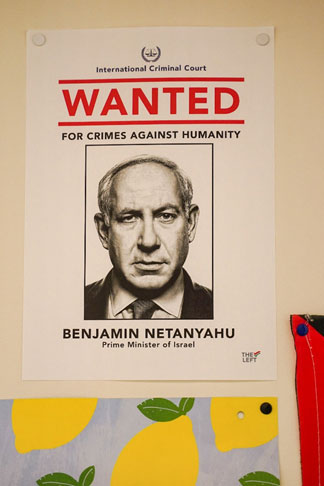 A poster depicting Israeli Prime Minister Benjamin Netanyahu as wanted by the International Criminal Court is displayed in a corridor of the European Parliament in Brussels, June 2026. Credit: Frédéric Pétry/HansLucas via AFP
LONDON, August 17 (IPS) - In a recent Wall Street Journal piece, US Secretary of State Marco Rubio pledged to ‘dismantle’ the International Criminal Court (ICC). The Trump administration intends to pressure states into quitting the court, threatening sanctions, travel bans, visa restrictions and ‘increased scrutiny’ of states that receive its funding. At stake is the court’s ability to stand with victims of the gravest of human rights crimes.
Challenging impunity
Established in 2002 following years of civil society advocacy, the ICC prosecutes atrocities, including crimes against humanity, genocide and war crimes, when national or regional courts can’t or won’t. It prosecutes individuals, and national leaders enjoy no immunity. It has secured several convictions, including of warlords from the Democratic Republic of the Congo, Mali and Rwanda. Among ongoing cases, former Philippines president Rodrigo Duterte awaits trial on crimes against humanity charges. Civil society plays a key role in collecting evidence. Filipino women-led groups, for example, have documented thousands of extrajudicial killings.
The court has 125 members, but the USA is among several powerful states, including China, India, Israel and Russia, that have never joined. US hostility intensified in 2020, when the ICC opened an investigation into crimes against humanity and war crimes in Afghanistan, including those committed by US forces.
A current US campaign could merit the court’s attention. In the Caribbean Sea and eastern Pacific Ocean, the US military is bombing boats it claims are being used by drug cartels to smuggle fentanyl and other illicit substances. It started the strikes as a way of building pressure on then Venezuelan President Nicolás Maduro, but has continued after US forces invaded Venezuela and abducted him, now seemingly with the purpose of communicating US strength and contempt for international rules.
US forces have killed over 200 people. All are civilians, leaving little doubt the strikes are illegal under international law. Last October, a group of UN human rights experts concluded that the strikes amount to extrajudicial executions. UN human rights chief Volker Türk called for an investigation, saying he believed the campaign violated international law. The USA responded by lining up with Israel, North Korea and Russia to oppose Türk’s second term.
The victims include nationals of Colombia, St Lucia and Trinidad and Tobago, all ICC members. The ICC could investigate any strikes carried out in member states’ territorial waters or against vessels registered with them.
Defending Netanyahu
Donald Trump is also determined to defend his prize ally, Israeli Prime Minister Benjamin Netanyahu. He’s said as much, undermining Rubio’s lofty rhetoric about sovereignty. In November 2024, the ICC issued arrest warrants for crimes against humanity and war crimes against Netanyahu, former defence minister Yoav Gallant and Hamas commander Mohammed Deif, later confirmed to have been killed by Israel. Israel doesn’t recognise the court, but the warrants stand because Palestine does.
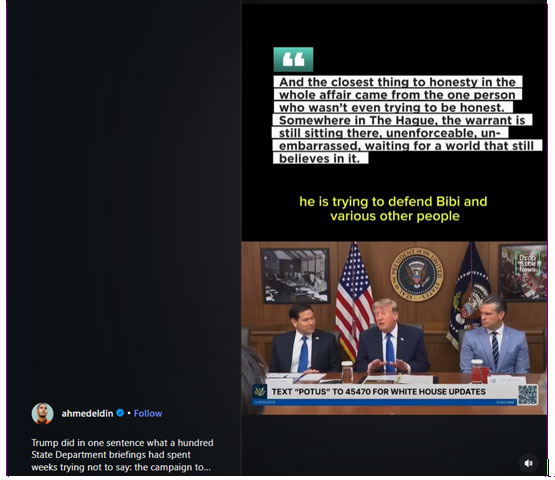
Netanyahu’s warrant is back in the headlines because he’s due to visit New York for the annual high-level opening of the UN General Assembly in September. Mayor Zohran Mamdani has called for his arrest, but the Trump administration has confirmed it will ignore the warrant. This may have fuelled the latest offensive, which goes further than the Trump administration’s 2025 decision to impose sanctions on nine ICC judges and officials. Early in his second presidency, Trump issued an executive order that declared a ‘national emergency’, arguing the court was a threat to the USA and Israel, and pledging sanctions against anyone who takes part in its investigations. The order was used to impose sanctions on Francesca Albanese, the UN Special Rapporteur on the Occupied Palestinian Territories.
Fearing criminalisation, US-based organisations may feel pressured to end cooperation with the ICC. Last year, two US-based civil society organisations pulled out of the ICC’s annual meeting. Civil society is however fighting back. In July, two US groups filed a lawsuit against the Trump administration, arguing the sanctions violate constitutional free speech protections.
International system under attack
The Trump administration’s attack on the ICC is part of its broader assault on the international system, and particularly its human rights functions. It’s withdrawing from some bodies, defunding others, trying to bend others to its will, forming alternatives it controls, such as the Board of Peace, and showing outright hostility towards those seen to stand in its way.
The USA isn’t the only one. Three military-run Sahel allies – Burkina Faso, Mali and Niger – have begun their withdrawal from the ICC, a process that takes a year. They previously quit the Economic Community of West African States, including its Community Court of Justice, leaving victims of human rights atrocities amid jihadist insurgency with no international routes to justice.
Venezuela set the same course under Maduro. Last December, parliament voted to repeal the law ratifying the Rome Statute, the treaty through which states accept the court’s jurisdiction. That path hasn’t changed under US-compliant Interim President Delcy Rodriguez, whose government recently declared its withdrawal ‘irrevocable’. The US government has welcomed the decision, which will deny justice both to victims of Maduro’s repression and the families of Venezuelans killed in boat strikes.
Others have rallied to the court’s defence. A European Union spokesperson said the bloc ‘stands firm’ behind it. Hungary, which under right-wing nationalist Viktor Orbán had committed to pulling out, reversed that decision under its new government.
Time to rally round
The court faces this onslaught while leaderless. On 24 July, member states voted to remove chief prosecutor Karim Khan following disciplinary proceedings triggered by a sexual abuse complaint from a former staff member. It’s vital that his replacement be a strong and independent leader who can continue the court’s work.
The ICC is under attack by the Trump administration because of its promise to hold the powerful to account. Its member states must defend the principle that no one is above the law by refusing to bow to US pressure.
Andrew Firmin is CIVICUS Editor-in-Chief, co-director and writer for CIVICUS Lens and co-author of the State of Civil Society Report.
For interviews or more information, please contact [email protected]
© Inter Press Service (20260817065659) — All Rights Reserved. Original source: Inter Press Service