7 months ago
34
7 months ago
34

Catherine MorrisonBBC News NI

 BBC
BBC
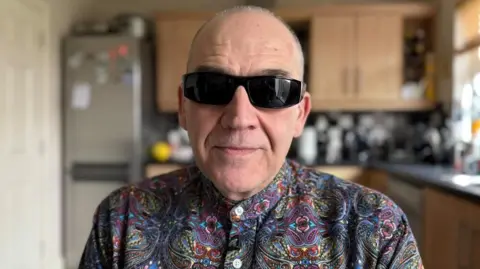
Ballymoney man Alex Patterson's hallucinations began 15 years ago
Alex Patterson sees insects crawling on food, characters from sci-fi films, and on one memorable occasion, a tiger walking down Royal Avenue in Belfast.
Elaine Orwin sees dark clouds falling from her kitchen ceiling. Sometimes she sees big, brightly coloured glitterballs and has done since she was a young child.
But those visions are not real. They both have a condition called Charles Bonnet Syndrome which causes visual hallucinations in people who already have sight loss. For the undiagnosed, one patient said some with the condition wrongly "worry they have dementia".
It's under-reported and under-diagnosed across the UK and experts believe there are many people with it who have not yet sought help.
Professor of Clinical Ophthalmology at Queen's University Belfast, Tunde Peto explains it can happen when the brain is struggling to cope with sight loss.
"The brain is trying to fill in what they don't have or don't see any more in those conditions and they generate images, or pictures. The brain doesn't like having empty spaces," she said.
'Dark clouds' during childhood
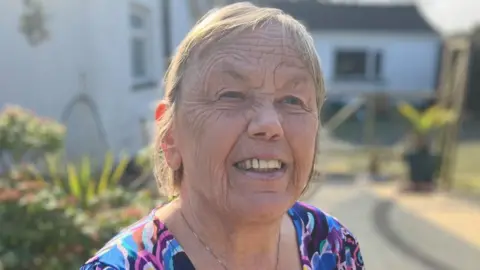
The hallucinations began for Elaine Orwin when she was a child but she was not diagnosed until her 30s
Elaine Orwin's episodes are usually triggered by stress or tiredness.
The Bangor woman began losing her sight at the age of just four. The visions began a few years later. Frightened and unsure of how to explain it, she kept it to herself and was not diagnosed until her 30s.
"I would be sitting in a room and suddenly these dark clouds would come down, right down," she said
"It feels incredibly real. And it affects my sight." It means she loses any of her remaining peripheral vision.
There is no cure, but there are coping strategies which help her live with the condition.
"Now I know and acknowledge what it is, it makes it much easier and that's why I'm hoping other people who are suffering in silence will come forward."
As part of a support group in County Down, Elaine has met many older people who have not yet been diagnosed.
"They have this experience and, haven't been able to share with their relatives simply because they're too frightened and they themselves think to themselves "is this dementia?" and that's the hard thing about this condition."
 Getty Images
At least one million adults in the UK live with Charles Bonnet Syndrome
Alex Patterson from Ballymoney, in County Antrim, is severely sight impaired. His hallucinations started about 15 years ago.
"It was just after the Christmas holidays, we were on Royal Avenue (in Belfast) coming out of a restaurant, and there was a tiger walking down Royal Avenue - that was a bit alarming.
"And that's when we started looking into what this is."
Alex also sees insects crawling over food - but he has learned techniques, like blinking, looking away, breathing.
One of his newest techniques is his guide dog Angus.
"If Angus doesn't flinch when we're out walking and nothing bothers him, I know I'm just having an episode and I trust him so I walk on.
"It's one of the myths, this is not a mental health issue. Please believe me, this is not a mental health issue. In layman's terms - and I can barely see at the best of times - it's my head and my eyes trying to communicate and the communication is leaving blank spaces, so there's hallucinations."
Alex says joining a support group was very beneficial to understanding the condition, and he credits the support of his wife and two daughters for where he is today.
But he says the condition should be better known about in Northern Ireland
"We need to talk about it. If you have any concerns, just pick up the phone."
'It's usually a great relief for patients'
According to Prof Tunde Peto many patients do not even report it but that when they find out it is a known issue it is often a "great relief" to have a diagnosis.
"A lot of clinicians feel uncomfortable asking about visual hallucinations, especially in primary care, and it's important we provide further information to healthcare professionals and to patients so they're not misdiagnosed and they're not sitting at home being frightened as to what's happening to them.
"It might be frightening to start with, but it is practically never threatening," Prof Peto added.
According to the Royal National Institute of Blind People (RNIB), research suggests that about one in five adults who experience sight loss develop the condition.
This means that at least one million adults in the UK are living with it. There are currently no Northern Ireland specific statistics.
An event is being held at Stormont on Monday to raise awareness of the condition.
Patients, health care professionals and MLAs will hear more about it and why it's important that with our ageing population, more is known about CBS.