1 hour ago
2
1 hour ago
2

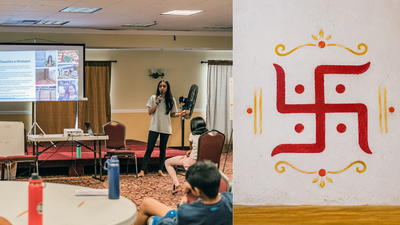
Mira Trivedi (left) presents a lesson on the history of the swastika to students, a sacred swastika is shown on a wall (right).
Hindu students across the US are pushing schools to distinguish the ancient swastika from the Nazi Hakenkreuz. The swastika is a sacred symbol associated with well-being and good fortune in Hinduism, Buddhism and Jainism.
The campaign has grown after students faced cases where religious swastikas were mistaken for Nazi symbols. In New Jersey, 15-year-old Mira Trivedi persuaded her school board to educate teachers about the distinction. Two Hindu students in Maryland also helped change their district's policy. Their efforts highlight a wider debate over how schools should teach the history and meaning of a symbol that carries very different meanings across cultures.
One student's classroom experience sparked a wider campaign
Religion News Service (RNS) reported that Mira Trivedi's campaign began after an eighth-grade social studies lesson. Her teacher described the swastika as a hate symbol linked to Hitler's antisemitism. Trivedi had grown up seeing the symbol during Hindu religious celebrations. Her family used it during festivals and auspicious occasions. A priest also drew it on her newborn cousin's forehead and relatives wore jewellery featuring the symbol.
She approached her teacher after class and explained its much older religious history. When the teacher said only senior officials could change what was taught, Trivedi took the issue further.In May 2025, she presented her concerns to her vice principal, principal and school board in central New Jersey. Her efforts led the board to educate 35 teachers about the difference between the Hindu swastika and the Nazi symbol.
"That's what started my whole journey," Trivedi said. She is now in Year 10 and has continued working with other Hindu and Buddhist students. She has also received support from her parents, who helped gather historical material and family photographs showing the swastika being used in Hindu religious ceremonies.
Her father helped compile references on the difference between the two symbols and provided photographs from family albums for her presentation to school authorities.Trivedi has said the campaign is also about preventing misconceptions about Hinduism and other faiths. She recalled facing subtle bullying over her religion and said she believes better understanding of religious symbols could help challenge such stereotypes. She has also said that several teachers acknowledged her concerns but told her that changes to curriculum terminology would need to come from district authorities.
Maryland students helped change policy for 50,000 students
A similar campaign took place in Maryland's Howard County Public School System. Hindu students Saisha Vyas and Priya Bakshi began challenging the district's treatment of the swastika. Bakshi said she wanted to wear a necklace bearing the religious symbol at school but that it was prohibited under district rules. The two students prepared educational material and met with school officials and Jewish groups to explain the difference between the symbols.
Their campaign resulted in a policy change in February.The district changed its rules to specifically prohibit the Nazi Hakenkreuz rather than the religious swastika. The change affects nearly 50,000 students. The students also stressed that they understood the fear and trauma that Nazi imagery can cause, especially among Jewish students. Bakshi said she did not want to be associated with people using the Nazi symbol to bully others.
Vyas said she hopes other Hindu students will feel empowered to speak up too: "I can also speak up at my school.
I can also speak up in my county. I can make an impact for my own culture." The students have also argued that distinguishing the symbols does not mean ignoring the Holocaust or the history of Nazi persecution. Instead, they want schools to consider the intention and context behind the use of each symbol.
Confusion over the symbols has caused problems beyond schools
The issue has also affected Hindu families and workers outside classrooms.
Pushpita Prasad, chief communications officer of the Coalition of Hindus of North America, said some Hindu Americans have been mistaken for neo-Nazis after displaying swastikas for religious purposes. During the COVID-19 pandemic, workers who displayed religious symbols in their homes during video calls were sometimes reported to human resources.
Neighbours have also called police after seeing swastikas used during Hindu festivals.
Prasad described the experience for some Hindu immigrants as "a very shaky, unpleasant experience", particularly for those with visas. Susan Benesch of the Dangerous Speech Project described the broader problem as "context collapse", where people interpret the same symbol through very different cultural norms. The students involved in the campaigns say they respect the trauma associated with Nazi imagery.
At the same time, they argue that schools should recognise the swastika's much older religious significance and consider the context in which a symbol is displayed.Trivedi has said the campaign is ultimately about protecting the identity of a religious symbol and preventing it from becoming another source of misunderstanding about Hinduism. She has also faced opposition from classmates, including an incident in which someone drew the Nazi symbol on her notebook and wrote "Nazi" beneath it. Despite such incidents, the students say support has outweighed hostility. Bakshi said some of her Jewish friends have been receptive to the campaign, while she and Vyas have met with Jewish groups to explain their position.
Their broader goal is to encourage other students to speak up when cultural or religious symbols are misunderstood. (Religion News Service)