1 hour ago
3
1 hour ago
3

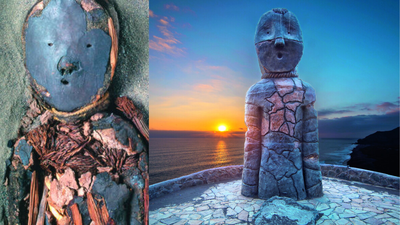
For most people, the word mummy immediately conjures images of ancient Egypt, gilded pharaohs and elaborate tombs along the Nile. Yet archaeology tells a very different story. Nearly 2,000 years before Egyptians perfected embalming, a community of marine hunter-gatherers living on Chile's arid Pacific coast had already developed the world's earliest known tradition of artificial mummification.
The Chinchorro people, who thrived along the Atacama Desert coastline, transformed the dead into carefully reconstructed bodies using reeds, plant fibres, clay and pigments rather than preserving them naturally. More remarkably, this practice was not reserved for rulers or elites. Adults, children, infants and even unborn babies received the same extraordinary treatment, making the Chinchorro one of history's most egalitarian societies in death.
Today, their remarkably preserved remains continue to reshape our understanding of early human ritual, craftsmanship and spirituality.
How the Chinchorro created the world's first artificial mummies
According to UNESCO, the Chinchorro culture inhabited the northern coast of present-day Chile and southern Peru, surviving primarily through fishing, shellfish gathering and hunting marine animals in one of the driest landscapes on Earth. Although the Atacama Desert naturally preserved many human remains, the Chinchorro went a significant step further by intentionally reconstructing the bodies of their deceased.
The oldest known artificially prepared Chinchorro mummy dates to around 5050 BCE, making it the earliest confirmed example of intentional mummification anywhere in the world. According to the Guinness World Records archive, this predates Egypt's oldest known embalmed mummy by roughly two millennia.Guinness World Records has recorded them as the ‘oldest mummified people.’ Unlike later embalming techniques, Chinchorro mortuary specialists often dismantled the body completely.
They removed the skin, muscles and internal organs, reinforced the skeleton with wooden sticks, replaced missing tissue with plant fibres, reeds, animal hair and clay, then carefully stitched the skin back into place.Finally, they modelled expressive clay masks over the face and painted the body, initially with black manganese pigments and later with red ochre, marking different phases in the tradition.Archaeologist Bernardo Arriaza, whose research has transformed understanding of the culture, described the Chinchorro mummies in the executive reports as "true pre-Hispanic works of art", reflecting not only technical skill but also profound emotional and spiritual beliefs surrounding death.
Why Chinchorro mummies are different from Egypt's royal burials
Perhaps the most striking difference between the Chinchorro and ancient Egyptian traditions lies not in the technique, but in who was mummified.Egyptian embalming largely served pharaohs, nobles and wealthy members of society during its early development. The Chinchorro, by contrast, appear to have practised mummification across their entire community. Archaeological evidence includes men, women, elderly individuals, children, infants and even miscarried foetuses, suggesting that social status played little or no role in determining who received these elaborate funerary rites.UNESCO notes that the Chinchorro "systematically dismembered and reassembled bodies of deceased men, women and children of the entire social spectrum to create 'artificial' mummies", highlighting the exceptional inclusiveness of their mortuary customs.Researchers believe these practices evolved over thousands of years into distinct mummification styles, demonstrating continuous experimentation and refinement rather than a single fixed ritual.
Why UNESCO recognised Chile's ancient Chinchorro mummification sites
The archaeological significance of the Chinchorro extends far beyond the mummies themselves. Their settlements reveal a remarkably successful adaptation to one of Earth's harshest environments, where rich marine resources sustained communities despite an extremely dry climate.In 2021, UNESCO inscribed the Settlement and Artificial Mummification of the Chinchorro Culture in the Arica and Parinacota Region on the World Heritage List.
The designation covers three archaeological sites around Arica and the Camarones Valley, recognising them as the oldest known evidence of artificial mummification and an outstanding example of human adaptation, innovation and spiritual expression.Many Chinchorro remains are still being uncovered around Chile's northern coast, offering archaeologists new opportunities to study prehistoric health, diet, technology and ritual.
As discoveries continue, the Chinchorro challenge one of archaeology's most enduring assumptions: the world's first master embalmers did not live beside the Nile, but along the windswept shores of the Pacific.
What the Chinchorro legacy reveals about human history
The Chinchorro civilisation reminds us that history's greatest innovations are not always the most famous. Long before Egypt's pyramids became symbols of immortality, coastal communities in what is now northern Chile had already developed sophisticated techniques to preserve the dead. Their extraordinary craftsmanship, inclusive burial traditions and enduring archaeological legacy continue to redefine the origins of mummification and deepen our understanding of humanity's earliest expressions of remembrance.