13 hours ago
4
13 hours ago
4

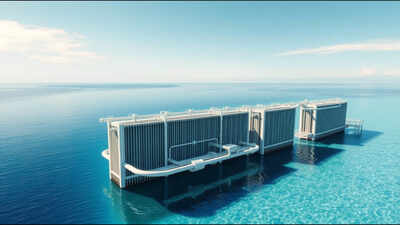
Halfway along the Afsluitdijk, the 20-mile dam that has separated the salty Wadden Sea from the freshwater IJsselmeer since 1932, sits a small blue building that most drivers passing over the dam never notice.
Since November 26, 2014, when King Willem-Alexander switched it on, this building has housed the world's first reverse electrodialysis power plant, a facility that generates electricity purely from the natural process of salt water and fresh water mixing. More than a decade later, the plant has produced something more valuable than steady power output: a detailed, published record of exactly how difficult it is to scale this kind of clean energy technology up from a laboratory concept to something resembling a real power source.
How reverse electrodialysis actually generates electricity
Unlike an earlier Norwegian osmotic power plant that used water pressure to spin a turbine, the Dutch facility at Breezanddijk works differently. Stacks of alternating membranes allow sodium ions to drift toward one electrode while chloride ions move toward the other, and the resulting electrical current is collected directly from the electrodes rather than through any mechanical turbine. This made it the first reverse electrodialysis plant of its kind anywhere in the world, built using membranes supplied by Fujifilm and developed with research support from Wetsus, a water technology research centre based in Leeuwarden.
The plant itself has been operated by REDstack, a company spun out of Wetsus in 2005.
Why the plant's original 50 kilowatt figure never matched real output
The pilot plant carried a design capacity of 50 kilowatts from the start, a figure that has followed the project for more than a decade without much public data to confirm it. That changed in 2022, when researchers from Wetsus, the University of Twente, Wageningen University and the University of Groningen ran a detailed 30-day test directly on the site, using real water drawn from the Wadden Sea and the IJsselmeer rather than laboratory samples.
Their findings, published in the Chemical Engineering Journal, recorded a gross power density of roughly 0.35 watts per square metre of membrane, which fell to a net figure of 0.25 watts per square metre once the energy needed to pump water through the system was accounted for.That gap between the nameplate figure and the measured reality turns out to be enormous once scaled up. Reaching the original 50 kilowatt design target at this measured output would require close to 200,000 square metres of membrane, an area roughly equivalent to 37 football fields.
The same study also found that performance degraded further over the course of the test, with net power density falling to about 0.1 watts per square metre by the end of the 30-day run, as pressure resistance inside the membrane stacks gradually increased.
What actually clogged the system during testing
When researchers examined the equipment after the test concluded, they found organic material had built up across the membrane surfaces and spacers, along with a layer of biofilm running through the water flow channels.
Some of the organisms found inside the system were roughly ten times larger than the pore size of the filters meant to keep them out in the first place. None of the cleaning methods the team tried was able to fully restore the system's original pressure levels.This points to a specific, practical challenge separate from the underlying chemistry. The Wadden Sea carries a significant amount of natural sediment and biological material, and filtering that out before it reaches the membranes consumes energy, cutting further into a power budget that was already thin to begin with.
Why the newer, smaller plant tells its own story
In March 2023, the Waddenfonds, a public fund supporting projects in the Wadden Sea region, approved close to 4.9 million euros toward a new, larger installation at the same site, according to the fund's own announcement, forming part of a total build cost of just over 11.1 million euros once additional regional funding was included. The resulting plant uses 12 large industrial membrane stacks and carries a rated capacity of 16.5 kilowatts, generating enough electricity annually to power roughly 40 Dutch households.Despite the scale of investment involved, REDstack's stated long-term goal remains a fully commercial 100 megawatt plant on the Afsluitdijk, a target the company has placed somewhere between 2030 and 2035, depending on future financing. According to the regional programme overseeing development along the dike, the original pilot facility remains listed as an active project even as this larger installation moves forward.
Where this technology stands today
More than a decade after the Afsluitdijk plant first switched on, REDstack's own current focus has shifted noticeably. Rather than emphasising electricity generation, the company's website now lists its main commercial markets as desalination, resource recovery, including nitrogen and lithium extraction, and carbon capture, with its original blue energy work now presented mainly as part of the company's history rather than its present direction.
What the Afsluitdijk site has ultimately proven is less about a finished power plant and more about the real cost, in time, funding and engineering effort, of trying to scale an elegant piece of chemistry into something that can meaningfully contribute to a power grid.