45 minutes ago
1
45 minutes ago
1

Having spent most of my life working in “advanced nations” that have strategically accentuated financial and professional services growth while outsourcing manufacturing to the lowest cost jurisdiction, the rapid rise of reindustrialization policies has shocked many by its rapid ascension and acceleration of mission investment.
Reindustrialisation is core to the sovereign aspirations of many nations driven by the need for national, economic and societal security underpinned by supply chain diversity and independence and real challenges for workforce growth now and into the future. Key delivery pillars include defence tech, energy sovereignty, critical mineral supply and advanced manufacturing.
Nvidia’s Jensen Huang declared at CES 2026 that Physical AI (robots that perceive, reason and act in the real world) are having their inflective "ChatGPT moment" and the numbers back the rhetoric with the sector projected to grow from roughly $138 billion in 2026 to over $500 billion by 2030. Not only are the numbers extraordinary, but the pace of functional improvement has also been remarkable. Almost overnight we’ve gone from laughing at robots falling over to the recent Robot Games in China with AI-powered machines jumping, running and somersaulting better than humans.
Governments from Canberra to Whitehall are betting that robotics will do for reindustrialization what tariffs and subsidies alone couldn't ie. bring manufacturing back onshore. Similar to the AI-related discussion about Data Centres, that bet may be right about the factories and wrong about who controls and captures the resulting value.
There is little structural awareness that Physical AI is on the same path to evolving sovereign cloud and AI strategies doomed to partial success – only wearing a proverbial hard hat.
Until recently, the gap between digital and physical AI has been somewhat of a running joke. How can the technology that can solve advanced mathematics or write a brilliant poem not figure out how to fold a towel? That gap is closing fast. Vision-language-action models pioneered by the likes of Nvidia and Google DeepMind allows robots to reason the principles of physics rather than execute rigid, pre-programmed motion. Generalist recently reported their GEN-1 model lifted task success rates from 64% to 99% at a rate 300% faster on standard benchmarks in a single release proving a “significant step towards our mission of creating generalist intelligence for the physical world.”
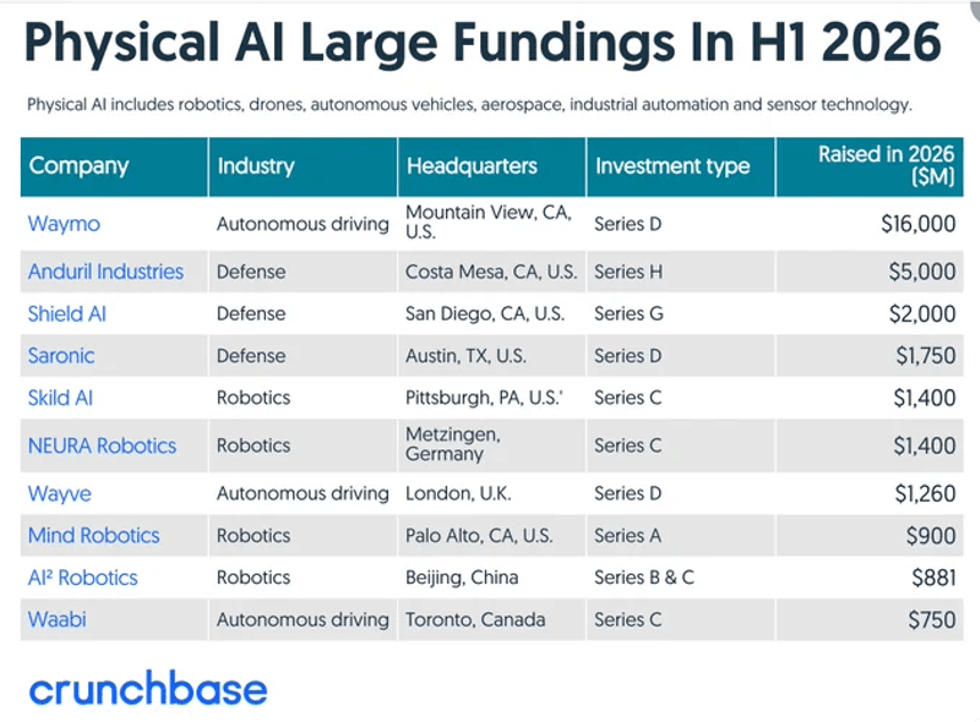
Capability demonstrations have moved from highly controlled labs to live on stage and arenas showing a level of confidence the industry hasn't seen before. The greatest proof perhaps being the broadcast of China’s Humanoid Games – not a country that takes technological or reputational risk lightly! While Elon gets the headlines with his “1 billion humanoid robots in 10 years”, conservative manufacturers like Hyundai are targeting 30,000 humanoid robots a year by 2028. Funding into physical AI start-ups jumped 400% in H1, 2026 according to Crunchbase while the Wall Street Journal reported that many of those investors were the founders of the software and AI industries previously providing a clear pathway to digital/physical AI engineering and manufacturing integration.
Politically, this is landing at the perfect moment. Reindustrialization has become a universal policy theme across the Western alliance and robotics are being pitched as the enabling technology. Humanoid and purpose-built machines that let Western economies rebuild factories without rebuilding a 1990s-scale labour cost base or the politically maligned immigration policies needed to resource them.
As Andreesen Horowitz Head of Global Affairs (former Whitehouse and NSA senior leader) Anne Neuberger illustrated, this advanced manufacturing revolution is spawning the necessary development of highly detailed digital twins to better understand, architect, build, test and upgrade critical infrastructure with global leaders like Belden, Caterpillar, Foxconn, Toyota and TSMC already building AI-driven digital twins of their factories on Nvidia's Omniverse platform.
Here is the uncomfortable part – politically, economically and socially. The entire pitch for reindustrialization has been implicitly, and often explicitly, about jobs and restoring a middle-class industrial base giving politicians a factory to place a plaque or cut a ribbon. Physical AI does not deliver that. A robot capable enough to fold laundry, pack boxes and operate coffee machines across different physical forms is capable enough to replace the very workforce reindustrialization was promised to restore. We are reshoring output, not jobs, by automating the labour out of it. The politics of reindustrialization and the economics of physical AI are pulling in opposite directions with little recognition of this at policy levels.
The implications will vary by nation and region. While Goldman Sachs reports the US has a gap to fill of 13million open manufacturing jobs ripe for robotic fulfillment, many allies have relatively high inflation and growing unemployment driven by legacy debt and technological disruption.
That's the first trap. The second is more familiar, and more dangerous, because we've built it before. Just as sovereign cloud infrastructure means little if a nation doesn't control the token pricing running on top of it, a reshored factory means little if the nation doesn't own the foundation model, the world-simulation data, or the "brain" directing the robots inside it. Nvidia's Cosmos and GR00T models, and the open foundation models rapidly becoming the default substrate for robotics development, are following the exact ownership pattern that concentrated cloud and AI value in a handful of American platforms. A factory built at home, running on embodied intelligence licensed from offshore, is not reindustrialization, it’s simply a very expensive lease.
In their recent report “Harnessing AI for the Physical Economy” Goldmans additionally pointed out that physical AI deployment, sovereign capital programs and strategic supply chains all coalesce around Defense with an uncomfortable conclusion that fully autonomous AI-executed warfare is an inevitability. Much like recent diplomatic engagement about weaponization in the space domain, this is a joint Allied discussion which can NOT be put on the backburner.
For Western Allies, it will be critical over the next 5 years to build national strategies around developing and controlling the physical AI IP and models, the physical-world training data, and the "sim-to-real" simulation infrastructure those robots depend on rather than simply the location of the manufacturing centers and number of robots deployed.
Nations should treat embodied-AI foundation models (the physical-world equivalent of the large language model) as a sovereign capability requiring the same deliberate investment as fabs or power grids, not an app layer to be simply imported off the shelf.
The collective challenge for allied nations is that physical AI will very likely reindustrialize the West's factories while perhaps further deindustrializing our workforce and destabilizing societal cohesion, and no amount of reshoring rhetoric changes that arithmetic. The real conundrum for sovereign policymakers is whether they own and control the intelligence running the machine revolution or merely rent the floor space the machines stand on.
The positive news is that the issues are foreseeable and controllable and we have time to do address them all before AI (in all its guises) reaches self-propagating scale and becomes turbocharged by the rapidly advancing quantum, space and 6G revolutions.
The Cipher Brief is committed to publishing a range of perspectives on national security issues submitted by deeply experienced national security professionals. Opinions expressed are those of the author and do not represent the views or opinions of The Cipher Brief.
Have a perspective to share based on your experience in the national security field? Send it to Editor@thecipherbrief.com for publication consideration.
Read more expert-driven national security insights, perspective and analysis in The Cipher Brief