6 months ago
24
6 months ago
24

Stephen McDonellChina correspondent, Beijing

 Getty Images
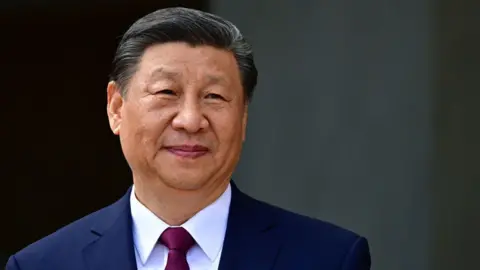
Chinese leader Xi Jinping has repeatedly called for the "Sinicisation of religion"
For decades the Chinese government has been accused of implementing repressive policies designed to subjugate ethnic minorities, forcing them to assimilate into the dominant Han culture.
Now a new law set to be rubber-stamped through the country's annual parliamentary session later this week will solidify, expand and even speed up this process, further threatening the rights of minority groups and their way of life, academics and human rights activists say.
The Chinese government, however, defends it as crucial for promoting "modernisation through greater unity" and calls it the law for "Promoting Ethnic Unity and Progress".
It lowers the status of other languages at the expense of Mandarin; encourages intermarriage between the dominant Han Chinese and other ethnicities by prohibiting moves to restrict this; requires parents to "educate and guide minors to love the Chinese Communist Party"; and, in a sweeping generalisation, prohibits any acts seen as damaging to "ethnic unity".
Xi Jinping has repeatedly called for the "Sinicisation of religion", requiring religious practices to conform with what the Communist Party deems to be Chinese culture and values - and experts see this law as an entrenchment of what had already become a core part of his rule.
"Whether it is the promotion of Mandarin or the restrictions on expression of ethnic minority identity, religious practices and so forth, the regime is saying that all that stuff we did is correct and, we are so confident in that, that we are going to now elevate what was previously just sort of policy to the level of basic law," Aaron Glasserman from the University of Pennsylvania says.
With populations ranging from tens of thousands to millions, there are 55 official ethnic minorities in China.
But Beijing has always worried more about some than others - it faces the gravest allegations of human rights violations in Xinjiang, home to Uyghurs and other Turkic minorities, as well as in Tibet.
 EPA
EPA
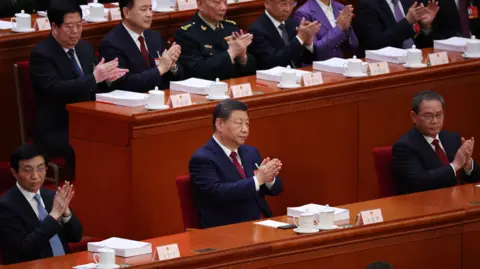
President Xi and the 14th National People's congress is expected to pass a law restricting the rights of ethnic minorities
The Communist Party has relied heavily on promoting fear of retribution to combat any example of dangerous talk of breaking away, rather than offering more autonomy to make minority groups happier to be part of China.
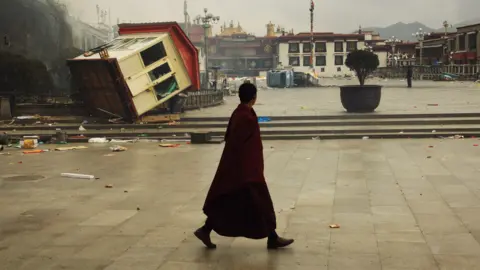
In the months leading up to the 2008 Olympic Games, Tibetan monks led an uprising in Lhasa against Beijing's rule. Like previous uprisings, this too was crushed - Beijing says 22 people died, but Tibetan groups in exile estimate it was around 200.
The next year, in the far west of the country, deadly clashes between Uyghurs and Han Chinese in Xinjiang's regional capital Urumqi led to nearly 200 deaths.
In 2013, a group of Uyghur separatists were killed driving a car loaded with explosive material towards the gate overlooking Tiananmen Square and in 2014 another group of Uyghurs attacked passersby at a train station in Yunnan Province.
Beijing would argue that its heavy-handed crackdowns on ethnic minorities have been justified by violent insurrections.
But UN and rights groups allege that more than a million Uyghur Muslims have been forcibly detained in camps. The Chinese government has called these locations centres for "re-education" and vocational training. Reports also say that Uyghur religious practices have been curtailed and mosques shut down.
In Tibet, monasteries, which were once centres of power, are heavily controlled. Everyone under 18 must now learn Mandarin in state-run schools, and cannot study Buddhist texts. This is a blow for a community where children used to enrol in monastery-run schools to train as monks.
 AFP via Getty Images
In 2008, the Tibetan capital Lhasa erupted in deadly violence with security forces using gunfire to quell protests against Chinese rule
In more recent years, upheavals have followed government restrictions on Mongolian language teaching in Inner Mongolia and officials ordering the demolition of Hui Muslim mosques in Ningxia in the north-west.
Faced with such potential destabilisation, the government may have felt it needed the new law to supersede existing legal protections for minority rights, according to analysts.
And it allows them to control critical regions that link China to its neighbours and key global trade routes.
In its analysis of the new law, the China Power Project quoted Communist China's founder Mao as saying: "We say China is a country vast in territory, rich in resources and large in population; as a matter of fact, it is the Han nationality whose population is large and the minority nationalities whose territory is vast and whose resources are rich".
It's true that although some minority ethnic groups, like the Uyghurs, number in millions, they are still dwarfed by the number of people recorded in the census as being Han, who make up more than 90% of Chinese citizens.
But when you look at the homelands of Tibetans, Uyghurs and Mongolians, these massive areas are rich in mineral resources and important for agriculture and they count for a significant proportion of the country's entire land mass.
Throughout history these groups have had periods of independence from China. They live in vast border regions with exposure to foreign countries. They not only speak their own languages but have their own distinct scripts for writing.
They have, at times, tried to protect their distinct cultures by resisting Beijing's control, even if they didn't succeed, and their exiled communities have been some of the harshest critics of the regime abroad.
And though the law in China can often be whatever the Party wants it to be, the new "ethnic unity" law makes it that much easier for officials to implement what has already been in the works – they now have a clearer set of orders from above.
For years, the Chinese Government has offered incentives for Han Chinese people to move to Tibet or Xinjiang where critics say it has deliberately tried to outpopulate minority ethnic groups. As a result, the regional capitals of Lhasa and Urumqi have already seen a massive influx of Han culture.
In addition, Beijing has encouraged marrying across ethnic groups with financial incentives, especially between Uyghurs and Han Chinese, and has been accused of trying to absorb minority groups into the majority Han culture in this way. Now the new law is touching on this.
"They're not explicitly promoting inter-ethnic marriage in the law. What they're saying is no person or organisation is allowed to interfere with marital freedom on the basis of someone's religious or ethnic identity," Glasserman says.
He gives the example of a local official having to deal with religious opposition from an imam or a priest when a marriage is proposed between a Han Chinese man and a woman from a minority ethnic group.
"You can imagine this official; their number one priority is to have as few problems as possible so they can get promoted or, at least, not fired. This official might quietly massage the situation so that pressure is put so that the marriage does not go through. This law is making it harder for that informal process to play out and making it more likely that people will not allow the imam or the priest or the parents to say you are not allowed to marry that person".
In the China of 2026, it is difficult to interview Uyghurs, Tibetans or Mongolians still living in their traditional homelands about their impressions of this law because criticising any government policy could see them imprisoned if their comments were judged to promote "separatism".
However groups overseas which advocate for them have raised the alarm.
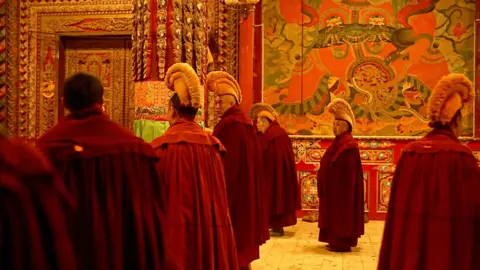
In 2025, the BBC visited a monastery that has been at the centre of Tibetan resistance for decades
By restricting minority language education for most subjects, the new law ensures that "Uyghurs, Tibetans, and Mongolians will no longer be entitled to use their native languages for subjects in schools and universities. Instead, they will be forced to use Mandarin Chinese in one facet of the Communist Party's ongoing crusade to assimilate China's ethnic minorities into Han-Chinese society", the Campaign for Uyghurs wrote on social media.
According to Phayul, an English-language website based in India and funded by Tibetans in exile, "Critics view the legislation as the latest phase of an accelerated 'Sinicisation' campaign under Xi's leadership".
In a sense, the Communist party agrees with activists and critics that this law is all about assimilation - except it argues that this is a good thing.
It "aims to ensure the party's comprehensive leadership over ethnic affairs, improve institutional mechanisms for strengthening a sense of a shared community for the Chinese nation and to support ethnic minority regions in better integrating into the country's overall development," said Lou Qinjiang, the spokesperson for this year's National People's Congress, where the law will be passed.
The party has long spoken of how the Han Chinese majority is at a different stage of modernisation compared to other ethnicities. What they mean is that they see the minority ethnic groups as backward.
Glasserman says this has also been a headache for the national government when dealing with overly zealous local officials whose attitude at times has been "We've had a revolution and therefore now it's time we all speak Mandarin. You don't need to respect their 'backward' funeral customs or marriage customs because we're all modern now".
In the past, this led to lower-level officials making Muslims eat pork or factory bosses employing Muslim workers without having halal kitchens. For Beijing, these are fights not worth having. However, in certain places, it has struggled to convey this message to cadres. So the hope is that this law might standardise responses.
Rights groups say that it should be read more as a public pronouncement than a document to bring offenders before the courts.
"It formalises an ideological framework related to a 'common consciousness of the Chinese nation' across education, religion, history, culture, tourism, mass media and the internet and directs that this ideology be integrated into urban and rural planning and economic development," said Human Rights Watch China Researcher, Yalkun Uluyol.
As most analysts see it, Beijing does not need a new law to assert its power across the country. But the importance of the legislation lies in the message it sends about where Xi is driving China in the immediate future.