
 7 months ago
42
7 months ago
42

Christine RoTechnology Reporter

 AFP via Getty Images
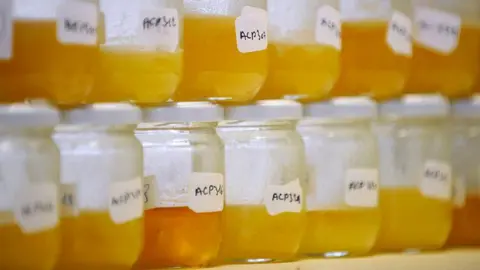
Honey is a common target for food fraudsters
Food crime mostly goes unreported, so it's difficult to grasp its scale.
It can include diluting or substituting ingredients, altering documents, or going through unapproved processes.
One 2025 estimate is that food crime costs the global economy around £81bn ($110bn) a year.
Fraudsters tend to target commonly consumed foods, like dairy, and high-value foods, like olive oil.
Along with alcohol, seafood and edible oils, honey is frequently among the most common foods that are faked.
Plant-based syrup, such as glucose syrup derived from sugar cane, can be half the price of genuine honey, or even less.
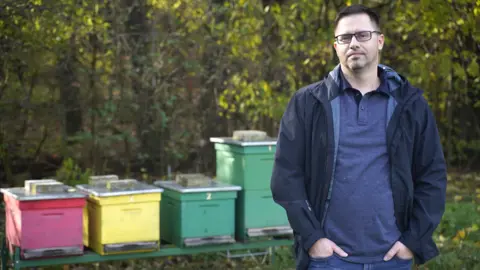
In addition to keeping five beehives, Dr Juraj Majtán heads a lab studying bees and bee products at the Institute of Molecular Biology, part of the Slovak Academy of Sciences.
He understands well just how biologically complex honey is. It contains hundreds of compounds, and there are many diverse types and sources of honey.
One result is that it's challenging to detect whether the honey in a jar genuinely comes from honeybees from a particular place, or has been mixed with syrup derived from rice, wheat, corn or sugar beets.
There isn't even an internationally agreed definition of honey.
While fake honey is sometimes runnier and weaker-tasting than genuine honey, sophisticated fakes can look, smell and taste just like the real thing. Inauthentic honey can also fool chemical analysis, because the sugar levels are so similar.
There are a variety of methods to test for suspicious honey.
Some analyse chemical bonds to compare them against genuine honey samples. Others analyse isotopes to determine where a product likely originated.
But "currently there is no single method…that can say that this honey is fake honey," Dr Majtán explains. He says that we desperately need new methods.
 Martin Bystriansky
New methods are needed to spot fake honey says Dr Juraj Majtán
The harms from faked honey are mostly to the livelihoods of beekeepers.
But food crimes can pose dangers to human health, because of the presence of potential allergens or toxic chemicals.
Back in 2008, Dr Selvarani Elahi was caring for her newborn daughter while growing horrified about the scandal of melamine-tainted infant formula in China. At least six babies died from kidney damage linked to the chemical.
Elahi, the UK's deputy government chemist, who is based at the measurement and testing services company LGC, couldn't believe that food fraudsters would target children.
Two people involved in the contamination were executed.
"Even the risk of that doesn't stop people from perpetrating fraud," Elahi marvelled.
Now, with several decades of food-standards work under her belt, Elahi remains alert to the possibility of fraud infiltrating other types of foods.
For instance, LGC is advising the UK government and working on DNA methods to identify foods containing the four insect species allowed for sale for human consumption.
Fraudsters could theoretically attempt to pass off a different insect species as one of those four.
One potential consequence is that an unpermitted insect species could trigger reactions in people allergic to shellfish, which can have the same allergenic proteins.
 Andy Bate, LGC
Even the risk of hurting children does not stop fraudsters says Dr Selvarani Elahi
While insects are a novel food in some countries, tainted spices are a persistent global problem. For instance, fraudsters add widely available industrial dyes to paprika.
Especially notorious is lead chromate mixed in with cinnamon to achieve a bright colour or bulk out the powders.
In the US in 2023, hundreds of children were poisoned by lead from imported cinnamon that made its way into applesauce.
The technological methods to detect industrial dyes in spices aren't the issue, according to Elahi. These are robust enough to detect the synthetic dyes at low levels.
The problem is spotty surveillance by under-resourced regulators.
For Dr Karen Everstine, lead in cinnamon shows the importance of not only regulatory agencies but also a well-functioning public health system, "to help support food safety and detect anomalies".
Everstine is the technical director of food safety solutions at FoodChain ID, a company that advises food-sector clients.
FoodChain ID commonly observes fraud that involves swapping out one species for another.
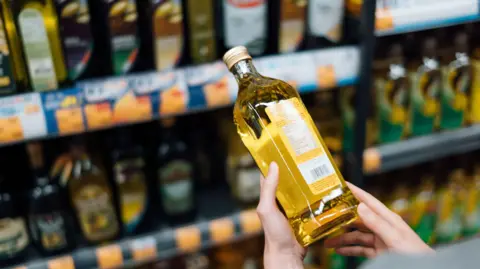
In 2025, their data also showed a slight increase in labelling fraud, such as olive oil labelled falsely as being extra virgin, or non-organic crops marked as organic.
For 2026, she's especially concerned about trendy superfoods and supplement-like foods. False claims on these foods can be especially hard to combat because they become crazes so quickly on social media.
 Getty Images
A common fraud is labeling regular olive oil as extra-virgin
Ultimately, the most rigorous traceability solutions, including QR codes and microchips, won't be useful if people don't actually check them as a condition of making their purchases. Imitators can simply counterfeit QR code labels, for example.
Nor will they be useful if they remain too expensive to implement.
"People thought blockchain applied to the food industry was going to solve all of our problems. It hasn't," notes Elahi.
She points out that blockchain-based tracking of a food at each point in the supply chain might be feasible for a product like South American bananas, but isn't feasible for a lasagne containing 50 ingredients from all over the world.
It can also be hard to interpret the results of testing finished products that contain lots of ingredients.
"One of the challenges is marrying that really high-technology, high-innovation space with the realities of food production," Everstine comments. It's just not practical to test everything.
Innovations in recent years to make testing methods more sophisticated include thermal imaging, light analysis using lasers, and DNA profiling.
In general, more testing adds to the costs. And lab-based testing may not be fast or agile enough to support border control officers, fraud investigators or food producers in the field.
Speed is important when seeking to stop the spread of tainted foods. Yet rapid testing tools may not be sensitive enough.
Emerging portable testing methods include X-ray fluorescence analysers for turmeric and handheld DNA kits to test olive oil.
Machine learning is also increasingly helpful for sifting through and categorising huge amounts of data. This can help to create early warnings about risks of fraudulent or unsafe food.
Still, relatively low-tech responses to food crime are among the most useful.
With honey, Majtán says, "the best way is just to buy from local beekeepers". This helps ensure that consumers know what they're buying, and who they're supporting.
One rule of thumb Everstine has is that "if the price seems too good to be true, that should be a red flag". For instance, $3 for a bottle of olive oil or honey in the US might be suspect.
More Technology of Business


