6 months ago
69
6 months ago
69

Jonathan GeddesBBC Glasgow and West reporter

 Getty Images
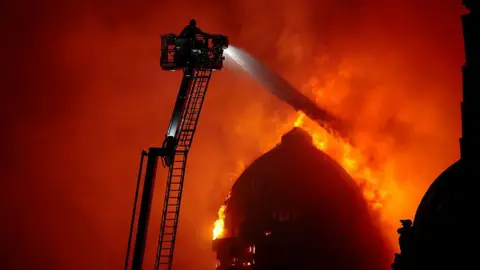
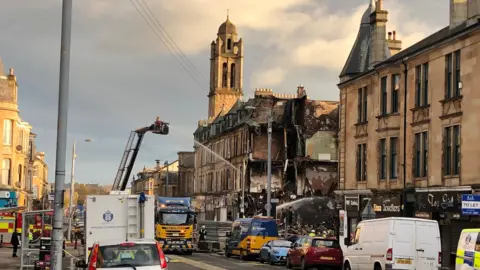
The domed building on Union Street was the latest historic Glasgow structure to go on fire
For 10 years Michelle Cohen would look out from her Glasgow art studio and feel inspired.
Her view was of a domed Victorian building on the city's Union Street, that hosted businesses and cafes next to the hustle and bustle of Central Station.
Although shocking, this is a situation people in Glasgow have become familiar with.
A spate of fires and disasters has befallen the city's historic architecture over the years, raising questions about whether these are freak accidents or a symptom of wider issues.
 Google
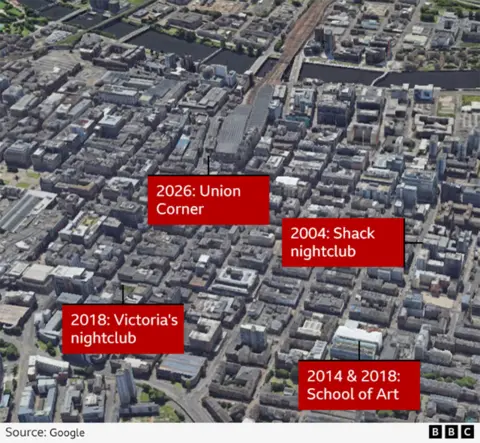
The locations of some of Glasgow's most prominent recent fires
"Each time these collapses or fires happen, the same conversations happen and everyone agrees it's terrible and we should do something about it," says Matt Loader, co-founder of architecture firm Loader Monteith. "Then 18 months later it happens again somewhere.
"Our Victorian city is disappearing, a piece at a time."
Niall Murphy, director of Glasgow City Heritage Trust, told BBC Radio 4's PM programme, "there is definitely a perception that Glasgow has more than its fair share of fires."
"They're very high profile fires in main streets," he added, "and that has an impact on the psyche on the city."
 Getty Images
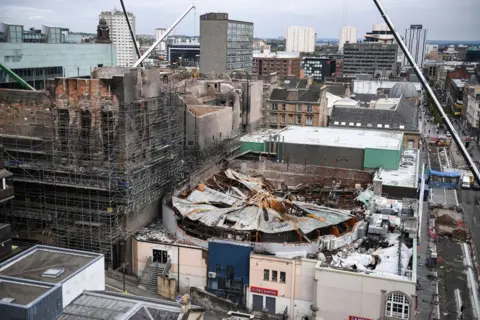
The 2018 fire at the School of Art also wiped out the neighbouring O2 ABC venue
The second of those blazes also wiped out the O2 ABC venue - a building which had existed in various guises since 1875.
B-listed tenement blocks at the Albert Cross in Pollokshields on the south side of the city caught fire in 2019 and 2020, while the India Buildings on Bridge Street on the south bank of the River Clyde had to be demolished in 2024 after general decay resulted in the roof collapsing.
Another listed building on Sauchiehall Street in the city centre - which housed popular nightclub Victoria's - was destroyed in 2018, following a fire blamed on an electrical fault.
In 2004 the Shack night club - based in another building dating back to the 19th Century - burned to the ground.
 PA Media
A tenement building in Pollokshields was devastated by fire in 2019
For Cohen, the latest loss was painful. She says she's taken photographs of the dome on top of the Union Corner building in every season, and every weather.
"I grew up in Canada and the oldest buildings would maybe be 100 years old, " she tells BBC Scotland News. "Coming to Glasgow and looking out at the architecture, the stonework, it was incredible. We had nothing like that at home.
"Glasgow has this history in a relatively small area that I find fascinating. It's going to change a lot of people's ideas of the area. The whole G1 [postcode] area had this vibe - it's still my favourite place and I feel that's irreplaceable. It feels like these historic buildings are just not being looked after."
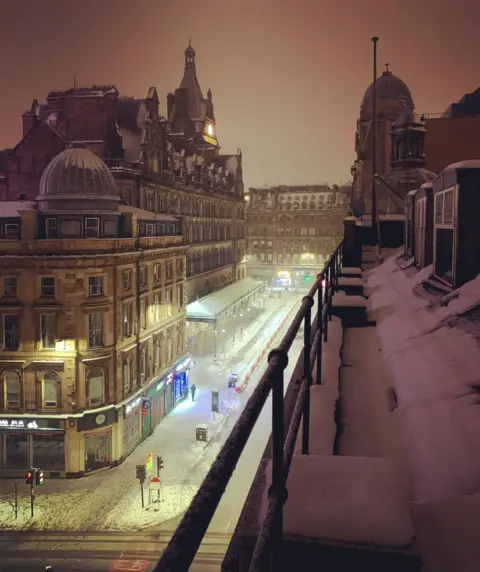 Michelle Cohen
Cohen regularly photographed the domed building on the corner of Union Street and Gordon Street from her studio
This sentiment is commonly shared. Any social media post regarding a fire in Glasgow will bring mutterings about flats replacing what has been destroyed, after years in which student accommodation has increased across the city.
The implication is these disasters are being deliberately engineered, but Loader believes the causes have more prosaic roots, and have their origins in economics.
"Because it's unusual for a city to have as many Victorian, pre-war buildings sitting there unoccupied," he says. "There is no doubt that elevates the risk – not just of fire, but of general decay, like what caused the India buildings to collapse.
"A big issue in the city is who owns these buildings and why are they sitting there unoccupied? They are open to the elements that way."
Murphy describes the Union Street buildings as being "stone box exteriors with timber in it" - the same sort of design technique used by Mackintosh at the School of Art.
He adds that Glasgow has the highest number of at risk buildings in Scotland.
This is due to "upper floor vacancies, which is tied to economic cycles, to shifts in business and to A-grade office space being available elsewhere".
The local authority stresses it has invested about £280m in heritage projects across the city in the past dozen years or so.
A spokesperson said: "It should be understood that the owners of buildings, including heritage buildings, are responsible for their maintenance and protection."
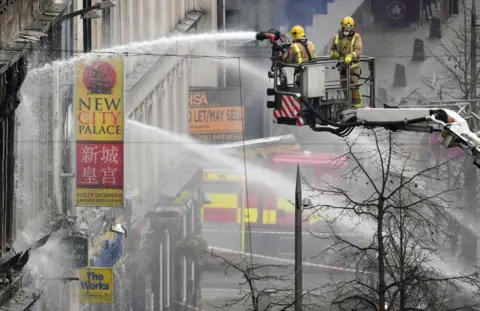 Getty Images
A fire in the building which housed Victoria's nightclub was blamed on an electrical fault
These reasons might not dampen vivid conspiracy theories being shared when a disaster occurs, and which are "more popular during times of crisis, when people feel anxious," according to Dr Yvonne Skipper, a lecturer in psychology at the University of Glasgow.
"They help us make sense of chaos. It might not be a good explanation, but it offers something, and gives you something to be certain about.
"They're very clear and reduce an issue to a simple thing - that people are doing things rather than chaotic chance."
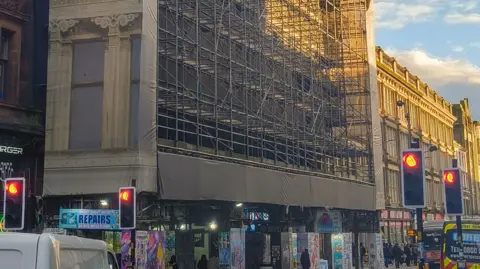 Glasgow City Council
The Egyptian Halls in Glasgow has been covered by scaffolding for 15 years
Yards away from the Union Street fire site the A-listed Egyptian Halls have been covered by scaffolding for years.
In 2025 Glasgow City Council launched a compulsory purchase order (CPO) process to take over the building from the current owners, and in February property firm Ediston was approved to advance plans to bring the site back into use.
Loader would like such methods to be used more frequently.
"There has to be a big stick and a big carrot here," he argues. "If these buildings aren't fully in use, then why not? You should encourage people to either develop them, or, if they're not in a financial situation then sell or give them to people who can. Maybe that means an enormous empty buildings tax."
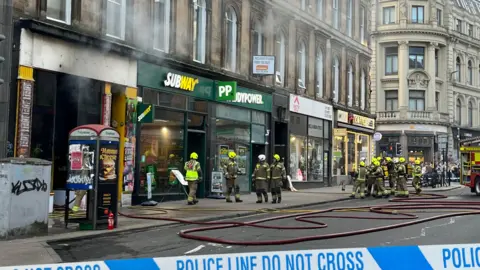
The latest fire began in a vape shop on Union Street
The blaze last Sunday started in a vape shop at 105 Union Street and since then a tangled web of ownership has emerged surrounding who had responsibility for the shop there.
An investigation by the Ferret website showed the shop's tenants Junaid Retail Limited had not paid business rates and did not appear registered to sell vaping products.
Journalist and historian Norry Wilson, who runs the popular Lost Glasgow page on social media, fondly recalls many visits over the years visiting record shops and technology stores, to what he calls "a major piece of the city's historic scenery" on Union Street.
But he believes the complicated ownership picture that now obscures who owns some of these buildings - or who the tenants are - is another difficulty in protecting at risk sites.
"The soi disant [self-styled] ownership, and myriad different factors, and property management companies, only add to the confusion," he adds.
"When owners are local, and have eyes on their investment, they take more care of their property. When they are miles away, they are happy to sit back and just take the rent."
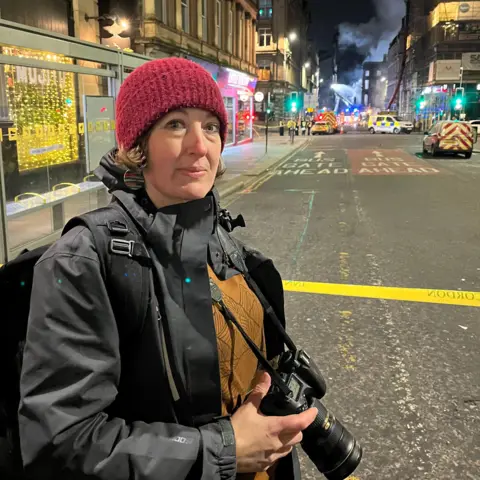 Michelel Cohen
Michelle Cohen was out with her camera as the fire took hold last Sunday
When the seriousness of last weekend's fire became apparent, Cohen headed into Glasgow from her home in Renfrewshire.
"I went straight into the city and just stood and watched it," she says. "I could see the fire coming round the back of the dome, and I said to my landlord, 'It's done'.
"I get the stonework will be hard to place, but it would be nice to have something that isn't a big glass box replacing it."
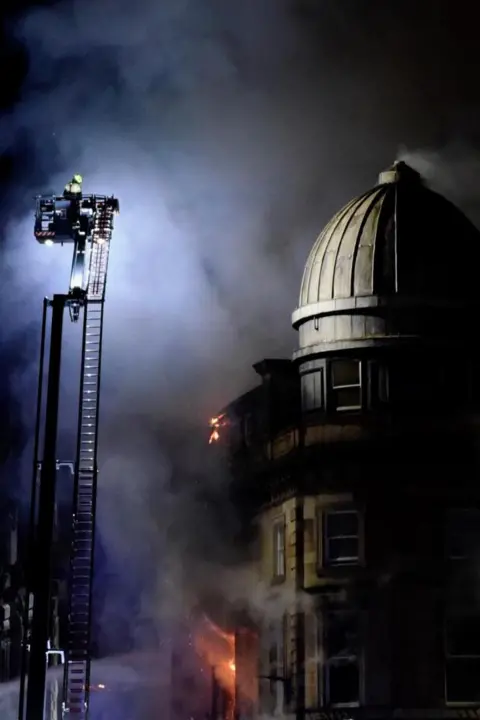 Michelle Cohen
This is one of the last photographs Cohen took of the dome before it succumbed to the flames
By Monday crowds of people had gathered at the edges of the cordons around the Union Corner site. Many expressed sadness about the loss of what had been a popular city landmark.
"There are links to our ancestors in these buildings," reflects Loader."It's an anchor to Glasgow's past and it's really important that these gifts are not lost.
"Because that's what they are – gifts to the city and to our heritage."
You may also be interested in