2 months ago
22
2 months ago
22

9 minutes ago
David SillitoArts and Media Correspondent
Attenborough's gorilla encounter
"There is more meaning and mutual understanding in exchanging a glance with a gorilla than any other animal I know."
It is the most memorable moment of his broadcasting career - the footage of Sir David Attenborough lying among a group of playful mountain gorillas in a Rwandan forest clearing.
The images for his landmark 1979 Life on Earth series were not just unexpected, they said something profound about our close relationship with the natural world.
As Sir David approaches his 100th birthday on 8 May, he has taken part in two documentaries that look back at that unforgettable encounter and the dramatic story of what became of that gorilla family.
The Making of Life on Earth returns to 9 January 1978, the day Attenborough and the team arrived in the Virunga Mountains.
They intended to show something very simple - a gorilla's thumb. Attenborough wanted to explain how the development of thumbs and fingers allowed apes to grip tools.
It was with that hope that the team climbed 9,843 ft (3,000m) up the 45-degree slopes in order to catch a glimpse of one of the few surviving mountain gorillas.
The crew had concerns. Poaching and capturing animals for trophies and zoo exhibits had taken mountain gorillas to the verge of extinction. The population in the Virungas had dropped below 285. They were also difficult to approach.
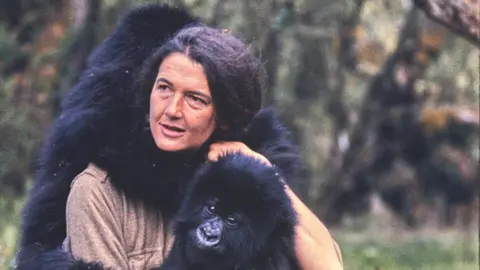
Their best option was to win the confidence of the one person studying them in the wild - the US gorilla expert, Dian Fossey, who had founded the Karisoke Research centre in Rwanda's Volcanoes National Park in the Virungas.
Her work became famous in 1970 when she appeared on the cover of National Geographic but Attenborough doubted she would allow a film crew anywhere near her gorillas.

 Bob Campbell / Smathers Libraries / University of Florida
Orphaned young gorillas, Coco and Pucker, cling to Dian Fossey in 1969.
But weeks after sending her a letter they received a reply inviting them to visit.
"We couldn't have got anywhere near them without Dian," he explains.
"She introduced us to this group and Dian taught us how to behave in their presence. You don't stare at a gorilla. That's a challenging thing to do. So you keep your head down and you make these belch vocalisations."
It was this advice that led to the crew getting far closer than they ever expected.
When they found themselves among a gorilla family, the crew prepared for Attenborough's address to the camera. But one of the younger gorillas, Poppy, had other ideas and tried to take off his shoes.
Another inquisitive infant, three-year-old Pablo, lay down on Attenborough just as he felt a hand on his head. An adult female twisted his head to look straight in his eyes, before putting a finger in his mouth and belching at him.
"So I did my best to respond," he says.
The camera team waited. This larking about with gorillas was not what they had set out to film and with limited film stock, they were keen to not waste it on their presenter rolling around with Pablo and Poppy.
Only a minute or two of the encounter was captured on film. Oblivious, Attenborough lay there in a sort of bliss.
"It was one of the most privileged moments of my life...
"I dream about it. I mean it was (the most) breathtaking experience that anybody could possibly want who's interested in the natural world."
 Dian Fossey Gorilla Fund
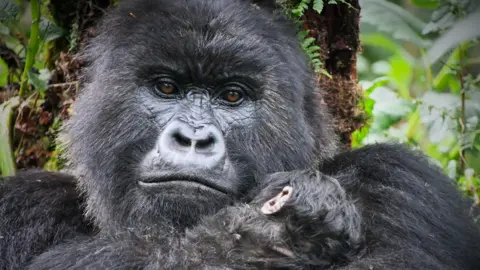
Akariza is a granddaughter of Poppy and now has her own infant.
As they headed back down the mountain and began to drive off, things began to go wrong. They heard the crack of rifles.
"We turned around the corner and there was an armed guard," he explains.
Rwandan soldiers stopped them at the next roadblock. The crew were questioned about their work in a police headquarters and held in a hotel overnight. The following morning, Attenborough and his cameraman were taken to an army compound before being released by a commander.
Their precious film hadn't been confiscated, but they were more than pleased once their plane out of Rwanda took off.
When Life on Earth was broadcast in 1979, it was a huge success - turning natural history into landmark television. The series was sold to almost every country in the world and an estimated 500 million viewers saw gorillas in a new light.
The gorilla moment also left a legacy on the mountain. Attenborough approached the conservation charity Flora and Fauna, who set up the Mountain Gorilla Project to help protect the animals.
In 1985, seven years after her meeting with Attenborough, Dian Fossey was murdered.
Her death brought the plight of the gorillas to an ever wider public and a programme of education and eco-tourism followed. While there will never be a moment when anyone can say the gorilla population is safe, there are now around 600 gorillas on the mountain.
It is a conservation success and the largest gorilla family group in the Virungas can trace its origins to that Life on Earth moment.
A new Netflix documentary, A Gorilla Story: Told by David Attenborough has followed the family - whose members are descendants of Pablo, the cheeky, curious, young gorilla captured on camera in 1978.
"I had no idea at the time what an incredible life Pablo would lead or the legacy he would leave... I will never forget him," he says.
As an infant, Pablo had been abandoned by his mother, making his survival to adulthood remarkable. But his story went much further.
Dr Tara Stoinski, chief executive of the Dian Fossey Gorilla Fund, explains that Pablo became the silverback leader of his family group - a privilege reserved for only the most dominant males. He died aged 33 while defending them.
"The story of Pablo's group has never been told," she says.
But just as with Attenborough's filming in the 1970s, things did not go as expected. Over 250 days of filming, Pablo's descendants were in the midst of a complex battle for supremacy between three adult males that led to beatings, a killing and mourning. Once again, the gorillas were writing the script just as they had in 1978.
 Toby Strong/Silverback Films/Netflix
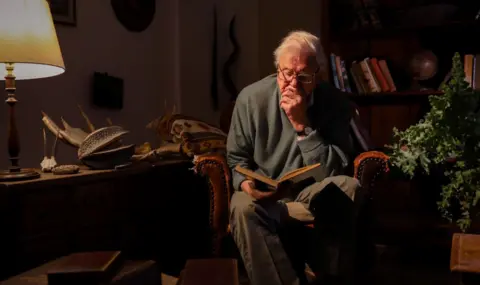
Attenborough reads from his diaries in A Gorilla Story: Told by David Attenborough
For Stoinski, that original gorilla moment has made a lasting impact because of the surprise and joy it brought to viewers.
"We can see so much of ourselves, we can really relate to their behaviour because it is so similar to ours. Any three-year-old might want to come and sit on your lap and use you as a piece of furniture. The baby gorilla, Pablo, was doing the same thing to David.
"And the trust, I think was something that maybe surprised people that they didn't realise you could be that way with the gorillas."
And in Life on Earth, a series with a serious scientific purpose, this playful and unexpected encounter in the undergrowth became a key message. Instead of us looking at nature, the friendly gorilla family upended the narrative and took on the role of the curious observer of a mysterious ape called Attenborough.
The imagined gap between humanity and nature vanished. Gorillas were not jungle beasts, they had rich emotional lives, cooperating, caring, fighting, learning and adapting.
As Attenborough said in the original footage: "We see the world in the same way as they do."
There is good reason this gentle, affectionate meeting between genetic cousins has become a TV landmark.
Making Life on Earth: Attenborough's Greatest Adventure, airs on Sunday 3 May on BBC One and BBC iPlayer.