1 hour ago
3
1 hour ago
3

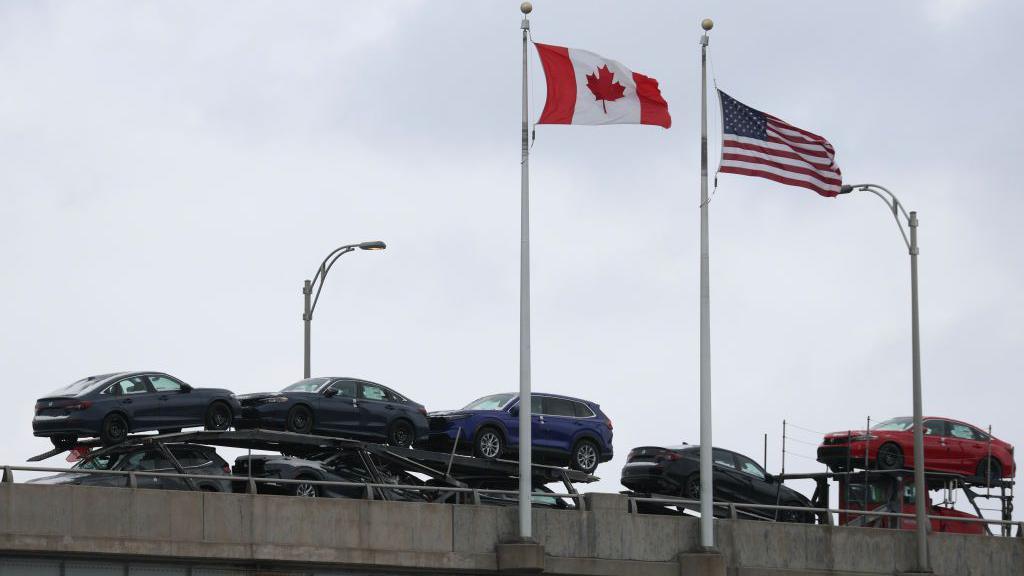 Image source, Getty Images
ByNadine Yousif
Senior Canada reporter
The US, Canada and Mexico are staring down a 1 July deadline to decide the future of a long-standing North American free trade pact. All signs point to them blowing past that date without a clear resolution.
On Wednesday, trade representatives from all three countries will meet formally for the first time since a review of the USMCA pact began. Canada and Mexico have both said they want the deal renewed, while the US has yet to outline its position.
Most recently, President Donald Trump said he sees the deal "expiring immediately", arguing that the US would be better off without it.
So where does that leave the USMCA, a trade deal that encompasses some 510 million people? And what happens if an agreement is not reached by the deadline?
Here's what we know.
Expect the 1 July deadline to come and go
One thing is certain: Canada, the US and Mexico all don't expect a decision to be made on Wednesday.
Prime Minister Mark Carney that he does not anticipate any type of agreement to be reached.
"I'm not looking for my pen," he told reporters on Tuesday.
A review of the USMCA pact was always scheduled for this summer as part of the original agreement, but Trump's tariffs - and Canada's response to them - have complicated negotiations.
Canadian officials are anticipating that talks with the US will continue past 1 July, and it's unclear for how long. Mexico and the US have announced another round of formal bilateral talks for later in the month.
In a statement to the BBC, the office of Canada-US trade minister Dominic LeBlanc said Wednesday's meeting will be "an opportunity to build on the positive, constructive bilateral discussions he has had with both countries in recent weeks".
"He is looking forward to continuing the work of supporting Canadian workers, farmers and businesses, on July 1 and beyond."
The current deal was negotiated during Trump's first term. It replaced the North American Free Trade Agreement, which had been in place since the 1990s.
It underpins nearly $1.6tn (£1.2tn) in annual trade between the three countries, has helped integrate key sectors such as North America's auto industry, and supports millions of jobs across the region.
It has also offered Canada and Mexico a much-needed shield from the bulk of US tariffs thanks to a USMCA exemption by the Trump administration on most goods.
The pact has broad support in the US, with a late 2025 Ipsos survey by the Chicago Council on Global Affairs suggesting, external 75% of Americans believe it has been beneficial to the economy.
What is stopping a deal from being reached?
Since the review began earlier this year, the US has been engaged in talks with Canada and Mexico separately to address a list of trade irritants.
There has been a perception that Canada is lagging behind, as Mexico and the US have announced multiple rounds of formal talks, while Canada and the US have not.
Members of a Canada-US trade advisory committee assembled by Prime Minister Carney, however, said the list of US demands for Canada is "much shorter" than Mexico's and that talks are actively taking place.
Some US demands include greater access for American producers to Canada's dairy market, the removal of Canadian taxes on major US streaming companies, and - more recently - the reversal of provincial boycotts on US alcohol imposed in response to Trump's tariffs.
The US is also discussing tighter rules of origin for North American-made vehicles with Mexico, fuelling speculation that it could make similar demands of Canada given the region's highly integrated auto sector.
Canada has presented "a number of specific proposals" to address US irritants, LeBlanc and Canada's chief negotiator Janice Charette said earlier this month.
For Canada, a major sticking point is US tariffs on a number of key sectors, including steel, aluminium and automobiles.
Carney insists Canada is not willing to sign a bad deal. Business leaders have made it clear that their most desired outcome is lower tariffs and clarity on the future of US-Canada trade, even if it means negotiating past deadline.
"The majority are willing to wait for a good deal despite the fact that it is obviously very hurtful for business right now," said Dennis Darby, a committee member and president of Canadian Manufacturers and Exporters.
The two countries were close to a deal last October, but progress was derailed after Ontario ran an anti-tariff advert on American networks that angered Trump, said US ambassador to Canada Pete Hoekstra.
"They were very, very close to having an agreement, and then you know, poof, it's all gone," Hoekstra said in an interview last week with Canadian broadcaster CTV.
What happens if the 1 July milestone is missed?
As talks continue, the USMCA will remain in place for another 10 years until its set expiry date of 2036.
In the meantime, the US, Canada and Mexico have three options:
All three could agree to renew the pact for another 16 years, extending it to 2042
If they fail to all agree, an annual review process - similar to the one occurring now - would be in place until the pact expires
One party can formally declare its intention to withdraw, giving the other parties a six-month notice
While President Trump has made his displeasure with the USMCA known, business leaders in Canada believe an outright withdrawal is the least likely outcome.
"Everyone is hopeful that won't be the case," Darby said, adding that there is a recognition by US trade negotiators that the pact has benefited all three countries.
He acknowledged, however, that rolling annual reviews are not ideal as they would leave Canadian businesses navigating damaging uncertainty.
The final decision, he added, likely rests with the US president.
Hoekstra echoed that sentiment, telling CTV that the future of North American free trade is in the hands of Trump and Carney.
Trump's recent comments on USMCA have been contradictory. He has said he is "not looking to renew it". He has also said that he is "open" to leaving the pact the place.
Carney has said that it is "no secret" Trump dislikes the USMCA. He noted, however, that US trade negotiators have acknowledged the pact's "underlying structure" was solid.
"What I have seen with the president is you're not close to making a deal - and then you make a deal," he told reporters recently.