4 months ago
51
4 months ago
51


 Getty Images
The UK economy grew by more than expected during the first three months of 2026, official figures show.
However, experts remain worried that the ongoing US-Israeli war with Iran will mean growth slows or stagnates later in the year.
Economic growth matters because it affects things like pay increases for workers and the amount of tax the government raises to pay for services.
What is GDP and why does it matter?
UK economic growth is defined by the change in the country's GDP, or gross domestic product. That is a measure of all the economic activity of companies, governments, and people in a country.
In the UK, the Office for National Statistics (ONS) publishes new GDP figures every month. However, these can vary quite a lot and the quarterly figures - covering three months at a time - are considered more significant.
Most economists, politicians, and businesses like to see GDP rising steadily.
That's because it usually means people are spending more, extra jobs are created, more tax is paid, and workers get better pay rises.
When GDP is falling, it means the economy is shrinking.
This can be bad news for businesses and workers as it can lead to pay freezes and job losses.
What is happening to the UK economy?
The ONS said there was some evidence that consumers and businesses had brought forward spending in March because of fears that the conflict would put up fuel and food prices.
The March increase followed another unexpected jump in February, and means that GDP grew by 0.6% during the first three months of the year. That was also higher than predicted.
However, analysts think the conflict will bring down GDP in the next three-month period between April and June, when further price rises are likely.
The Bank of England has already warned that it expects UK inflation to increase as a result of the war, possibly as high as 6% in the worst-case scenario.
In April, the International Monetary Fund (IMF) said it expects the war to hit the UK the hardest of the world's advanced economies.
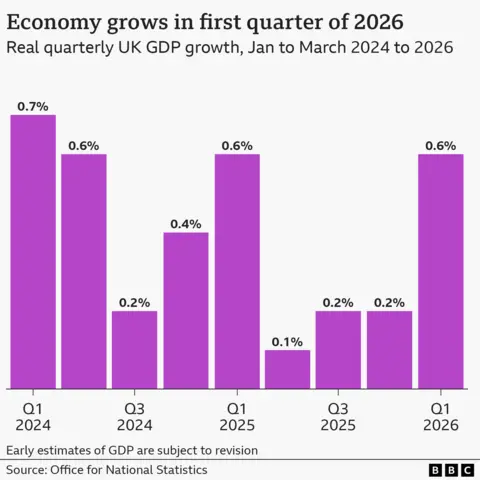
The Labour government has repeatedly said growth is its top priority, but has faced criticism for achieving only moderate GDP growth since it took power in 2024.
Across 2025 as a whole, UK GDP was estimated to have increased by 1.4%, up from 1.1% in 2024.
The IMF has cut its estimate for 2026 UK growth from 1.3% to to 0.8%.
How does GDP affect tax and public services?
If GDP is going up steadily, people pay more in tax because they're earning and spending more.
This means more money for the government, which it can choose to spend on public services, such as schools, police and hospitals.
When the economy shrinks and a country goes into recession, these things can go into reverse.
Governments tend to get less money in tax, which means they may decide to freeze or cut public spending, or put taxes up.
In 2020, the Covid pandemic caused the most severe UK recession for more than 300 years, which forced the government to borrow hundreds of billions of pounds to support the economy.
GDP can be measured in three ways:
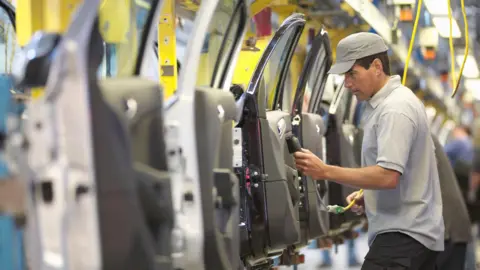
Output: The total value of goods and services produced by all sectors of the economy - agriculture, manufacturing, energy, construction, the service sector and government.
Expenditure: The value of goods and services bought by households and by government, investment in machinery and buildings. This also includes the value of exports, minus imports.
Income: The value of the income generated, mostly in terms of profits and wages.
 Getty Images
In the UK, the ONS publishes one single measure of GDP, which is calculated using all three measurements.
But early estimates mainly use the output measure, using data collected from thousands of companies.
Why does the GDP figure sometimes change?
The UK produces one of the quickest estimates of GDP of the major economies, about 40 days after the quarter in question.
At that stage, only about 60% of the data is available, so the figure is revised as more information comes in.
What are the limitations of the GDP figure?
The hidden economy: Unpaid work such as caring for children or elderly relatives isn't captured.
Inequality: Rising GDP could result from the richest getting richer, rather than everyone becoming better off, and some people could be worse off.
Living standards: If the population is also growing, increased GDP can still mean less money per person, which can reduce people's living standards. This is why the GDP per capita measure is important.
 Getty Images
Official GDP figures don't take into account unpaid work like looking after children
Alternative measures have been developed which try to capture this.
Since 2010, the ONS has also measured well-being alongside economic growth. This assesses health, relationships, education and skills, as well as people's personal finances and the environment.
But despite its limitations, GDP is still the most widely used measure for most government decisions and international comparisons.