5 months ago
26
5 months ago
26


 Louise Parry/BBC
The AA attended 68,785 pothole-related incidents this January, compared with 58,380 in January 2025
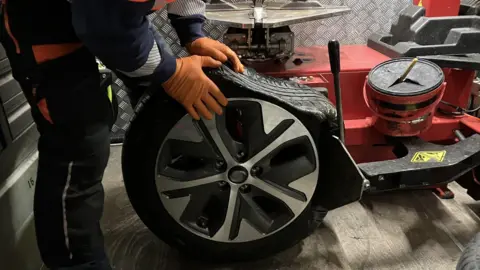
I was driving on the B653 - a well-used country road - when the pothole loomed. The road was too narrow to swerve, and we heard a nasty clunk. I put on the hazard lights – as did the driver in front, and the two vehicles behind. Four cars with busted tyres, thanks to a pothole.
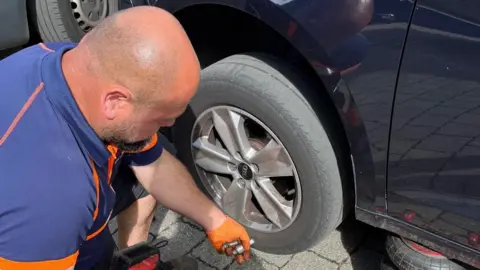
"The potholes are absolutely crazy - the roads are so bad in the last year," said the man who came to our rescue - George Mircas, a mobile tyre fitter based in Hertfordshire.
So why are we seeing so many potholes and is there hope they can be fixed?
 George Mircas
George Mircas says potholes are the worst he has seen in four years as a tyre repair mechanic
"Recently, on the M25 at Potters Bar there was a massive pothole in the middle of the motorway and eight cars had damaged tyres. It's very risky," said Mircas.
Mark Slack from Shelford in Cambridgeshire agrees that it is dangerous.
"You see people swerving to avoid the potholes – into the cycle lane or road. I do fear somebody's going to get harmed," he said.
He was unlucky enough to hit a pothole on the same road twice, costing him £700.
Slack blames the county council and said although they eventually filled the holes, some were already breaking up.
"The only solution is to completely resurface the road," he said.
Cambridgeshire County Council said funding was agreed to resurface sections of the A1301 Cambridge Road and Shelford Road.
 Mark Slack
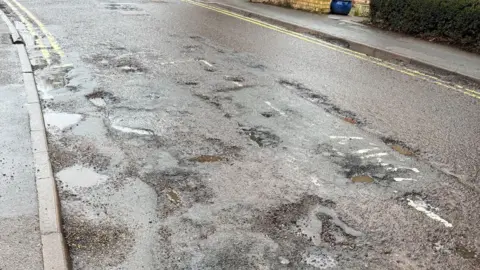
A "freeze and thaw" cycle sees water expand and contract which damages the road surface - such as this one in Shelford
Potholes are formed by a vicious circle. Tiny cracks in the road surface – usually caused by traffic – allow water to seep in.
When that freezes, it expands and makes the cracks bigger. Further traffic can turn that into a hole.
Nick Thom, assistant professor of engineering at Nottingham University, said: "Water's the enemy, but it becomes a worse enemy when it freezes.
"It's not just the surface – it's further down. The water table within the road rises.
"Materials do not behave well when it's full of water. They lose some of their strength and stiffness," he explained.
 Getty
Getty
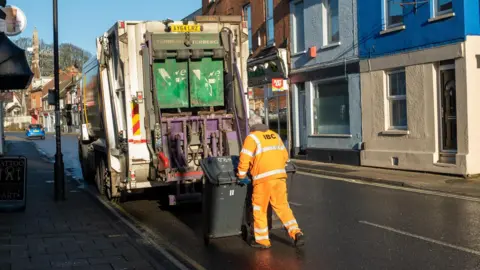
An expert in road damage at Cambridge University says large trucks on urban and rural roads are a leading cause of potholes
Other experts say the weight of large vehicles is a key driver of potholes.
"Really heavy vehicles cause damage to roads and that combines with the weather," said David Cebon, Professor of Mechanical Engineering at Cambridge University.
He has spent 20 years researching the impact of trucks on roads.
"Each tyre of a heavy truck carries up to five tonnes of force, compared with a car which might carry 300-500kg.
"The tyre forces are about 10 times more than under a car tyre. But it causes a thousand times more damage," he said.
Cebon said potholes mostly form on "thin, lightweight roads" such as B-roads or urban streets.
"The very heavy weights of buses, rubbish trucks, urban delivery vehicles, they're the ones that cause the most damage," he added.
The volume – and weight – of overall traffic has risen considerably in the past 30 years, but Cebon does not believe this is a significant factor.
"Light delivery vehicles or cars are not the culprits in the road damage. It's really the very heavy axle loads of trucks," he said.
 Simon Dedman/BBC
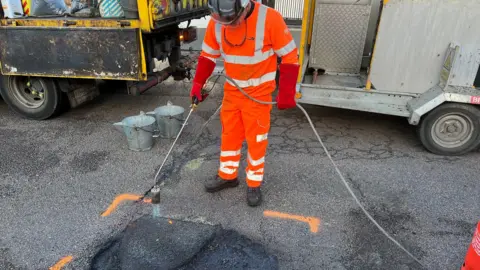
The Pothole Partnership discovered that councils use 78 different methods to repair potholes
One common complaint is that emergency pothole repairs do not always last.
Thom said the rain was also partly to blame for this.
"The ongoing wet weather means they last even less time than would otherwise be the case."
However, he said these repairs are only supposed to be temporary.
"I don't think councils are being stupid - they're all doing quite sensible practice with emergency repairs.
"They usually use cold-mix asphalt, which can be used in cold or wet conditions and lasts two to three months. Then hopefully they'll schedule longer-lasting repairs in spring for hot-mix asphalt."
He said, ultimately, many councils "need to resurface", combined with making roads more resistant to surface damage.
The RAC - which saw a 15% rise in pothole-related incidents in 2025 - praised the government for "demanding local authorities use techniques like surface dressing to keep their roads in better condition for longer".
 North Northamptonshire Council
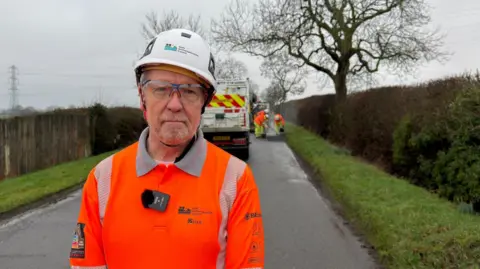
Councillor Chris McGiffin says keeping on top of pothole repairs feels like "an impossible task"
"Potholes are very much a local authority problem, as it occurs on their roads," says Cebon.
"It's a lack of spending – and councils have had severely curtailed budgets, particularly since the financial crash.
"The problem is, if you don't do preventative maintenance, then things get worse quickly," he said.
North Northamptonshire Reform councillor for Highways, Chris McGiffen, shares the frustration.
"Every 10 potholes I get repaired, another eight appear a bit further on.
"No matter what we're doing at the moment, it's not enough. We need to spend an awful lot more money, which we simply do not have," he told the BBC.
 Tony Fisher/BBC
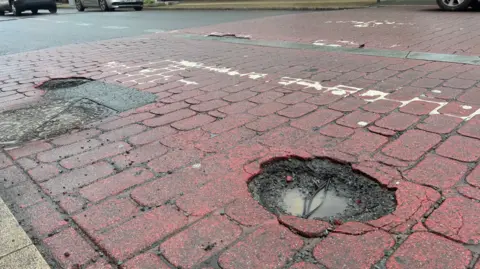
The AA says a really wet January "stifled council roads teams from carrying out works"
"That would be about £200 million in my area. This year we'll spend £11m," he said.
The Department for Transport said: "Historic under-investment has made it difficult for authorities to maintain their roads, and the average driver forks out nearly £320 to repair serious pothole damage.
"That's why we're backing councils in the East of England with £1.2 billion over the next four years to tackle potholes."
You may also be interested in