6 months ago
16
6 months ago
16

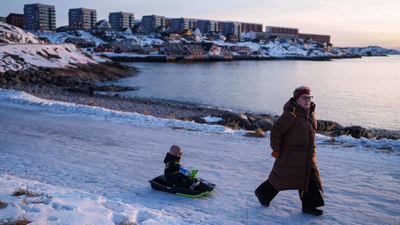
For Greenland’s Inuit, the indigenous population, the Arctic land is not owned by any one state or individual, but shared collectively, a principle they say is being ignored as geopolitical interest in the island intensifies.Nearly 90 per cent of Greenland’s population of about 57,000 are indigenous Inuit, who have lived on the island continuously for around 1,000 years. The community includes the Kalaallit of West Greenland, the Tunumi of the east and the Inughuit of the north, spread across an Arctic landmass of roughly 830,000 square miles.
Macron Calls Greenland Standoff With U.S. a Strategic Wake-Up Call For Europe | Watch
"We can't even buy our own land ourselves, but Trump wants to buy it - that's so strange to us," Kaaleeraq Ringsted, 74, a resident of Kapisillit, was quoted as saying by Reuters.“Since childhood, I have been used to the idea that you can only rent land. We have always been used to the idea that we collectively own our land.”The issue has drawn renewed attention after US president Donald Trump described Greenland as a strategic asset that Washington could buy, prompting Denmark to restate its legal sovereignty over the territory. Inuit representatives say such claims disregard their long-standing relationship with the land.
Around 80 per cent of Greenland is covered by ice, with most of its population concentrated along the south-western coast near the capital, Nuuk. The economy depends largely on fishing and is supported by substantial subsidies from the Danish government.The concept of collective ownership is central to Inuit society and is recognised in law: people may own houses, but not the land beneath them. The idea has survived nearly 300 years of colonisation.“People here are interested in the day that is coming. Is there food in the fridge? Fine, then I can sleep a little longer. If there is no food, then I will go out and catch fish or go out and shoot a reindeer,” Vanilla Mathiassen, a Danish teacher in Kapisillit who has worked in towns and villages across Greenland for the past 13 years, was quoted as saying by Reuters.The ancestors of today’s Inuit reached Greenland about 1,000 years ago, equipped with technologies such as kayaks, dog sledges, harpoons and fur clothing that enabled them to survive in the Arctic’s harsh conditions.Rakel Kristiansen, from a family of shamanic practitioners, said Inuit people traditionally viewed themselves not as owners of the land, but as its temporary guardians."In our understanding, owning land is the wrong question,” she said. “The question should be who is responsible for the land. The land existed before us, and it will exist after us.”"I’m staying here. I belong here," she said, as cited by Reuters. "This is my land. Greenland is my land.”