43 minutes ago
1
43 minutes ago
1

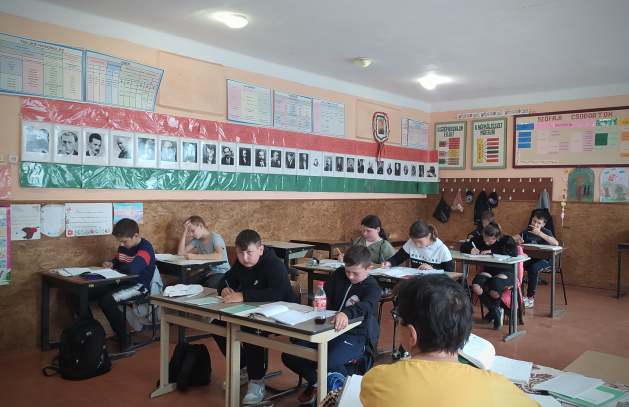 A Hungarian school in western Ukraine. Financial support from Budapest
is vital for this community in the west of the country. Credit: Zanko
Barnabas/IPS
A Hungarian school in western Ukraine. Financial support from Budapest
is vital for this community in the west of the country. Credit: Zanko
Barnabas/IPSUZHGOROD, Ukraine, September 17 (IPS) - It happened in 1920. At the Grand Trianon Palace at Versailles, the Allies drew a new map of Hungary that sliced away two-thirds of its territory. Such a cartographic mutilation went down in history as the Treaty of Trianon. No country lost more territory after the First World War.
Overnight, more than three million Hungarians woke up on the wrong side of Hungary’s new border. Their descendants are now scattered across Slovakia, Romania, Serbia and Ukraine.
People like Rita Simon, a 31-year-old history graduate who works for Karpaty Igaz Szo, “The Honest Voice of the Carpathians.” Ukraine’s oldest newspaper turns out to be a Hungarian daily based in Uzhgorod, 800 kilometres southwest of Kyiv.
It is as old as the treaty that, for Hungarians, remains a byword for humiliation. Simon points to a framed front page from 1920 on the wall. “The presses only stopped during the Second World War. We have never missed an edition since,” Simon tells IPS.
It is a weekly with a print run of 5,000 and a digital edition updated daily. But keeping it going has become ever harder since Moscow launched its full-scale invasion in February 2022.
The war has turned into a grinding conflict of attrition and trenches in the east and south, with Russia occupying 20 per cent of the country and Ukraine holding out with Western support. Moscow is demanding territory; Kyiv wants a full withdrawal.
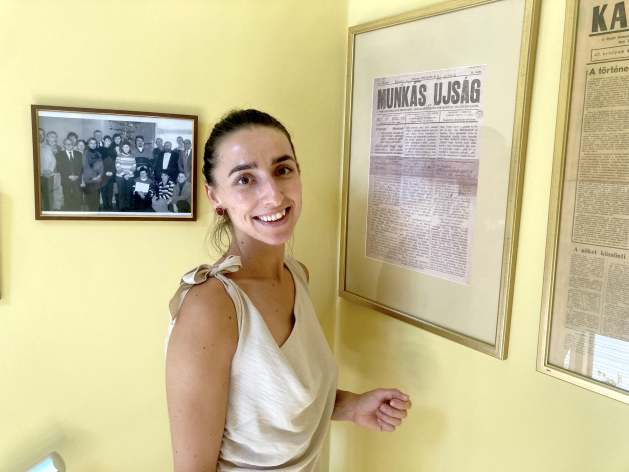 Rita Simon next to a century-old front page of Kárpáti Igaz Szó, now a weekly, where she works in Uzhgorod. Like the rest of the staff, the Hungarian journalist cannot survive on her salary as a reporter alone in western Ukraine. Credit: Karlos Zurutuza / IPS
According to the UN refugee agency, the war has left tens of thousands dead, more than six million refugees and 3.6 million internally displaced, in a country of 44 million people, including the occupied regions of Crimea and Donbas.
The economy is feeling the strain too. An internal report by the European Commission suggests Ukraine will spend around 60 per cent of its total budget on the military this year.
Today, the Hungarian title survives on the commitment of its ten staff. Almost all of them have to combine this job with one, or even two, others. “The other option is to cross the border into Hungary, but I want to stay here, at home,” Simon insists.
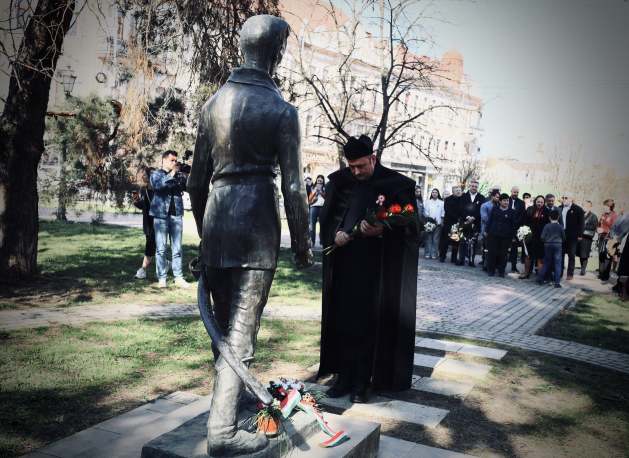 In Uzhgorod, western Ukraine, marking Hungarian National Day in front of a sculpture of Sándor Petőfi, Hungary’s national poet. Credit: Zanko Barnabas/IPS
A dwindling minority
In Uzhgorod, Hungarians make up no more than 15 per cent of the 140,000 inhabitants, based on pre-war figures, but they are still the majority in Berehove, the second largest town in the Transcarpathia region, and even more so in the surrounding villages.
There, people watch Hungarian television, live on Budapest time, one hour behind, by choice; the local church is Calvinist and Ukrainian is a language the young have learned at school. Their parents speak it with difficulty and their grandparents fall back on the Russian they learned in the Soviet Union because they do not know Ukrainian at all.
But all that is changing. Before the war, an estimated 150,000 Hungarians lived in western Ukraine. Today the figure is put at around 100,000. While the numbers are unconfirmed, Simon already talks of a demographic shift.
“Because it is on the border and far from the front, the region has become a destination for hundreds of thousands of refugees from Kyiv and eastern Ukraine. Housing costs and the cost of living in general make it very hard for us to stay here,” she explains.
Almost all Hungarians here hold a Hungarian passport after Budapest offered citizenship in 2010, something that, Simon recalls, moved many to tears at the time. It has proved to be a double-edged sword. With the war now in its fifth year, dual nationality is simply channelling people towards the border.
Hungarians are leaving.
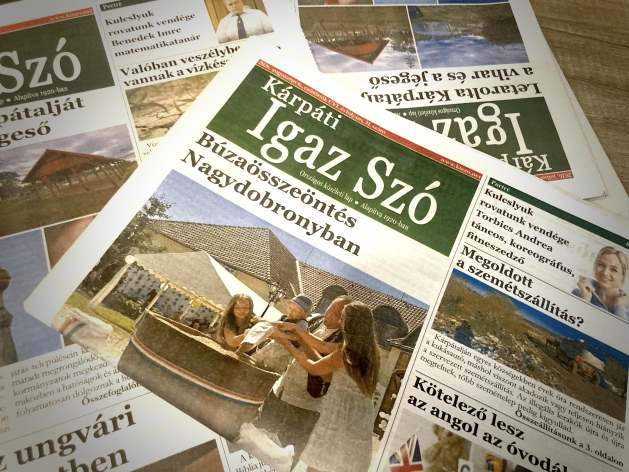 Copies of Kárpáti Igaz Szó in its newsroom in Uzhgorod. At 106 years old, it is Ukraine’s oldest newspaper. Credit: Karlos Zurutuza/IPS
An existential threat
Ukraine is home to 130 historic nationalities, who account for around 20 per cent of its population, based on pre-war data. The largest is the Russian community with a 17 per cent of the total population.
At the same time, Belarusians, Moldovans, Poles, Crimean Tatars and a long list of others, including Hungarians, each make up less than 1 per cent.
The vast majority of the latter live in Transcarpathia, which is in turn the most diverse region in Ukraine. Having changed country five times in a century helped create a place where, alongside languages, Protestant, Orthodox, Catholic and Uniate churches also bear witness to that diversity.
Today, Hungarians have closed ranks in a tight-knit community a long way from Kyiv, both mentally and geographically, which has only fuelled claims that they have no interest in integrating into Ukrainian society.
The former closeness between Viktor Orban, Hungary’s previous prime minister, and the Russian president, Vladimir Putin, has fed that narrative. Budapest has also been central to funding schools, cultural events and media outlets, including Ukraine’s oldest newspaper, Karpaty Igaz Szo.
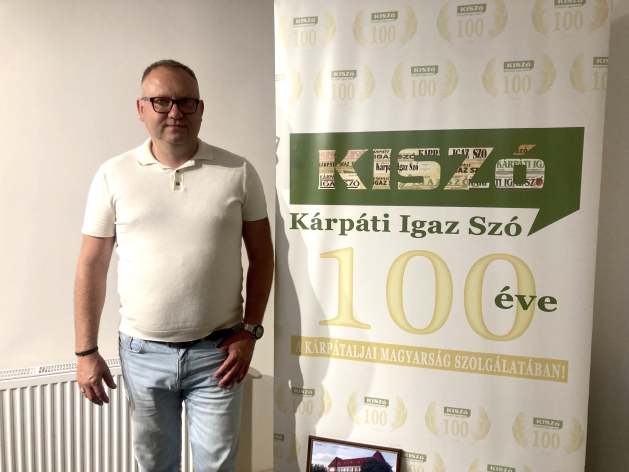 6. György Dunda poses next to the poster marking the centenary of the Kárpáti Igaz Szó newspaper six years ago. The Hungarian weekly, published in the western region of Transcarpathia where Ukraine’s Hungarian minority is concentrated, would not be viable without financial support from Budapest. Credit: Karlos Zurutuza / IPS
Csilla Fedinec is a Hungarian researcher from Transcarpathia and one of the leading authorities on her own community. She lives in Budapest, where she works at the Institute for Minority Studies of the ELTE Centre for Social Sciences in Budapest.
Living right on the border, she says, has been decisive in shaping local Hungarian identity.
“A family could live for generations in the same village and find itself in Austria-Hungary, Czechoslovakia, the USSR and finally Ukraine. The state is seen as an entity that is always changing, while the village, the family and the language remain,” Fedinec tells IPS via video call from Budapest.
The expert points out that the region has a sizeable Roma population who also speak Hungarian and who are also vital to the survival of schools. “It is a factor that has received very little attention in Hungarian political discourse in the region,” she says.
Fedinec is pessimistic. In her view, emigration, war, economic insecurity and the disappearance of young people pose an existential threat to the community. There are internal factors too.
“While our community is changing and shrinking rapidly, Hungarian political representatives in Budapest and Transcarpathia keep talking about schools, language rights and institutional guarantees without addressing a short-term scenario in which there will be no people left to sustain any of it,” she notes.
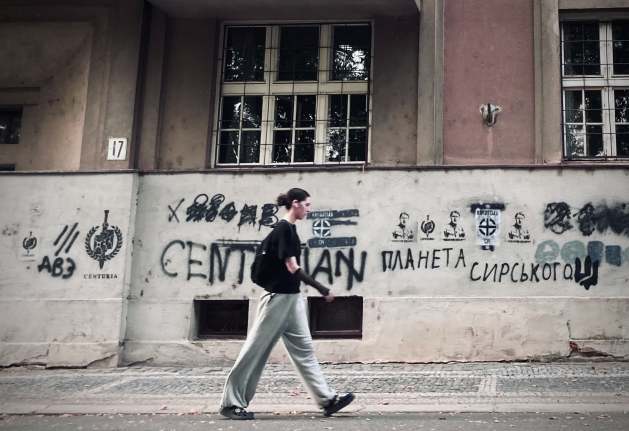 A view of central Uzhgorod. The war, now in its fourth and a half year, is also taking a toll on the country’s cultural fabric. Credit: Karlos Zurutuza/IPS
The future
From an office where a Hungarian national football shirt hangs framed on the wall, György Dunda, editor of Karpaty Igaz Szo, acknowledges that the project would be unviable without financial support from Budapest.
“While Hungarian minorities in neighbouring countries receive help from their respective governments, Kyiv simply turns its back on us,” tells IPS the 47-year-old man who has worked for the paper for 30 years.
A gesture from Kyiv, he says, would help improve relations between the two peoples. That gesture may not be long in coming. After almost 20 years in power, Viktor Orban was voted out last May and replaced by Peter Magyar, a former member of his own party.
It took barely a month to unblock relations between Kyiv and Budapest. In June, Magyar lifted Hungary’s veto on Ukraine’s accession to the EU, released the 90-billion-euro loan from Brussels that had been blocked since March and backed the twentieth package of sanctions against Russia.
In return, Kyiv agreed to recognise the linguistic and cultural rights of Hungarians in Ukraine. “The agreement is promising, but we need guarantees from Kyiv. What we do have is a guarantee from Brussels to monitor the process: without rights for us, there is no EU access for Ukraine,” Dunda notes.
Even so, he knows time is not on his side. “I am not worried about the future because it is already here. The demographic shift has happened. But if the war ends and the border opens for everyone, many may leave and never come back.”
© Inter Press Service (20260917174744) — All Rights Reserved. Original source: Inter Press Service