53 minutes ago
2
53 minutes ago
2

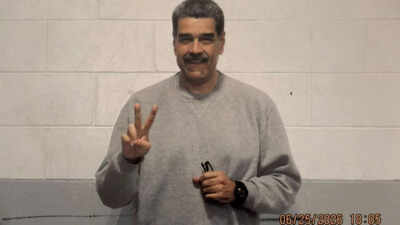
Former Venezuelan President Nicolás Maduro smiles and flashes a peace sign in a photograph. (Photo: @NicolasMaduro)
Two photographs posted to Nicolás Maduro's official social-media accounts on Sunday appear to show the former Venezuelan president smiling and making peace signs at the Metropolitan Detention Center in Brooklyn, nearly eight months after US forces captured him in Caracas.The pictures show the 63-year-old dressed in a grey sweatshirt and trousers with white shoes. Although released on August 30, timestamps on the photographs indicate they were taken on June 25.
“I send these photos as a small gift to all my grandsons and granddaughters, to the boys and girls, and to all the noble people who love us,” Maduro said in an English rendering of his Spanish-language message. He said he and his wife, Cilia Flores, would “remain strong, serene, and confident” and added: “Venezuela will be reborn.”
Maduro also described the support reaching the couple as “that love that reaches us transformed into prayer, into constant action, into solidarity and true support.
”The June 25 date places the photographs a day after two earthquakes measuring magnitude 7.2 and 7.5 struck Venezuela. The death toll from the quakes had risen to 6,509 by August 25.
Oil deal widens US role in Venezuela
Maduro's message emerged as the government led by acting President Delcy Rodríguez moves into a new phase of relations with Washington, particularly over Venezuela's vast oil reserves.
President Donald Trump said on Friday that the United States had secured majority control of more than 65 billion barrels of Venezuela's proven oil reserves through a partnership with private business.Rodríguez subsequently said the bilateral energy project would run for 25 years and involve 17 strategic oilfields, with an initial production target of more than 1.5 million barrels a day, news agency Reuters reported.News agency Associated Press separately reported, citing a US official familiar with the agreement, that the new private company had been granted 100-year rights to develop the oilfields.Several important terms have yet to be made public. The US official told AP that the United States would receive 55% of the effective output of the new company through a combination of an ownership stake and rights to buy oil at cost.
It remains unclear how much of that share would come from equity ownership and how much from the oil-purchase arrangement.Questions also remain over how the agreement will be financed and implemented, while the identity of the private operator has not been disclosed.Trump said on Sunday that Venezuelan crude obtained through the arrangement would also be used to replenish the US Strategic Petroleum Reserve. The stockpile held about 290 million barrels on August 21, near its lowest level in 44 years.A substantial increase in Venezuelan production is unlikely to come quickly. The country's oil infrastructure requires major investment, while unresolved financing and legal questions could affect how rapidly companies commit capital.
Defence prepares immunity challenge
While relations between Caracas and Washington have shifted since Maduro's removal, he and Flores remain in US custody awaiting a trial scheduled for June 1, 2027.US forces seized the couple from their Caracas residence during an overnight operation authorised by Trump on January 3 and transferred them to New York.
They appeared in federal court two days later and pleaded not guilty.Maduro faces four felony counts, including narcoterrorism conspiracy and conspiracy to import cocaine. Federal prosecutors accuse him of involvement in a scheme to facilitate cocaine shipments to the United States. He could face life in prison if convicted.His lawyer, Barry Pollack, has said he will seek dismissal on the ground that Maduro is immune from prosecution as the head of a sovereign state.
Pollack has also previously indicated that the defence may challenge the legality of Maduro's capture.US District Judge Alvin Hellerstein has given the defence until September 2 to file its first round of motions seeking dismissal. Arguments on those motions are scheduled for November 17, while a second round of motions is due by January 11, 2027, after prosecutors turn over additional evidence, some of which is expected to be classified.