4 months ago
55
4 months ago
55

Just now
Dominic CascianiHome and legal correspondent

 BBC
BBC
Catriona Ball, whose late husband's case will not be heard until 2029, says she did not realise there would be such long delays
Unprecedented employment tribunal service delays in England and Wales mean people bringing unfair dismissal claims are waiting up to five years for their case to be heard.
Expert lawyers say there must now be radical change if there is to be justice for both claimants and the companies involved.
One of those affected is Catriona Ball, whose husband Lewis died in 2024, weeks after he quit a job he believed had been making him ill.
After his death, she lodged a claim at the Employment Tribunal for constructive unfair dismissal and an alleged failure to make reasonable adjustments for disability. His former employer is contesting the claim.
This story is not about what went on between him and the company and who's right or wrong - but how long it will take to resolve the case.
Catriona filed the claim in February 2025, but the case will not come before a judge for a full hearing and judgment until 2029.
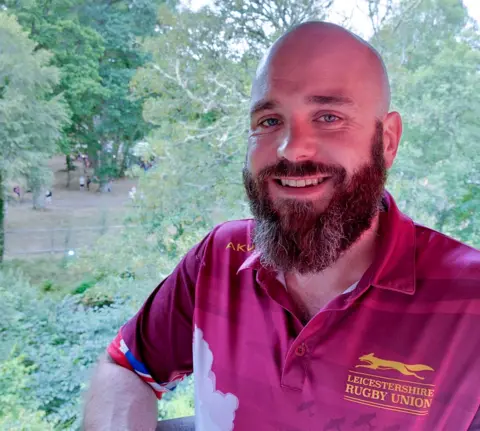 Catriona Ball
Lewis had quit his job just weeks before his death
For Catriona, the daily roller coaster of coping with the death of her husband has been worsened by the legal limbo she now finds herself in.
Lewis died on 2 November 2024 aged 43.
It began as just a normal Saturday at Aylestone St James, Lewis's childhood rugby club, half an hour from where they lived with their two children near Kettering - and where he still played.
"Part-way through the game, he came into the clubhouse, saying he had chest pains," says Catriona.
"He then went off to try and find aspirins at the far end of the clubhouse - and collapsed."
Everything was done to try to save Lewis - including using a defibrillator he had helped the club to secure.
There was nothing anyone, including the paramedics, could do and he died at the scene.
"It's been horrific," she says. "Grief is brutal. Every day is affected and you have to get through each day. You've got kids who need you. You have to just take it literally one day at a time."
Lewis died of coronary artery disease and hypertension.
He had quit his work weeks earlier because he believed he was under intolerable stress that was not being taken seriously.
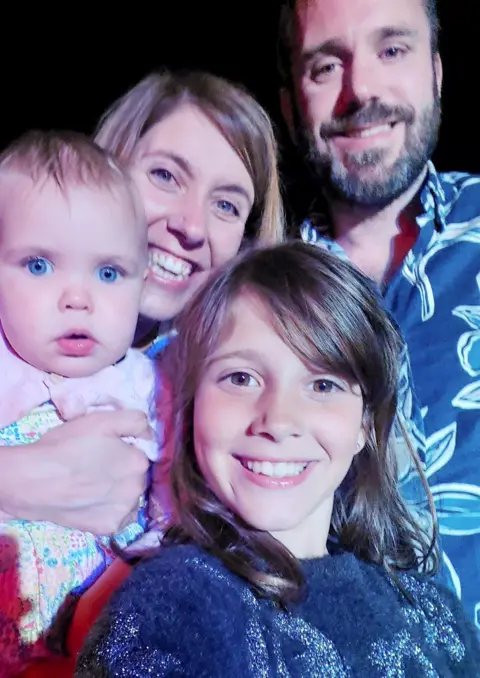 Catriona Ball
Catriona says her husband Lewis was very family-oriented
Catriona says she will have to sell the family home in order to fund her tribunal case, because until it is completed she cannot settle her late husband's estate. There's virtually no legal aid for employment tribunals.
"He was very loving and very family-oriented, very funny," she says. "It's hard. I don't have much opportunity to think back about the positive things about him, because I'm stuck in this grief and managing legal issues.
"I was told it would take a good few months, potentially a year, year and a half, but I never anticipated it to take as long as what it is now looking like it will take.
"It's shocking, absolutely shocking. It stops me getting closure and feeling like Lewis can rest in peace."
Catriona's loss is exceptional - but the legal limbo she is experiencing is not.
Tens of thousands of lives on hold
The latest figures show that there is now a backlog of almost 72,000 claims before the Employment Tribunal - up almost 26,000 in a year.
In practical terms, say expert lawyers in the field, unfair dismissal claims being lodged now may not go to a full court hearing for five years.
That's tens of thousands of lives on hold - and businesses that cannot put a case behind them either.
The Employment Lawyers' Association (ELA) is now calling on the government to take radical steps to turn around the enormous backlogs.
"The system isn't coping at the moment, and it's only going to get worse in the future," says Caspar Glynn KC, the chair of the ELA.
"Normally in an employment tribunal, the worker has been dismissed, they have no income, they have nothing to live on, and a delay of five years is effectively economic servitude for that person."
Workers are not the only losers, he says. Firms who may have a solid case to defend themselves find it harder to do so because delays mean people leave their company and, on occasion, a key witness may have even died.
"We have examples of cases where a case has been struck out [because] the judge has said it's no longer possible to have a fair trial. My real concern is whether cases are going to be struck out because of the delays themselves."
The reasons for the delays in the Employment Tribunal are complicated.
There has been a rise in complex discrimination and whistleblowing claims. Many of these take a long time to hear in court.
But there is also a twist in the tale caused by the very tool that you might think would speed things up: Artificial Intelligence.
Many people seeking redress for alleged unfair dismissal go to court as "litigants in person" because they cannot get legal aid to pay for a professional lawyer.
That enormously slows down the proceedings - and self-represented people are turning to AI for help.
"What we're now finding is that a litigant in person, unsure of their rights because no-one's helping them, goes to the internet and inputs it into an AI service," says Glynn.
"They then get a voluminous case, bringing up every single possible claim there is, and every single fact that could possibly be in the person's favour, and indeed sometimes also imagining those rights.
"Now you have claims, which used to be, say, one or two pages long, that are now 30 to 40 pages long."
And every time this happens the delays get longer because judges need more and more time to consider the claims being submitted to them.
The ELA is recommending a new dispute resolution body to cut the number of workplace disputes going to court.
It wants the tribunal service to start using an AI model to evaluate claims, rather than expand them, and to split the caseload into different "tracks" depending on their complexity and their value.
Simple claims could be handled by a legal officer of the court, rather than a judge - vastly cutting the time and expense.
A Ministry of Justice spokesperson said: "We recognise the pressures on Employment Tribunals and we're taking action to bring down the backlog, drive efficiencies and ensure swifter justice.
"That includes maximising sitting days, recruiting more employment judges, using virtual hearings where appropriate, and investing in new digital systems."
Whatever the government does, Catriona remains stuck for now.
"There's a big expense to me personally, continuing with this," she says. "I could easily end it. I could easily withdraw the claim. But there's an amount of pressure to do it for Lewis on his behalf.
"He certainly wouldn't want me suffering the way I am because of this process, but equally he would want some accountability."