6 months ago
60
6 months ago
60

Orla GuerinBBC News, Northern Iraq
Watch: Orla Guerin visits Kurdish Peshmerga fighters who say they're ready to fight
Like many exiled Iranian Kurds, Shaho Bloori, 53, hears the call of home from both the living and the dead.
Two of his sisters remain in Iran, and 18 of his relatives lie buried there, killed by the regime. That includes one of his brothers, who he tells us is "forever young" - a protest singer, executed at the age of 21.
It wasn't enough for Iran's Islamic Revolution Guard Corps to hang him, he says, and riddle his body with bullets, they heaped more suffering on his mother, after his death.
'When she went to wash his body [for burial], there were 16 bullet holes," he says. "They told her: 'You must not cry. If you do, we will not let you clean him and bury him.'"
He wants justice not revenge, if the regime falls; there is no sign of that yet.
"We must stop the hanging," he says. "Even if someone is guilty of hanging my brother, I don't want them to be executed. We need freedom, not another regime like the Islamic regime."
If Iranian Kurdish fighters based in Iraq do cross the border into western Iran - to open a new front against the Islamic Republic - his first mission will be to honour those who are gone.
"I will go to my mother's grave, then my fathers, and my brothers," he says. "I will go to all the friends and family I will never see again, and lay flowers and tell them: 'I remember you always, and I cry for you.'" At this, he is silenced by his grief and his memories.

 Matthew Goddard/BBC
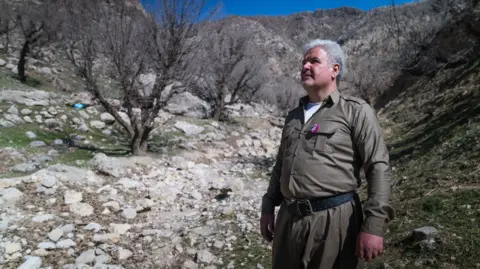
Commander Shaho Bloori says he wants justice not revenge if the Iranian regime falls
We meet Bloori, 53, in northern Iraq at a tented camp for Iranian Kurds where he is training a new generation of Peshmerga – "those who face death". He's perched on a boulder under a warm spring sun. Two Peshmerga come to stand guard behind him.
The commander - who is white haired and softly spoken - belongs to a small dissident group called Komala of the Toilers of Kurdistan. It's part of an alliance of Iranian Kurdish organisations formed recently to oppose the regime.
Thousands of fighters are "organised in the mountains, and ready to go home", Commander Bloori tells us, adding "that will be soon".
US President Donald Trump, by contrast, has publicly blown hot and then cold on the idea of the Iranian Kurds joining the US and Israel's war against Iran. For now, it looks unlikely.
The Kurds are stateless, and spread mainly across four countries - Iraq, Iran, Syria and Turkey. They are the fourth largest ethnic group in the Middle East, and have a shared history of persecution, and of internal divisions.
 Matthew Goddard/BBC
The authorities in this autonomous region are Iraqi Kurds, who desperately want to stay out of the war next door. They also want to keep Iranian Kurdish fighters away from the cameras.
But we managed to reach the camp on our second attempt. It's a collection of tents ringed by mountain peaks, some still capped with snow – a place of beauty, and a target for Tehran. We are not identifying the location.
Days before our visit there were two drone strikes about a kilometre away, causing injuries but no deaths.
The last part of our journey is a climb up a stony hillside. It's hard going at first - the altitude and our body armour making it difficult to breath.
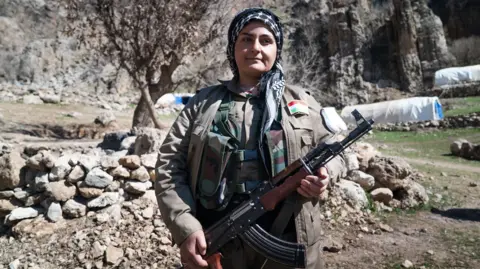
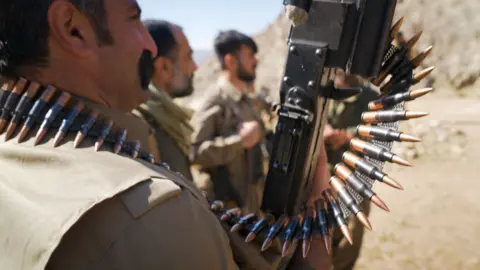
As we arrive around two dozen Peshmerga - men and women - line up to greet us, chanting and raising their Kalashnikovs in the air.
The slogan "Woman, life, freedom" echoes through the mountains – an old Kurdish demand adopted by recent protest movements in Iran.
More Peshmerga are dotted around on the hilltops standing sentry – a low-tech early warning system for incoming drones. On one peak a lone fighter scans the horizon, his dog by his side.
We carry drone detection equipment with us here - as we do in war zones like Ukraine. It should give us an early warning if a drone is headed our way, and some time to look for cover.
Our safety adviser gives us clear advice - "if there's nowhere to shelter, get down on your belt buckle".
 Matthew Goddard/BBC
A senior Komala party official, Amjad Hossein Panahi, is visiting the fighters. He's also a Peshmerga, along with his wife.
He tells us he's been waiting to see the fall of the regime since its birth 47 years ago, but air strikes alone won't bring it down.
"Bombing is weakening the regime, but it's a big country and this is not enough," he says. "Ground forces must intervene, and the Kurds can play an important role in this." First, he wants to see a no-fly zone imposed by the US.
But with rising oil prices, hurting Americans (and many others) at the petrol pumps, how long will the US remain in the fight?
"I don't trust Trump," he replies bluntly. "I feel he may decide to stop the war. This is my personal view. But whether or not Trump stops the war, the Islamic Republic is in its final days. It will be brought down, by him or by [Israeli Prime Minister Benjamin] Netanyahu, or by the people."
Then we are interrupted when he gets a call with news of an attack of a Komala camp in the city of Sulaymaniyah, near the border with Iran.
"We have to leave this place now," he warns. "The Iranians are attacking with drones. They could attack here."
He shouts to the Peshmerga who are gathered around.
"Spread out, spread out. Drones and ballistic missiles are coming. Hurry!"
The fighters scatter and so do we.
We wait for a while, but the skies remain clear. We leave the Peshmerga in position in the mountains, just as they have been for decades.
If they do enter the war - at some point - it could be very costly for them, and threaten the fragile stability of Iraq.