7 months ago
50
7 months ago
50

Mitchell LabiakBusiness reporter

 Getty Images
UK businesses face uncertainty after the US Supreme Court struck down many of President Donald Trump's tariffs, trade experts have said.
The court's decision affects the tariffs Trump introduced using the the International Emergency Economic Powers Act (IEEPA), which includes all the "Liberation Day" tariffs from April last year.
However, Trump said on Friday he would introduce an additional 10% global tariff and would reintroduce the struck down tariffs using different legal means.
The British Chamber of Commerce (BCC) has said the Supreme Court decision "does little to clear the murky waters for business".
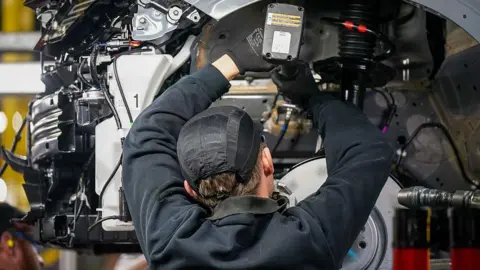
The decision overrules the 10% additional tariffs Trump put on the UK last year, but it does not impact tariffs on specific sectors in the UK, such as steel, aluminium, pharmaceuticals, automobiles and aerospace.
It also does not affect the deals the UK government has secured in those sectors, which represent most of the UK's trade with the US.
BCC's head of trade policy William Bain said that for the UK the president has "other options at his disposal" to bring back the 10% IEEPA tariffs on the UK.
"For the UK, the priority remains bringing tariffs down wherever possible," Bain added.
"It's important the UK government continues to negotiate on issues like steel and aluminium tariffs and reduces the scope of other possible duties."
Trump said the Supreme Court's decision was "deeply disappointing".
"Foreign countries that have been ripping us off for years are ecstatic; they're so happy. They're dancing in the streets, but they won't be dancing for long," he said.
He later said that he would introduce 10% global tariff and reintroduce the IEEPA tariffs overruled by the Supreme Court.
"There are methods [...] even stronger than the IEEPA tariffs available to me as president," he said.
A UK government spokesperson said: "This is a matter for the US to determine but we will continue to support UK businesses as further details are announced.
"The UK enjoys the lowest reciprocal tariffs globally, and under any scenario we expect our privileged trading position with the US to continue."
Paying back tariffs will be a 'mess'
There is also uncertainty around the question of refunds.
Despite the ruling, economists have raised doubts about the likelihood of the US handing all of that money back. Supreme Court justice Brett Kavanaugh said the refund process was likely to be a "mess".
On Friday, Trump said the question of refunds would be fought in the courts "for the next five years".
For the UK, Bain said the court's decision raised the question as to whether any UK exporters will receive a share of any refund if US importers passed the costs onto them.
Richard Rumbelow, director of international business at manufacturing industry body Make UK, said UK businesses need "clear, practical guidance on how the ruling will be implemented, alongside progress on resolving the remaining [...] tariffs on UK steel and aluminium".
Despite the lack of clarity, Andy Prendergast, national secretary of the GMB Union, said the Supreme Court decision was "very welcome".
"These unreasonable and ill considered tariffs have unfairly punished British companies since their inception," he added.
"Business and workers need certainty and the manner in which the tariffs have been imposed [...] has done nothing but create chaos, costing valuable jobs."