7 months ago
39
7 months ago
39

Justin RowlattClimate Editor
 Andy Cowrie, Cornwall Wildlife Trust
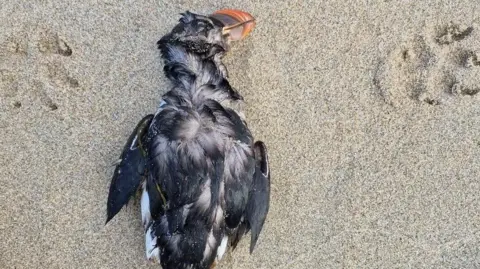
150 dead puffins have been reported this month via a British bird tracking scheme
Hundreds of dead and dying seabirds - including puffins, guillemots and razorbills - are washing up on British beaches in the wake of this winter's severe storms, according to wildlife charities.
The death toll is even higher in France and Spain, where many of the seabird populations that breed in the UK spend the winter, raising fears of catastrophic seabird "wreck".
France's main bird protection charity says more than 20,000 bird strandings – most of them puffins – have been reported along the Atlantic coastline since 1 February.
Since most birds that die at sea are never found, the true death toll is thought to be far higher.
Samuel Wrobel, senior marine officer at the RSPB, the UK's leading bird charity, said "the sheer volume of reports coming in gives great cause for concern."
The RSPB believes this is evidence of a seabird 'wreck' - a mass mortality event caused when winter storms leave birds too exhausted or starved to survive.
"The last time we saw a wreck on this scale was 2014," Wrobel added, "and after the impact of avian flu this is the last thing our seabirds need".
In that year more than 50,000 seabirds washed up on the Europe's Atlantic coast.
The episode is believed to be one of the largest seabird wrecks in recent European history.
This latest wreck is believed to have been caused by the series of brutal storms that have battered the Atlantic coast of the UK and Europe since January.
Storms Goretti, Ingrid and Chandra in particular caused floods and devastation for both humans and wildlife.
The full impact on seabird populations won't be known until the birds return to their breeding sites in the coming months. But the RSPB warns UK seabirds are already in crisis, with two thirds of species in decline.
It points out that when the first UK Birds of Conservation Concern Red List was published in 1996, it contained only one species of seabird. Today, ten of the UK's 25 breeding seabird species are on the Red List, among them the puffin and the kittiwake.
The latest figures from the Ligue de Protection des Oiseaux (LPO), France's main bird protection charity, show 15,000 birds have washed up in France so far this year, 4,400 in Spain and 1,200 in Portugal. Most are puffins with significant numbers of common guillemots and little auks.
The LPO says: "Mass seabird strandings frequently follow winter storms, but this episode is exceptional in both its scale and duration."
French rescue centres have been overwhelmed, with sick birds being transferred across the national wildlife network to relieve the most overstretched facilities.
Roland Gauvain, the chief executive of the Alderney Wildlife Trust on the northernmost inhabited Channel Island said he believed rough seas had made it difficult for birds to feed.
"Those populations will most likely be UK and northern European breeding populations that have been wintering out at sea and have been picked up in the storms during the last couple of months and bashed around the place," he said.
"Finally, they are making their way back on shore where, unfortunately, a lot of them are already dead or dying as they approach the coastlines and get into rougher coastal waters."
 AFP via Getty Images
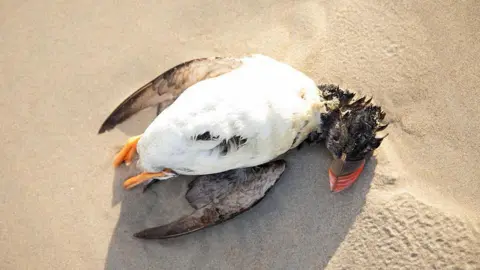
This dead puffin was found earlier this month on a beach in Brittany in France
Katie-jo Luxton, director of conservation for the RSPB said: "Mass deaths like this underline just how fragile our seabirds are, as well as the urgent need to build resilience in their populations to be able to withstand exactly this type of unpredictable event."
The RSPB is calling for better management of the fishing industry to allow seabirds to feed safely, gaps to be filled in the UK's network of marine protected areas and stronger protection of breeding colonies from invasive predators.
It also says new offshore wind development should avoid the most sensitive areas for wildlife, and has been critical of the government's decision to award a contract to the Berwick Bank windfarm off the East coast of Scotland.
Luxton says the development sits on top of "a vital feeding ground for globally important species that will kill tens of thousands of seabirds over its lifetime".
Anyone who finds a dead wild bird is urged not to touch it and to report the sighting to Defra (or Dera in Northern Ireland) for possible collection and testing. Sightings should also be logged with BirdTrack, the online reporting scheme run by the British Trust for Ornithology.