8 months ago
23
8 months ago
23

Jaroslav Lukivand Kathryn Armstrong

 Handout via Reuters
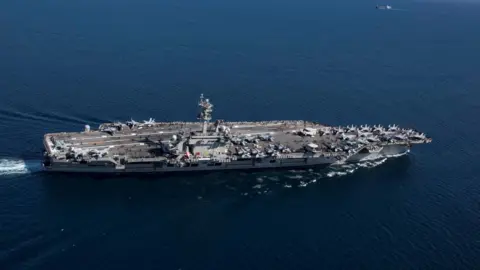
The fleet is headed by aircraft carrier USS Abraham Lincoln (file image)
Donald Trump has warned Iran that "time is running out" to negotiate a deal on its nuclear programme following the steady build-up of US military forces in the Gulf.
The US president said a "massive Armada" was "moving quickly, with great power, enthusiasm, and purpose" towards Iran, referring to a large US naval fleet.
In response, Iran's Foreign Minister Abbas Araghchi said the country's armed forces were ready "with their fingers on the trigger" to "immediately and powerfully respond" to any aggression by land or sea.
Iran insists its nuclear programme is entirely peaceful and has repeatedly denied accusations by the US and its allies that it is seeking to develop nuclear weapons.
Trump's latest warning follows his promise that Washington will intervene to help those involved in the brutal and unprecedented crackdown on protests in the country earlier this month.
Demonstrations began after a sharp fall in the value of the Iranian currency, but swiftly evolved into a crisis of legitimacy for the country's clerical leadership.
"Help is on the way," Trump said, before later changing his tune and saying he had been told on good authority that the execution of demonstrators had stopped.
The US-based Human Rights Activists News Agency (HRANA) says it has confirmed the killing of more than 6,301 people, including 5,925 protesters, since the unrest began at the end of December.
HRANA says it is also investigating another 17,000 reported deaths received despite an internet shutdown after nearly three weeks.
Another group, the Norway-based Iran Human Rights (IHR), has warned that the final toll could exceed 25,000.
Trump's latest comments on Iran appeared to focus more on the country's nuclear programme.
"Hopefully Iran will quickly 'Come to the Table' and negotiate a fair and equitable deal - NO NUCLEAR WEAPONS," he wrote on Truth Social.
Trump added that this force was "ready, willing, and able to rapidly fulfil its mission, with speed and violence, if necessary".
Mohammad Bagher Ghalibaf, the Speaker of Iran's parliament, said in an interview with CNN thatTehran was ready to negotiate with the US, but only if talks were "genuine".
However, did not think that was "the kind of talk the president of the United States is after; he just wants to impose (his will on others)".
"Maybe Mr Trump can start a war, but he doesn't have control over (how it ends)," he added.
Speaking to the Senate Foreign Relations Committee on Wednesday, Secretary of State Marco Rubio said the Iranian "regime is probably weaker than it's ever been".
"They don't have a way to address the core complaints of the protesters, which is that their economy is in collapse," Rubio said.
He added: "What you're seeing now is the ability to posture assets in the region to defend against what could be an Iranian threat against our personnel."
Responding to Trump's latest warning, Araghchi said: "Iran has always welcomed a mutually beneficial, fair and equitable NUCLEAR DEAL - on equal footing, and free from coercion, threats, and intimidation - which ensures Iran's rights to PEACEFUL nuclear technology, and guarantees NO NUCLEAR WEAPONS."
"Such weapons have no place in our security calculations and we have NEVER sought to acquire them," he added.
Iran's Deputy Foreign Minister Kazem Gharibabadi said that no negotiations with the US were currently under way, despite "exchanges of messages".
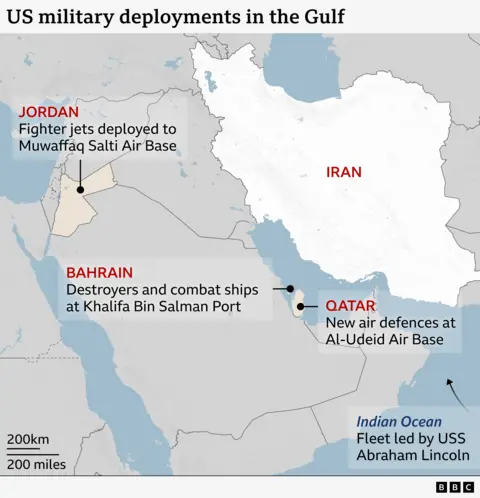
Using open-source tools, BBC Verify has been able to track some of the recent US deployments to the region, with satellite images showing that at least 15 fighter jets arrived at Jordan's Muwaffaq Air Force Base.
There has also been an increase in the number of aircraft arriving at bases in Jordan, Qatar, and Diego Garcia in the Indian Ocean.
BBC Verify has identified dozens of cargo planes and refuelling aircraft arriving in the Middle East, while drones and P-8 Poseidon spy planes have been seen on the FlightRadar24 tracking site operating near Iranian airspace.
A naval "armada", as Trump referred to it, led by the USS Abraham Lincoln aircraft carrier has also arrived in the Middle East, a US defence official confirmed to BBC Verify.
On Monday an Osprey aircraft's tracker was seen on FlightRadar24 landing in Oman after leaving an offshore location in the Gulf, suggesting that the Lincoln could be operating somewhere nearby.
"In the past two weeks, the US has surged naval and aerial assets to the region, significantly increasing its regional posture," Megan Sutcliffe, a principal analyst at the risk advisory firm Sibylline, said.
Satellite images show that at least two US guided missile destroyers and three combat ships have been docked in Bahrain for several months.
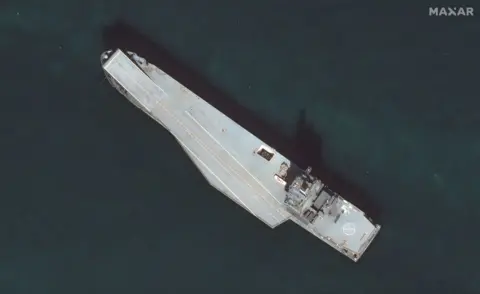
Meanwhile, Tehran has deployed the IRIS Shahid Bagheri - a drone carrier ship which entered service last year - just off the Iranian coast, satellite images show.
 Maxar Techn
IRIS Shahid Bagheri, shown on a satellite image taken in December 2024
Under a 2015 nuclear deal with world powers, Iran was not permitted to enrich uranium above 3.67% purity - the level required for fuel for commercial nuclear power plants - and was not allowed to carry out any enrichment at its Fordo plant for 15 years.
However, Trump abandoned the agreement during his first term in 2018, saying it did too little to stop a pathway to a bomb, and reinstated US sanctions, which crippled the Iranian economy.
Tehran retaliated by increasingly breaching restrictions under the deal, particularly those related to the production of enriched uranium, which is used to make reactor fuel but also nuclear weapons.
US officials, quoted by American media, have said Iran must stop enriching uranium, limit its missile programme and stop supporting proxy groups in the Middle East, as part of a new nuclear deal.
US officials then said the operation - codenamed "Midnight Hammer" - had significantly set back the prospect of Tehran building a nuclear weapon.
However, Hassan Abedini, the deputy political director of Iran's state broadcaster, claimed that the country "didn't suffer a major blow because the materials had already been taken out" of the facilities.
In retaliation, Iran launched missiles on a US military base in Qatar - an attack described by Trump as "very weak" and "expected".
Additional reporting by Joshua Cheetham, Matt Murphy, Alex Murray, Barbara Metzler and Sofia Ferreira Santos.