5 months ago
28
5 months ago
28

Just now
Guy DelauneyBalkans correspondent

 AFP via Getty Images
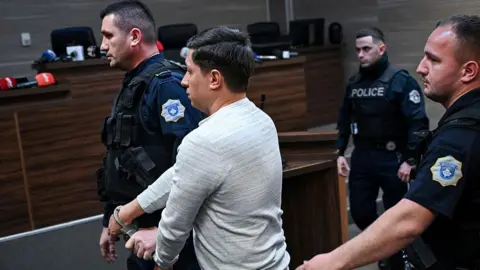
Dušan Maksimović (centre) is seen handcuffed in a courtroom in Pristina after being sentenced to 30 years in prison
A court in Kosovo has sentenced two Kosovo Serbs to life imprisonment and another to a 30-year jail term for taking part in what it described as a "terrorist" attack in September 2023.
The men were found guilty of violating Kosovo's constitutional order and inciting terrorist activities. Prosecutors have charged 45 people in total - but they believe most of them are in Serbia and unlikely to be handed over.
The "Banjska incident" is a prosaic label for one of the most dramatic, dangerous and deadly days Kosovo has seen since it unilaterally declared independence from Serbia in 2008.
A police officer and three members of an armed group of Kosovo Serbs died during several hours of shooting in northern Kosovo.
On Friday, the court in Kosovo's capital Pristina sentenced Vladimir Tolić and Blagoj Spasojević to life in prison and Dušan Maksimović to 30 years in prison.
Kosovo's acting President Albulena Haxhiu welcomed the verdict, describing it as "proof that the attack on the Kosovo police, on the constitutional order and on the security of our country will not remain unpunished".
Despite the convictions, many questions remain over what happened in the village of Banjska, which is less than half-an-hour's drive from the crossing point into central Serbia.
The authorities in Pristina maintain that Serbia's government in Belgrade was ultimately responsible, though it is still far from clear what the armed group actually hoped to achieve.
 Kosovo government / handout via Reuters
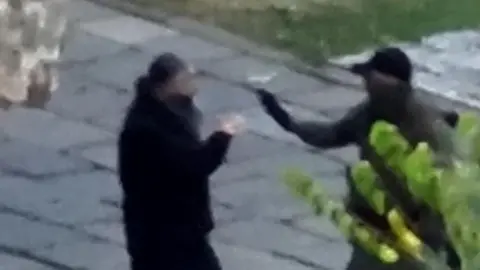
During the 2023 attack, one of the armed men was seen approaching a priest inside the Serbian Orthodox monastery in Banjska
The shooting started when police responded to a lorry blockade set up on a bridge in the early hours of Sunday 24 September.
Kosovo authorities said that a group of about 30 men attacked the officers with guns and grenades.
Sgt Afrim Bunjaku was killed, while two of his colleagues were injured.
The armed group then retreated to the nearby 14th century Serbian Orthodox monastery, forced their way in and barricaded themselves inside, much to the alarm of a group of pilgrims from Serbia's second city, Novi Sad.
Shooting continued throughout the day, resulting in the deaths of three members of the armed group.
But by the time Kosovo police's special forces took control of the monastery in late afternoon, the surviving group members had somehow slipped away despite being, to all intents and purposes, surrounded.
The self-confessed leader of the group, Kosovo Serb politician Milan Radoičić, soon emerged in Serbia, boasting that he had "personally made all the logistical preparations" for the attack.
Police questioned him, but he does not face any charges in Serbia and remains at large there - although an Interpol arrest warrant means his freedom to leave the country is limited.
Kosovo's authorities have seized on Radoičić's connections to Serbia's government as proof that the attack had an official seal of approval from Belgrade.
Radoičić was the deputy leader of the main Kosovo Serb political party, Serbian List, which has strong ties to the governing Progressive Party of President Aleksandar Vučić
Radoičić insisted that nobody in Serbia's government knew about his plans.
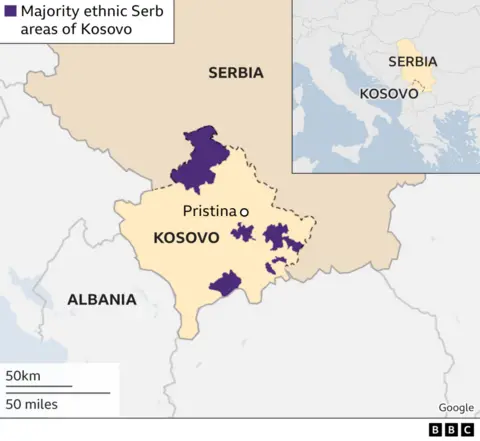
But Kosovo's Prime Minister Albin Kurti claimed the attack was part of a Serbian plot to annex a majority-Serb north Kosovo.
Relations between Belgrade and Pristina were already strained before the "Banjska incident". Since then, they have been close to non-existent.
Multiple attempts to revive the EU-moderated normalisation talks between the two sides have failed.
The convictions are unlikely to do anything to improve the atmosphere.
Kosovo's Interior Minister Xhelal Sveçla said "it remains for Serbia to be held accountable for its political, financial and logistical role in this aggression".