1 hour ago
1
1 hour ago
1

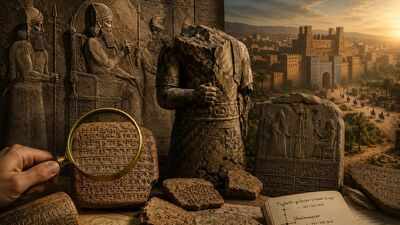
Representative Image (AI-generated)
For more than 2,700 years, the story of Assyria’s kings has survived through fragments of clay tablets, royal inscriptions, monuments and carefully preserved lists of rulers. Together, these records have allowed historians to reconstruct the succession of one of the ancient Near East’s most powerful kingdoms.
Yet ancient history is rarely as complete as surviving records make it appear. A name missing from a royal list does not necessarily mean the person never ruled, particularly when other objects and inscriptions point to a different sequence of events. Now, researchers have brought together several such clues to argue that three rulers who were largely absent from the traditional record may have briefly occupied the Assyrian throne.The study, published in the Journal of Cuneiform Studies by Alexander Johannes Edmonds and Eckart Frahm, examines evidence from ancient tablets, inscriptions and a damaged royal statue. Their findings suggest that three previously overlooked kings may have ruled during periods of political uncertainty, potentially requiring parts of Assyria’s accepted chronology to be reconsidered.
A gap in the king list
The Assyrian King List has traditionally been an important foundation for reconstructing the succession of Assyrian rulers.
The problem, according to Edmonds and Frahm, is the assumption that it contains every Neo-Assyrian monarch. The researchers examined ancient evidence that does not fit comfortably into the established sequence. Rather than treating those inconsistencies simply as scribal mistakes, they considered whether they could indicate the existence of short-lived rulers who were subsequently omitted from the official record.
Their study presents three separate historical scenarios involving rulers who either reigned alongside kings already known from the list or occupied gaps between them. The evidence comes from different types of surviving material, including cuneiform tablets, royal inscriptions and a damaged statue.
The rebel king Tiglath-pileser
One of the most striking cases concerns a ruler named Tiglath-pileser, who appears to have challenged his nephew, Aššur-dān III.
The evidence comes in part from a clay tablet recording a royal grant issued in Tiglath-pileser's name. The tablet is dated to 762 BCE and identifies him as king of Assyria, despite the established chronology placing Aššur-dān III on the throne at that time.Edmonds and Frahm propose that this Tiglath-pileser briefly seized power around 763-762 BCE. Their reconstruction connects his rise to a period of political instability that followed a solar eclipse.
He appears to have attempted to overthrow Aššur-dān III before being removed from power. His short reign could help explain why the ruler is absent from the conventional king list. The researchers argue that references to him were subsequently excluded from the official historical record, leaving only fragments of evidence behind.
A missing Shalmaneser and a rewritten inscription
The second proposed king is Shalmaneser, whose existence helps explain an unusual ancient monument.
A stela discovered at Tell 'Abta in Iraq had an inscription whose original royal name was later overwritten with the name of Tiglath-pileser III. For years, the alteration created a historical puzzle because the monument appeared to contain evidence that did not fit neatly into the established succession.Edmonds and Frahm argue that the mystery becomes more understandable if a previously omitted Shalmaneser is placed into the sequence.
They propose that he ruled from approximately 747 to 745 BCE, immediately before Tiglath-pileser III came to power in 745 BCE. The researchers suggest that the monument's original name was deliberately replaced. This would mean the physical object itself preserves evidence of a ruler whose place in the official historical memory was later erased.
Aššur-uballiṭ and the damaged statue
The third proposed ruler, Aššur-uballiṭ, belongs to an earlier period.
The researchers tentatively place his reign around 913-912 BCE, between the reigns of Tukultī-Ninurta I and Tukultī-Ninurta II. A cuneiform text provides an important clue. It describes a ceremonial vessel originally made under Tukultī-Ninurta I and later restored by Aššur-uballiṭ. Yet the established Assyrian King List contains no ruler with that name between the two Tukultī-Ninurtas.The researchers connect this evidence with a damaged royal statue discovered at the ancient city of Aššur.
The statue had been decapitated, while its arms and royal insignia had also been deliberately damaged. Edmonds and Frahm argue that it may represent Aššur-uballiṭ and provide another physical trace of a ruler who was later removed from the historical record.
What this means for Assyrian history
The three cases do not simply add three names to an ancient list. They raise questions about how Assyrian political history was recorded in the first place. Edmonds and Frahm argue that the Assyrian King List may not have functioned as a completely neutral record of every ruler.
Instead, they suggest it could have served as a legitimising canon of kings, with short-lived or rival rulers removed from the sequence by later authorities.All three proposed kings appear to have had extremely short reigns, with the evidence suggesting that each ruled for less than two years. Their omission could therefore have helped create a cleaner succession than the political reality actually allowed. The findings suggest that early Neo-Assyrian political history involved more rebellion, rivalry and contested succession than the traditional chronology reveals.
They also demonstrate how seemingly disconnected pieces of evidence can become meaningful when examined together.Rather than completely overturning Assyrian chronology, the study challenges the assumption that the existing king list provides a complete record of the kingdom's rulers. It opens the possibility that further inconsistencies in ancient texts and monuments could reveal additional details about rulers who disappeared from the official historical memory.