7 months ago
56
7 months ago
56

Luke MintzBBC News

 BBC
BBC
One morning in May 2024, Doris Suchet noticed something was amiss outside her flat in north Oxford. A chunk of pavement had been repainted into a parking bay for electric scooters. The box was labelled "E-scooter hire" in large white letters, and Suchet says it obstructed a walkway for her neighbours.
"These are elderly people, then you have younger families, mums with prams… there's no chance in hell that person can manoeuvre around a scooter badly parked randomly in the middle of the pavement," she says.
She embarked on a battle with the council to get it removed. In one email she wrote, "I and all residents of the apartment block are appalled and demand this rank be removed swiftly, with immediate effect."
The council says that the bay allowed a two metre space on the pavement for pedestrians to walk.
Eventually, Suchet won. With agreement from the council, the Swedish company Voi (which operates the city's fleet of e-scooters) repainted the pavement back to its original state a few weeks after the parking bay was installed.
But Suchet says the e-scooters - part of a shared transport scheme introduced in 2021 - are still parked haphazardly around the area, blocking pavements.
"They are absolutely everywhere," she sighs.
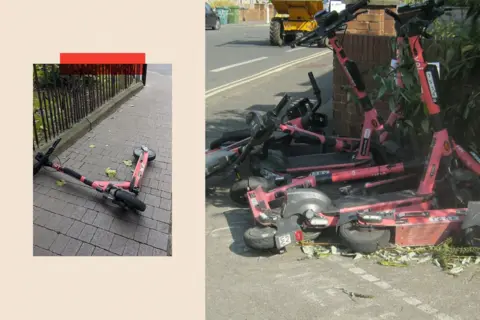 Oxford Pedestrian Association
Residents in Oxford have complained of e-scooters parked inconveniently on pavements
To an outsider, the situation in Oxford might seem like a classic local skirmish between angry residents and their council. In fact, it's a microcosm of battles happening across the country.
The biggest operator in the UK is the California-based Lime, with tens of thousands of e-bikes in London alone. In 2024, London's Brent Council threatened to remove their bikes over parking issues before an agreement was reached. Meanwhile in December, Islington Council told Lime and fellow operator Forest to improve parking or face losing permission to operate in the borough. Both companies said they were working with the council.
Council-approved e-bike and e-scooter schemes have been introduced in virtually every major British town and city over the last decade. For their users, they represent freedom and convenience; cutting journey times and carbon emissions. But for opponents they are an ugly, obstructive blight on Britain's urban landscape.
To soothe concerns about obstructed pavements, councils are now installing parking bays directly onto streets, permanently embedding the schemes into the architecture of cities. But deciding where those bays should go creates headaches. Painting them on pavements risks angering pedestrians (as Suchet's case shows). To avoid that backlash, several London boroughs have instead moved towards placing the bays on the road - an approach that comes with its own problems.
Now, Labour is introducing legislation that will give local officials more powers to regulate the schemes.
Is it possible, or even desirable, to crack down on e-bike and e-scooter parking? And what does the growing culture war over these schemes tell us about who feels listened to in modern Britain - and who feels shut out?
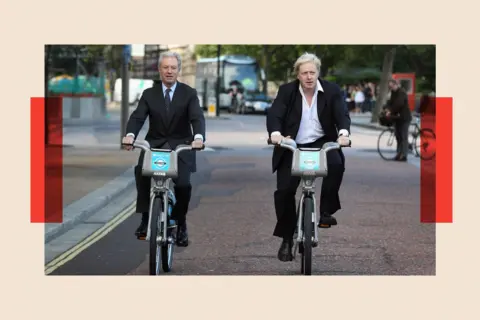
It was London's Barclays bicycles in 2010 that kickstarted Britain's craze for "micro-mobility" schemes, in which users can rent a lightweight vehicle for a short period. Nicknamed "Boris Bikes", after the city's mayor, they quickly spread around the country. More than 2.6 million Britons used a bike-share scheme in the year to September 2025, according to the transport charity CoMoUK.
But from about 2018 an important thing changed, says Richard Dilks, the charity's chief executive.
Until then, schemes like Barclays's were docked hire schemes - meaning you had to wheel the bike into a physical holster (and listen to it click into place) after your journey finished.
But after 2018, dockless schemes - where the bicycle or scooter could be left virtually anywhere - became more popular. This is what truly sparked the war over pavement space.
 Getty Images
London's shared-hire bicycles were nicknamed 'Boris Bikes' after the city's then-mayor Boris Johnson, who demonstrated them in 2010 with Barclays Chairman Marcus Agius
Liverpool, Edinburgh, Milton Keynes, Oxford, and Brighton are among the places that have introduced some form of dockless bike or scooter scheme since the 2010s, though many of those places have since imposed rules about where the vehicles can be left.
Matthew Lesh, who researched the topic for the Adam Smith Institute, a free market think tank, says that dockless schemes are "far more convenient for users, because you don't have to start and stop at specific points".
Dockless schemes can usually operate over large areas of cities, benefiting poorer and badly-connected neighbourhoods, says Lesh. In contrast, traditional docked schemes tend only to operate in city centres, he says, meaning they mostly help people who already have good transport links. London's docked Santander scheme mostly operates in zones one and two (in the city centre), whereas dockless schemes like Lime stretch all the way to zone five (in the outer fringes).
"It's a question of what kind of city do you want to be - a city that embraces innovative new technologies… or a relatively backwards, reactionary [city]?", Lesh says.
 Getty Images
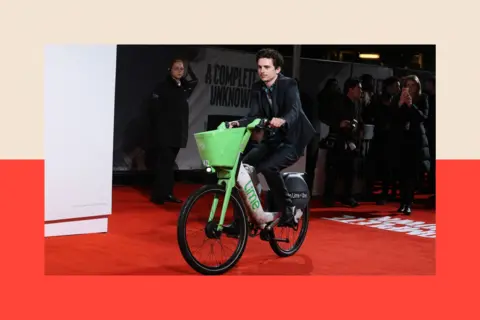
Lime e-bikes have become popular among young adults - including Timothée Chalamet, who cycled in on one for the premiere of his Bob Dylan biopic
Dockless schemes might also help the economy - something that Ant Breach, a director at the Centre for Cities, an economic think tank, says is explained by the "agglomeration" effect. The theory is that businesses perform better and workers get richer when they are based in big, dense cities, because of the concentration of knowledge. And the easier it is to get around a city, the richer it can become.
For agglomeration to work at its best, travelling within a city would ideally be frictionless - and Dilks says that dockless e-bike schemes promise "the ultimate flexibility".
But still, many residents balk at the sight of their pavement space being taken away.
Just one week after e-scooters were introduced to Newcastle in 2021, a councillor warned they were being "dumped all over the place". In Colchester, residents complained just last month about e-bikes being "abandon[ed]" on pavements, "with no consideration for others".
Sushila Dhall, a psychotherapist who has lived in Oxford for 42 years, broadly welcomes e-vehicles as a green form of transport - but she thinks they should be parked on roads, not pavements.
"You can walk through central Oxford any time and you'll find at least one pavement blocked by e-scooters," she says. "Even just one scooter… abandoned in the wrong place can block a route."
Under its deal with the council, it is the responsibility of Voi, the e-scooter operator, to clear up badly parked vehicles in Oxford. Voi told the BBC they are "working closely with the council and local groups to improve parking across the city" and that they ban riders for repeat bad parking incidents.
Oxfordshire County Council said that public hire e-scooters help to achieve "safer, cleaner, less congested and more accessible streets", adding: "We encourage riders to use the e-scooters responsibly."
Many authorities have responded to complaints by imposing tougher rules on where vehicles can be parked. In many cities riders are now asked to park their e-vehicle in a designated bay (with GPS trackers helping to ensure they do this).
But this doesn't always soothe concern. For one, the parking bays are sometimes painted on pavements, not roads - meaning pedestrian space is still lost (as happened in Doris Suchet's case in Oxford). Plus, riders don't always follow the rules. The GPS is not totally precise, meaning often riders can simply leave a bike or scooter near a parking bay without incurring a penalty.
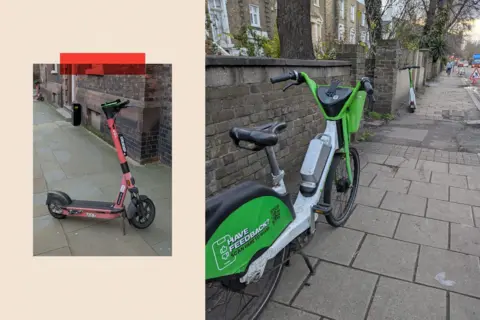
E-scooters and e-bikes blocking sections of pavements in Liverpool (left) and south London (right)
For David Spencer, a former Detective Chief Inspector at the Metropolitan Police, badly parked e-bikes are corrosive to our sense of fairness.
"It just has a negative impact on how we all feel about the state of our public realm," says Spencer, who is now head of crime and justice at the Policy Exchange think tank.
"You see [e-bikes] at specific street corners. It's almost like they breed - a couple of people park them, and then lots of people. [It] starts to take over," says Spencer.
And there's one group in particular who say they feel largely silenced.
I meet Erik Matthies at a busy street market in Lambeth, south London. It's a vibrant neighbourhood, popular with young people and tourists - but it's also said to be a hotspot for e-bike clutter. That's why we've come here today.
Matthies, who is registered blind and a policy lead at the Royal National Institute of Blind People, says e‑bike pavement clutter is the top transport complaint he hears from blind people.
"This has changed so much in only the last few years," Matthies says.
He shows me what he means. Walking away from an underground station, it's less than two minutes until we reach our first obstacle: a single e-scooter, parked in the middle of the pavement.
"It looks like someone left it there, hopped off to whatever they were doing and never thought about the scooter again," he tells me with an exasperated sigh.
After another few minutes of walking, we reach a street corner littered with e-bikes and e-scooters. It's a classic case of parking bay-sprawl: there's an official parking box painted on the road, but many of the vehicles have been left outside the boundary, meaning they block much of the pavement. Some are lopsided on the ground.
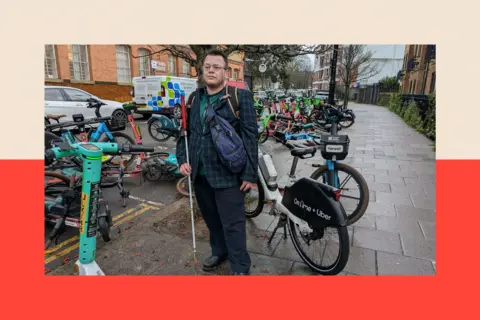
Erik Matthies, who is registered blind and relies on a white cane, shows the BBC a case of 'parking bay sprawl'
Matthies uses a white cane to guide him over the ground and along walls, but he says that becomes near-impossible when the path is obstructed. "The way we're trained to use white canes means that I would come up to this junction, expecting the corner, curb, everything to [feel] a certain way, in a certain position. But I can't access any of that - it's covered with bikes and scooters."
Lambeth Council told us it is "unacceptable" for e-bikes to block walkways for disabled and elderly people, or parents pushing buggies. They say they are rolling out dedicated parking bays across the borough and telling riders they have to park within them. Lime, the US company that operates most of the bikes we came across, says they will usually remove a badly-parked bike within a few hours of it being reported to them. Riders who flout rules are warned and sometimes fined, they say, with repeat offenders banned.
Even most of those campaigners who enthusiastically support the roll-out of e-bikes say that the experience of disabled people like Matthies needs addressing. Dilks of CoMoUK says there is "no excuse" for e-bikes to block pavements, and says some rules are needed.
One option is to beef up the powers of local officials.
The Labour government is trying to do that via its English Devolution Bill, which is at committee stage in the House of Lords.
Currently, councils regulate these e-bike and e-scooter schemes (meaning rules can vary considerably over small areas). Labour's measure will shift that power to metro mayors, who cover larger areas. In London, decisions currently made by boroughs like Camden or Wandsworth would instead fall under the city mayor, Sadiq Khan.
The Department for Transport says the measure will give mayors "greater flexibility to shape schemes around their needs and tackle badly parked cycles quickly and decisively". The Bill will also give officials the power to fine e-bike companies that break licence conditions, they added.
Breach, of Centre for Cities, hopes it will allow mayors to impose sensible, consistent rules across cities, helping both riders and pedestrians.
But Dilks says it "remains to be seen" whether the measure will actually reduce parking clutter, "the original problem it's trying to solve".
He argues that whilst metro mayors will get the powers to set city-wide e-bike strategies, it will still be up to individual councils to actually build the necessary infrastructure. So, theoretically, a mayor like Khan or Andy Burnham could tell councils they want to see a new network of on-street parking bays - but if councils drag their feet, or say they can't afford it, there's a risk that little will happen, he says.
Another option is to convert council-run car parking into space for e-bikes and e-scooters.
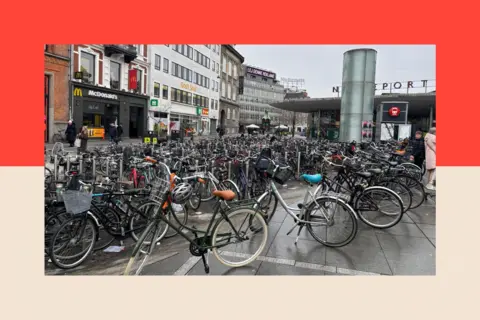
This could be called the Copenhagen model. Since the 1970s, Danish planners have converted thousands of car park-spaces in the city into bicycle park-spaces. Copenhagen has now become renowned for its supersize bicycle parks, where thousands of personally-owned bikes and dockless e-bikes are clustered together.
Tristan Fender admits it was a "culture shock" when he moved to the city from Germany last year. He commutes to his job at a Copenhagen newspaper via bicycle, and says it can sometimes be difficult just to find a bike amid the mess of metal and rubber.
 Tristan Fender
Copenhagen has become famous for its bicycle parking
"It gets crazy. You'll leave your bike, come back and there's a person who's parked right next to you, and their pedal is stuck in your wheel. Or you try to pull out your bike and knock over the one next to you," says Fender.
But any attempt to mess with roads or car parks comes loaded with risk. English councils made £2.16bn from car parking in 2024-25, according to the RAC Foundation. That amount will be hard to recoup from e-vehicle schemes, says Dilks. There's also the politics: drivers are a loud, powerful voting bloc, and they "get uppity" when they see parking space taken away, he says.
Most analysts think that e-bike and e-scooter schemes are here to stay - and local skirmishes over how they are parked may simply become a fact of life.
Breach wants to see e-bike schemes that are widely available - but also for rule-breaking users to face consequences. "A balance has to be struck," he says.
Technology might also ease the problem: more precise GPS tracking could make it easier to tell when an e-bike is parked inside or outside of a parking bay.
Lesh takes a longer view, pointing out that virtually every advance in transport technology has come with controversy. "When it came to the emergence of bicycles in the 19th Century, you saw all this discussion in the Times of London about how bicycles are menaces to society, going too quickly, causing far too much danger," he says.
"Over time, we get used to it."
Top image credit: InPictures / Getty Images

BBC InDepth is the home on the website and app for the best analysis, with fresh perspectives that challenge assumptions and deep reporting on the biggest issues of the day. Emma Barnett and John Simpson bring their pick of the most thought-provoking deep reads and analysis, every Saturday. Sign up for the newsletter here