1 month ago
52
1 month ago
52

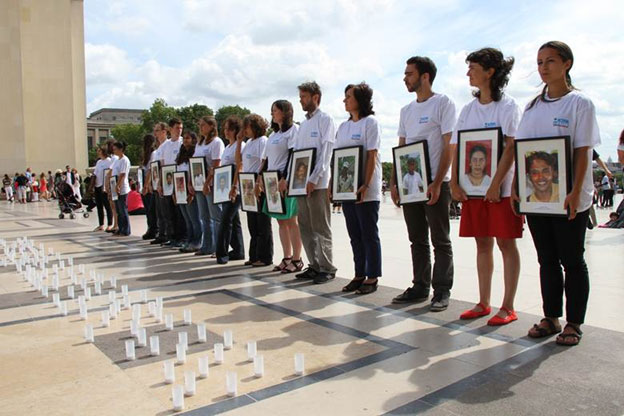 Action Against Hunger holds a commemoration event for the 17 staff members killed in Muttur, Sri Lanka on August 4th, 2006. Credit: Action Against Hunger
NAIROBI, Kenya, August 7 (IPS) - This summer, an ambush on a marked humanitarian convoy in Duk County, South Sudan, left 17 dead and five injured. While the UN called for an immediate investigation, history suggests the victims’ families will wait indefinitely for answers.
We suspended field movements in the area pending a security review, which means communities already facing crisis levels of hunger lost access to life-saving assistance, at least temporarily.
The emblem on a vehicle or a vest once offered protection: a shared understanding, codified in international law, that those delivering food, water, medical care and other basic relief would not be targets of violence. That understanding is breaking down.
In the past three years, more than 1,000 humanitarian workers have been killed, most notably in Gaza, Sudan, South Sudan, and the Democratic Republic of Congo. Worryingly, 2024 was the worst year on record with 383 aid workers killed worldwide. That’s more than one each day.
This year, the recent ambush brought the toll to 29 in South Sudan alone — and it is only August. Roughly 90% of those attacked are local and national staff, the people furthest from headlines and closest to the danger.
Twenty years ago this month, seventeen of our colleagues were executed in our office in Muttur, Sri Lanka, wearing shirts that clearly identified them as humanitarian aid workers. It remains one of the deadliest attacks of its kind. Two decades later, despite evidence pointing to the likely responsibility of state security forces, no one has been held accountable. We are still calling for a new, independent investigation.
 Rotimy Djossaya, Chief Impact Officer for Action Against Hunger
My organization operates in more than 55 countries and is made up of nearly 9,000 people, most of them locals from the communities we serve. When I ask them to travel a road in Jonglei State or run a nutrition site in Sudan, I am asking them to accept a risk that many people in the world would refuse. Donors, governments, and agencies like mine share a duty to reduce that risk so that every humanitarian worker comes home at the end of the day.
There is a framework for addressing this. In 2024, the UN Security Council passed Resolution 2730, which calls on States to respect and protect United Nations and humanitarian personnel in accordance with their obligations under international law. Last year saw the introduction of the Declaration for the Protection of Humanitarian Personnel, a commitment to uphold international humanitarian law, prevent attacks, and pursue accountability. Over 110 countries have signed on, from every region and political tradition. While the issue still generates broad agreement, it is increasingly polarized, and the declaration’s enforcement is weak.
When a marked humanitarian vehicle is attacked with impunity, the international laws designed to protect humanity become nothing more than abstract targets.
The recent cuts to international aid budgets make a challenging situation even harder. Although it’s not clear that recent funding cuts led directly to any violence, it’s evident that NGOs have far less money to spend on security response management. The 2025 Aid Worker Security Report documented what the funding collapse means for safety: organizations are cutting security positions, communications, and risk analysis, with the danger falling overwhelmingly on local organizations.
In principle, localization is smart, and the humanitarian reset is a chance to build a system that is locally led, globally supported, and more efficient. But it only works if resources move with the risk. Local NGOs are routinely excluded from security funding, training, and data-sharing. They are expected to work in the world’s most dangerous places without the protections international agencies take for granted. They face a difficult choice: abandon some of the people and places they serve or accept greater risk to the safety of their staff.
The aid workers this summer were traveling in a marked humanitarian convoy. Five of them were staff of our local partner, the John Dau Foundation, an organization founded by one of the “lost boys” of South Sudan, who fled unimaginable violence as a child and answered it by building clinics and feeding children in the very county where this attack took place. That people who devoted their lives to healing were met with this violence shows how badly protections for humanitarian workers have eroded. The markings on their vehicle were supposed to shield them, but they did not.
As we mark World Humanitarian Day on August 19 and approach the UN General Assembly in September, the global community and member states must act. They must mandate and fund security allocations directly for local partners, insist on independent investigations for harmed personnel, and enforce UN Security Council Resolution 2730. Commitments on paper only protect lives when perpetrators face consequences. Those who step into the crossfire to feed the world’s forgotten children should not have to pay for that humanity with their lives.
Together, let’s honor those who have served, stand with those who continue to serve, and act for humanity.
Rotimy Djossaya is, Chief Impact Officer at Action Against Hunger.
IPS UN Bureau
© Inter Press Service (20260807051654) — All Rights Reserved. Original source: Inter Press Service