7 months ago
51
7 months ago
51

Rumeana JahangirNorth West

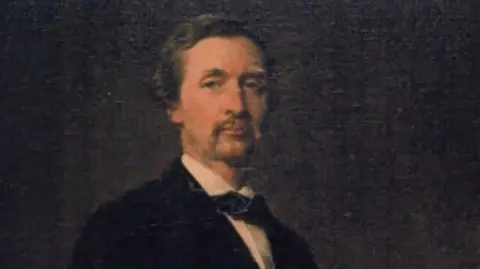 The Stanley Family
Lord Henry Stanley, who owned land in Cheshire and Anglesey, became a Muslim in 1859
It's nearly 200 years since the birth of a British aristocrat who became the first Muslim member of the House of Lords.
But few have heard of Lord Henry Stanley, who "defied convention and his family's wishes" when he converted to Islam in 1859, according to historian Jamie Gilham.
Little remains of Stanley's letters and diaries "which is really frustrating but adds to the idea that he was a private man," he said.
Since medieval times, a relatively small number of Brits had become Muslims while travelling abroad.
But Gilham said Stanley was notable as he had influence politically and on his lands in Cheshire and Anglesey.
Born in 1827, Stanley was the eldest of 10 children given free rein to develop their own thoughts and beliefs.
The wider family, whose aristocratic ancestors can be traced to Norman times, had members belonging to various Christian denominations and at least one who was Jewish during Victorian times.
Family historian Lady Carla Stanley, who is married to the current Lord Stanley, said they were "free thinking" and born to educated, well-travelled mothers.
"They were people who did things," she added. "It was acceptable to be argumentative.
"Thinking, debate, discussions were OK as opposed to a 'get off my land, I'm going shooting' attitude."
 EPA
EPA
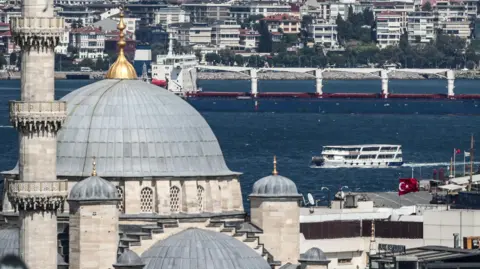
Lord Stanley worked for the British diplomatic service in Istanbul (above) and Eastern Europe
Like many educated Victorians, Stanley was dazzled as a child by travelogues and the Arabian Nights tales.
He also had a hearing impairment which affected his schooling, and he left Eton after one year to study with a private tutor.
Gilham said Stanley's father, who was an MP, and his mother - who helped establish the first women's college at Cambridge University - had "great expectations for their first-born".
However his struggles with hearing meant "his family worried greatly about his future prospects".
"He only really started to shine when he went to Cambridge and learned Arabic," Gilham added.
Within a year, the 20-year-old was employed as an assistant to the then Foreign Secretary, Lord Palmerston in 1847.
 Geograph/G Laird
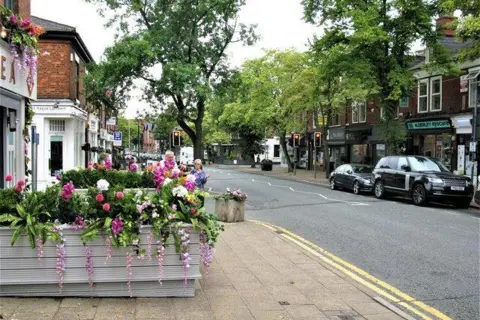
Lord Stanley famously closed some pubs in Alderley Edge, Cheshire, now a village popular with footballers
Over the following decade, Stanley worked for the diplomatic service, with postings in the Turkish-based Ottoman Empire, as well as Greece and Bulgaria.
"Stanley came to appreciate the social and the spiritual benefits Islam provided the Ottomans," Gilham said.
It was also a time when various European empires were reaching their peak yet faced republican or nationalistic revolts.
"From letters, we see that Stanley experienced both political and spiritual crises," Gilham added.
"He didn't lose faith in God but he certainly had theological doubts. He did question the literal accuracy of the Bible, for example, and the letters between his parents show that he didn't go to church for the first time in his life.
"Unusually for Britain in the mid-Victorian period, Stanley did gravitate towards Islam - the religion of the Ottoman Turks - and symbolically at that time, around 1849-50, he gave up wine."
 Geograph/Peter Worrell
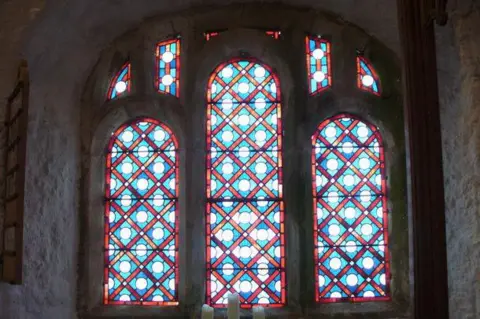
Lord Stanley paid for geometric church windows in Anglesey, including at St Patrick's (above) - also known as Eglwys Llanbadrig
Disillusioned with Britain's expanding imperialism, Stanley quit the diplomatic service in 1858 and decided to become a Muslim some months later while travelling in Arabia.
"There's little account of his religious conversion and beliefs," Gilham said. "It's just things that you can read in some of the family letters."
Press reports of Stanley's conversion emerged in Sri Lanka on his visit there in 1859, before news travelled back home to Cheshire - where it was reported in the local Macclesfield Courier and then the national outlets in London.
Some reported that he made a pilgrimage to Islam's holiest site in Mecca and adopted the name Abdul Rahman - Arabic for "servant of the merciful Lord" - although evidence is unclear, Gilham added.
"Letters show his parents were absolutely furious and equally embarrassed and humiliated that their son would convert to Islam from Christianity.
"His father said to his mother, 'Is he mad? What can he possibly mean by parading himself in our colonies and our possessions in the degrading position he occupies?'
"His mother replied to his father that the newspaper report in the Macclesfield Courier 'made me feel sick'."
They later issued a public denial that their son had converted to Islam however Stanley wrote to one of his brothers that "I have always been a Mussulman [Muslim] at heart".
In 1862, he married a Spanish Catholic lady in Algeria under Islamic law, but kept their relationship secret until his father's death seven years later.
It emerged his wife was already legally married to a Spanish man at the time of their wedding, although it's unclear if Stanley was aware of this, Gilham said.
The couple registered their marriage under English law after he became the third Lord Stanley of Alderley and second Baron Eddisbury on his father's death in 1869.
"The Spanish husband was still alive until 1870 so again, the marriage wasn't actually valid.
"But it was eventually made valid when they remarried in 1874 and that was a Roman Catholic ceremony, which kind of raised eyebrows," Gilham explained.
"I think he was respecting the religion of his partner, his wife."
After inheriting his father's lands and titles, he took his place as a non-partisan crossbench peer in the House of Lords in 1869 and became its first Muslim member.
"I don't know how many of his peers would have known that he was a Muslim," Gilham said.
"I guess they would have because they read the newspapers and knew he was involved in Orientalist societies."
Lord Stanley inherited lands in north Cheshire, including the village of Alderley Edge - better known as an affluent area near Manchester that's popular with Premier League footballers.
"Famously or infamously, he did close some of the public houses on the Alderley Park estate," Gilham added.
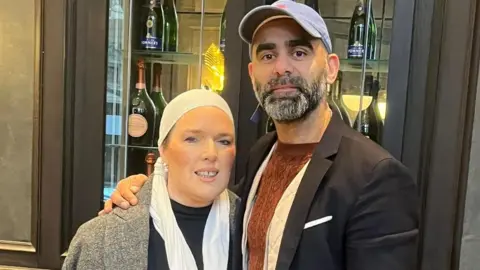
Eve Hawwa Iqbal-Khokhar (seen with her husband) said discovering about Lord Henry Stanley was "exciting"
Following the death of an uncle in 1884, Lord Stanley inherited the Penrhos estate in Anglesey, north Wales, where he contributed to the upkeep of local churches.
He also paid for windows with geometric designs rather than traditional figurative scenes, in line with Islamic rulings against the drawings of creatures.
"As a Muslim, Stanley respected Christianity as a sister faith of Islam - of its shared Abrahamic roots," Gilham said.
Eve Hawwa Iqbal-Khokhar, an English woman who converted to Islam and volunteers in the Manchester Muslim community, said she "felt compelled to visit" the churches after finding out about Lord Stanley's life just before a family holiday to Anglesey.
"History really excites me and learning about the first converts to Islam in Victorian Britain is so exciting - especially a local aristocrat of Lord Stanley's standing."
She described the churches' designs as a "visual feast", adding they form part of "a rich tapestry of our past".
 The Stanley Family
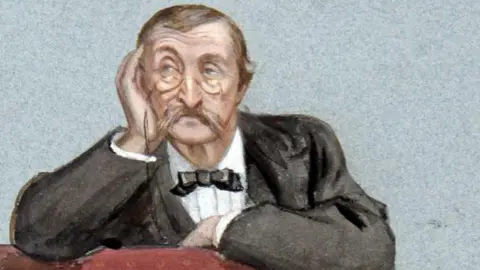
A magazine caricature of Lord Stanley, whose hearing declined with age, at the House of Lords
However as a supporter of the political union of the UK nations, Lord Stanley disapproved of teaching Welsh in local schools.
"He really respected language," Gilham said. "But I guess in this case it was about the union and the union was more important to him."
He described Lord Stanley as someone who "didn't believe in the extension of empire", adding: "He believed in the consolidation of the empire as it was.
"And so he spoke out in the Lords about preserving the empire, but also about looking after its people.
"He was a conservative man but also a Victorian. He did defy convention in many respects - and a crucial respect in terms of religion - but in other ways he didn't."
Lord Stanley died at the age of 76 during the Islamic holy month of Ramadan in 1903 and was buried in unconsecrated ground on his Alderley estate, in a service led by an imam from the Ottoman Embassy in London.
"In some respects he was ahead of his time and he is starting slowly to be recognised and reclaimed to some extent," said Gilham.
"He was not showy and maybe that was to the detriment of his legacy but I hope people will start to recognise him a little more than maybe he has been so far."