
 3 months ago
59
3 months ago
59

3 hours ago
Katharine Da CostaBBC South Investigations

 Family handout
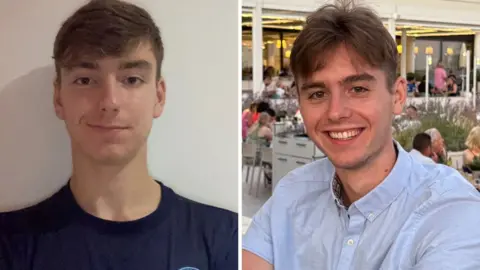
Adam Ankers, 17, and Matthew Dunning, 20, both died after suffering a sudden cardiac arrest
Seventeen-year-old Adam Ankers and 20-year-old Matthew Dunning were both keen footballers, fit, healthy and in the prime of their lives.
They did not know each other but they have one thing in common - they are among 600 young people under 35 who die from sudden cardiac arrest every year in the UK due to undiagnosed heart conditions. That is about two people every day.
Their bereaved parents, who are from Buckinghamshire and Hampshire, are supporting the charity Cardiac Risk in the Young (CRY) with its campaign for more funding for research and for the introduction of a national cardiac screening programme for all over-14s.
In Adam's case, his parents say there were a number of missed chances that could have saved his life.
He had played for Risborough Rangers in Buckinghamshire from a young age before joining Wycombe Wanderers under-19s foundation team whilst studying a BTEC diploma in sport at Henley College.
 Getty Images
Matt Bloomfield, who was Wycombe Wanderers' manager when Adam died, previously said he was "deeply shocked" by what happened
On 31 January 2024, Adam collapsed during the second half of a match complaining of chest pains.
"When they [paramedics] got to Adam's side he was cold, blue but the defibrillator was open out of the box next to him but not connected and had they connected it, it would have delivered a shock and told them to carry on CPR, so the device that could have saved him was there but it wasn't used," says Adam's dad, Alastair.
Adam died in hospital on 4 February that year after it was found he had suffered unsurvivable brain damage.
His inquest earlier this year heard that neither the coaches nor the 999 call handler recognised his irregular, shallow breathing was a sign of cardiac arrest.
It appears there had been confusion over whether the defibrillator could be used safely on a teenager, which it could.
The coroner ruled a failure to spot Adam was suffering from cardiac arrest "more than minimally" contributed to his death.
"He shouldn't be dead," says Alastair.
"He was failed by the system... and none of the experts in the inquest are convinced that this won't happen again...the NHS has known for the last 10 years that the call handling system only picks up 75% of cardiac arrests that are phoned in," he says.
The Football Association (FA) had argued at the inquest that making training obligatory could exclude children from refereeing but it says it was reviewing the coroner's findings and recommendations.
South Central Ambulance Service says changes have now been made at a national level so that a patient who has collapsed whilst taking part in sport will be triaged as a potential cardiac arrest and basic life support instructions will be provided, including the use of a defibrillator where one is available.
 Alastair Ankers
Adam represented Aylesbury and Buckinghamshire in athletics competitions
In a cruel twist of fate, the family only discovered after Adam's death that a distant family relative had been diagnosed with a genetic heart condition in 2018 but the wider family were not aware of the diagnosis.
Had that information been shared, Adam's parents say he could have been tested, whereupon he would have been diagnosed with the same genetic condition and measures put in place to reduce his risk.
Adam's mum, Naomi Wakefield, thinks there needs to be a joined up approach to saving young lives from sudden cardiac arrest: "We're losing 12 to 13 children or young people a week, it's a large number of people, it needs...everybody involved.
"The more we train, the more people are aware of the situation happening up and down the country then we can all work together."
What are the symptoms of a cardiac arrest?
A cardiac arrest is an emergency that usually happens without warning. If someone is in cardiac arrest, they collapse suddenly and:
Two hours away in Ringwood, Hampshire, Marie and Simon Dunning are grieving for their son Matthew who died suddenly and unexpectedly in September 2025.
Eight months on and they are no closer to understanding what caused his fatal cardiac arrest.
Like Adam, Matthew had been very sporty and regularly played football and golf.
His parents said he was 'loving life' at the University of Surrey where he was studying physics with astrophysics.
Then, out of the blue one Wednesday morning, Matthew collapsed and died in his bedroom at his student accommodation.
"They call it the invisible killer," says Simon.
"Lots of people are in the same situation as us, their son or daughter won't present at all and then literally they will die in their sleep."
Marie adds: "We just didn't know it existed, because we can't understand how you can have such a healthy 20-year-old boy there and then not."
Mathew's parents say experts found nothing structurally wrong with his heart and no inherited genetic condition.
Three years earlier in 2022, Matthew had undergone a number of tests at Salisbury hospital in Wiltshire after he passed out during a tag-rugby match at school.
He was fitted with a loop recorder to monitor his heart but his parents say there had been no episodes since then and they were told he was in perfect health.
Marie says: "I joked with him I couldn't keep up with him because he was that active and fit and I just don't understand why he's been cheated really because he should be here."
 Simon Dunning
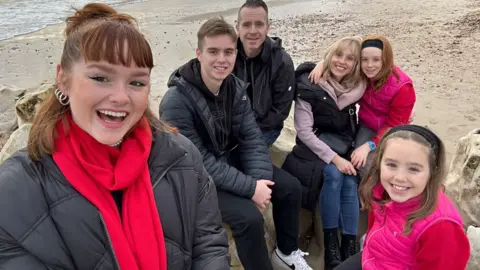
Matthew had a twin sister, Sophie, and two younger sisters, Holly and Charlotte
The UK National Screening Committee is currently reviewing whether all over-14s should be screened for conditions associated with sudden cardiac death.
A public consultation is due to be held this spring although no date has yet been confirmed.
In 2019, the committee did not recommend national screening citing that testing might not be accurate for people without symptoms.
The charity, CRY, believes proactive screening is vitality important.
"Research shows that one-in-300 people who have their hearts tested through CRY's national screening programme will be picked up with a "hidden condition that could prove to be fatal if left untreated or unmonitored," says Chief Executive Dr Steven Cox.
He adds: "Once a young person is aware they have a cardiac condition and an increased risk of sudden cardiac arrest, then treatments (including medications or surgical procedures such as cardiac ablation and lifestyle modifications) are quite simply, lifesaving."
He says it is essential to be aware of any heart issues and inherited conditions so that other family members can be tested to find out if they are also at risk.
The Department of Health and Social Care says government screening policy is guided by expert scientific advice.


