4 months ago
50
4 months ago
50

SYDNEY, May 12 (IPS) - The Republic of Korea (Korea), Vietnam and Bangladesh are on three different rungs of the development ladder. While Korea is a member of the rich nations’ club, i.e., the Organisation for Economic Cooperation and Development (OECD), Bangladesh is still a least developed country (LDC); and Vietnam is in the middle.
 Anis Chowdhury
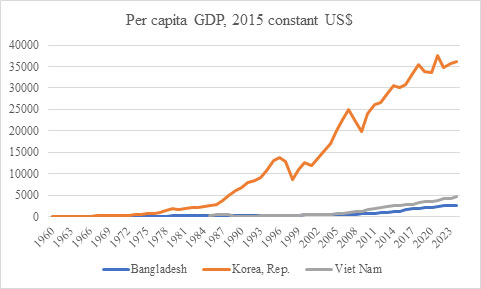
However, their initial conditions had significant similarities – they all emerged from devastating wars, and were at the bottom of the development ladder until the late 1960s. They were among the world’s poorest countries struggling to feed a large population, rapidly growing, exceeding 2.5% per annum with per capita GDP less than US$300 in the early 1970s while facing the challenges of reconstruction and rebuilding. Thus, they had to depend heavily on foreign aid.
But relative policy independence vis-à-vis donors, among other factors, played a crucial role in separating their development trajectory. Development succeeded in countries that maintained policy independence despite their heavy aid dependence.
Aid dependence and policy independence
Being among the world’s poorest countries, all three had to depend heavily on foreign aid. For example, foreign aid financed around 74% of Korea’s imports on average during 1953-1960, and proceeds from the sales of aid goods (e.g., food aid under the PL480 programme of the US, packaged as “Food for Peace”) constituted on average 38.4% of government revenue.
US aid to Korea was “huge”, contributing about 80% of foreign aid during 1945-1975. Korea received nearly as much economic aid from the US as ALL of Africa during 1946-1978. Excluding military aid, the US economic at its peak was 21% of Korea’s GDP, and financed about 50% of government expenditure.
 Source: The World Bank
Yet, the Korean government maintained considerable policy independence regarding the use of aid funds. While the US aid agency insisted on providing non-project assistance for macroeconomic stabilisation rather than growth, the Korean government used non-project aid to rebuild the manufacturing sector for accelerating growth, and demanded more project assistance. The policy conflict was negotiated and coordinated by the Combined Economic Board (CEB, established in 1952). Although CEB was jointly chaired by the representatives of the US aid mission in Korea and the Korean government, Korea prevailed.
The Korean government also maintained its policy independence from the World Bank (WB). For example, when in 1967 the WB rejected Korea’s funding request for the Seoul-Busan expressway, connecting the nation’s capital to its main sea-port, Korea completed the 428km expressway with domestic finance and resources in 1970 as other multilateral and bilateral donors also refused to finance it following the WB’s rejection.
The WB and donors believed the expressway was an excessively grandiose project for a country so poor. Proving them wrong, the expressway not only spurred economic activities along the corridor of two major population centres, its construction was a critical learning opportunity for the Koreans. With the gained capacity, Korean construction companies were able to win major infrastructure projects in the Middle-East, which was a critical source of foreign exchange. Korea is now regarded as a leader in infrastructure construction.
The WB also was very critical of Korea’s Heavy and Chemical Industry (HCI) drive (1973-1979). Ignoring the WB, Korea pushed ahead, and proved the WB and other critics wrong. By the early 1980s, HCI became the nation’s leading export industries. The HCI drive was greatly successful in boosting investment, leading to the rapid growth of the manufacturing sector and its structure change. The manufacturing sector grew 16.2% per annum from 1971 to 1980, much higher than the GDP growth of 9.1% during the same period, while the share of HCIs in manufacturing value added rose to 58.3% in 1980.
No wonder, Korea broke away from the poverty trap in the early 1970s, leaving its “poor cousins” – Bangladesh and Vietnam – behind to become a full member of the OECD in little over two decades in 1996.
Vietnam’s story is not so different from that of Korea. Since initiating reforms in 1986, Vietnam quickly became WB’s one of the top loan recipient countries. But the WB’s influence over Vietnam’s development path has been limited, as the government has always refused to adopt policies imposed by foreign organisations. With strong enough institutions Vietnam achieved “ownership” of public policies.
Here is an interesting story of Vietnam’s determination to pursue its own development strategies. When in 1997, the WB approached Vietnam with an offer of US$300 million in credit in exchange for structural adjustment, à la the Washington Consensus model, including faster privatisation and financial liberalisation, the Vietnamese government declined. The WB returned with a higher offer in 1998, and Vietnam declined again. When the WB came again in 1999 with an even higher offer, the government issued a stern rebuke. The minister of planning and investment, Tran Xua Gia, told WB representatives, “You cannot buy reforms with money . . . no one is going to bombard Vietnam into acting.”
By then the Vietnamese government knew from the experience of Indonesia the risks of yielding too much sovereignty to international markets and institutions. The International Monetary Fund (IMF) had to wind up its last programme in 2004 as Vietnam refused the IMF’s demand for an independent audit of its central bank and disagreed over privatisations of state-owned enterprises.
Vietnam charted its own path of reforms – Đổi Mới, learning from successes and failures of neighbouring East Asian countries, including China as well as its former patron and role model, former Soviet Union.
Vietnam posted remarkable macroeconomic performances following the launch of Đổi Mới, with GDP growing at close to 8% per annum. Since the beginning of the 2000s, it also recorded Asia’s highest rate of growth in exports, half of which were made up of manufactured products, prompting The Economist to hail Vietnam as “Asia’s other miracle”.
Starting in 1975 with a per capita GDP of about US$85 after successfully defeating the US that waged a devastating war on Vietnam for more than two decades, Vietnam became a lower middle-income country in 2009. “Desperately seeking model countries”, unsurprisingly the first country Robert Zoellick visited after becoming President of the WB in 2009 was Vietnam, a country governed by its Communist Party, constructing a ‘socialist-oriented market economy’. One could almost say, “Vietnam is more important for the WB than the WB is for Vietnam”!
Poor Bangladesh lacks self confidence
Bangladesh, in search of development, joined the club of LDCs in 1975 when its GDP per capita was US$230, and still remains a LDC after more than five decades maximising LDC related facilities. Bangladesh is scheduled to graduate out of the LDC category in November this year; but it is asking for a deferment, lacking self-confidence.
On the other hand, self-confident Vietnam with its per capita GDP of only US$82 in 1975 decided not to join the LDC club, despite having to face the challenges of reconstruction and reunification in the most difficult global economic situation – stagflation. It received aid (mostly from the former Soviet Union); but did not blindly follow either its former patron USSR’s reform package or that of the WB/IMF. Its former enemy, the US, which pressured the WB to halt all funding, made a U-turn in the early 1990s, and signed the US-Vietnam Bilateral Trade Agreement in 2000.
Korea could have also joined the LDC club in 1971 when the UN created the LDC category for the world’s poorest countries; but it did not. Heavily dependent on US foreign aid for food, fuel and other raw materials, Korea was not seen as a promising place for major investments until the late 1960s. So, the State took the lead to break the vicious circle of low income and low investment.
Of course, Bangladesh is no longer a “basket case”; it is now a lower middle-income country. It also showed some courage to stand on its own feet when the WB declined to finance the Padma Bridge project, citing corruption.
However, Bangladesh could have done better had it not surrendered its policy independence to the donors, as the experiences of RoK and Vietnam demonstrate. Like successful marriages, there are many factors for successful development. Failure in any one of those essential elements can be damning according to Leo Tolstoy’s Anna Karenina principle, even if it has all the other ingredients of success.
Anis Chowdhury, Emeritus Professor, Western Sydney University (Australia). He held senior UN positions in Bangkok and New York and served as Special Assistant to the Chief Advisor for Finance (with the status and rank of State Minister) in the Professor Yunus-led Interim Government. Anis has written extensively on East and Southeast Asian economies, including The Newly Industrialising Economies of East Asia (Routledge) and The Political Economy of East Asia (Oxford University Press). E-mail: [email protected]
IPS UN Bureau
© Inter Press Service (20260512121255) — All Rights Reserved. Original source: Inter Press Service