7 months ago
57
7 months ago
57

Bethany BellGermany reporter

 Gelsenkirchen police
This hole in the wall was created by an enormous drill on 27 December 2025
It has been described as Germany's most "spectacular" bank heist in years.
On a quiet weekend just after Christmas, a group of thieves broke into a High Street bank in the western town of Gelsenkirchen, by boring through a wall with an industrial drill.
They looted more than 3,000 safe deposit boxes and made off with millions of euros.
Over a month later, police have yet to make an arrest.
For the bank's clients, some of whom say they have lost their life savings and precious family jewellery and valuables, this is a time of anger, confusion and shock.
There is a strong sense that trust in institutions has been shaken.
The case has thrown up all sorts of difficult questions, and some of them have been spelled out by Herbert Reul, the interior minister in the western state of North Rhine-Westphalia.
Why did no-one notice what was going on? Was it an insider job?
Why did no-one hear the drill and how did the thieves know exactly where the vault was?
Were the bank's security systems too weak?
Police in Gelsenkirchen are appealing for witnesses to come forward.
 Reuters
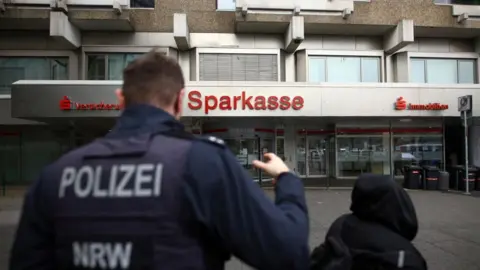
Police believe the thieves entered the building through a neighbouring car park
Investigators believe the thieves probably broke into the Sparkasse savings bank in Nienhofstrasse through the next-door multi-storey car park in the town's Buer district.
The thieves may have tampered with an escape door between the car park and the bank, they believe.
Under normal circumstances the door could not be opened from the outside, but the gang managed to make sure it no longer closed properly, allowing them "unhindered access from the car park to the Sparkasse building".
From there, police believe they overcame several security systems and made their way into an archive room next to the vault, in the bank's basement.
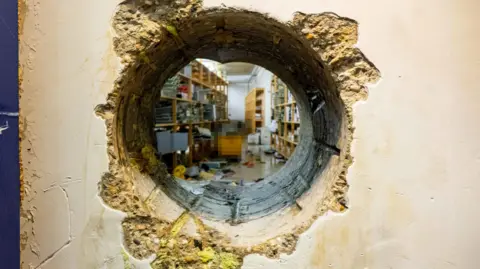
They set up the drill and bored a hole 40cm (15.7in) wide in the wall leading to the strongroom, where the safe deposit boxes were kept.
 Gelsenkirchen Police
A view of the vault and the drilled hole as seen from the other side of the bank wall
The heist must have taken place some time between Saturday 27 and Monday 29 December, according to officials, who think the burglars may almost have been caught shortly before reaching the vault.
Just after 06:00 on 27 December, the fire brigade in Gelsenkirchen and a private security firm received a fire alarm warning from the bank, which may have been triggered by the thieves.
Police and 20 firefighters arrived at the bank at 06:15, "but could not find anything that indicated damage", police said in a statement.
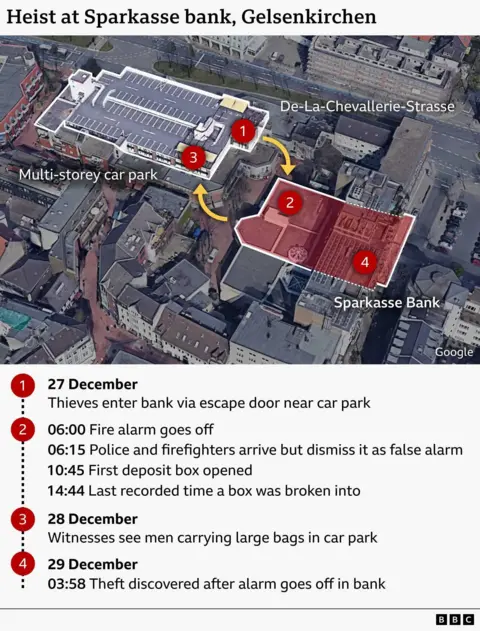
The fire alarm had come from the vault, Herbert Reul revealed.
But firefighters could not get in because it was locked with a roll shutter. Reul said they saw "no smoke, no smell of fire, or damage", so they "concluded it was a false alarm", which he said was not unusual.
He told a state parliament committee the police did not have the right to search the bank at the time, as it was a matter for the fire brigade. They would have needed a warrant.
Once inside the vault, the thieves opened almost all the 3,250 safe deposit boxes, taking cash, gold and jewellery.
Reul said that computer systems in the bank show that the first box was broken into at 10:45 on 27 December and the last at 14:44. It is not clear whether they managed to open most of the boxes in four hours or if the technology stopped recording data.
Witnesses later told police they saw several men in the stairwell of the car park carrying big bags during the night into 28 December.
Authorities say they do not know exactly how much was taken, but German media estimate the thieves must have got away with up to €100 million (£87m).
 Gelsenkirchen Police
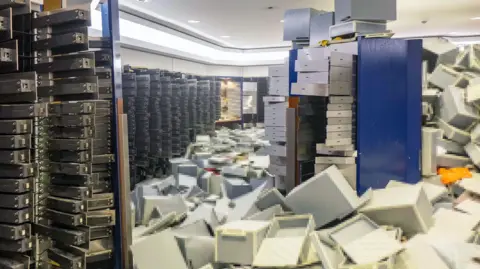
Police have released images of the mess left behind inside the vault on 29 December
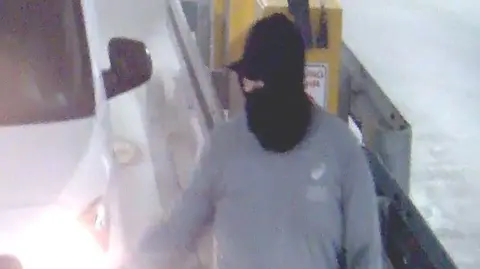
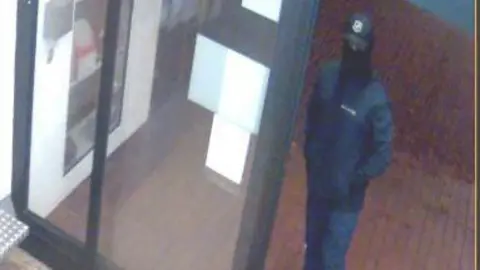
Police subsequently released photos and video footage from the car park's security cameras, which showed men with their faces covered, and two cars, a black Audi RS 6 and a white Mercedes Citan. Both had fake licence plates.
The theft was not discovered until 29 December when another fire alarm went off at 03:58 on the Monday – and firefighters returned to the bank to find a scene of chaos.
 Gelsenkirchen police
CCTV pictures from 29 December show three masked men with two vehicles
Herbert Reul said it looked like "a rubbish dump", with more than 500,000 items strewn across the floor - the contents of the safe deposit boxes that the thieves had left behind.
Police said many items were damaged after the thieves threw water and chemicals on them. They have since been painstakingly sorting through the debris, searching for clues and trying to establish what belongs to whom.
As details of the heist emerged, about 200 clients gathered outside the Sparkasse, demanding to be let in. Police arrived with several patrol cars and secured the entrance.
Joachim Alfred Wagner, 63, said he had lost not only gold worth tens of thousands of euros, but also jewellery that belonged to his father and grandparents.
He had rented the safe deposit box after several break-ins at his apartment, thinking that his valuables would be safe there. "I cried with rage," he said.
 Gelsenkirchen police
Another of the thieves is pictured by CCTV in the car park
The bank has said the contents of security boxes are generally insured for €10,300 each.
Wagner is one of the first people to file a lawsuit against the bank, suing for damages for what his lawyer, Daniel Kuhlmann, has called lax security. Another had deposited €400,000 in cash from the sale of a flat which had been meant for their retirement.
The bank has said it was itself a victim of the crime and that its premises were "secured in accordance with recognised state-of-the-art technology".
While some clients had official receipts for the contents of their safe deposit boxes, others do not.
"Even the Sparkasse doesn't know what is in [the boxes] because each person can put whatever they want into them," Herbert Reul said.
He stressed that the psychological damage shouldn't be underestimated.
"We need to help the victims," he said. "For many, this is more than just the loss of property, this can also impact their trust in their own sense of security and... their trust in our order," he said.
Police Chief Tim Frommeyer said they were dealing with "one of the biggest criminal cases in the history of the state of North Rhine-Westphalia".
"My department and all of its employees are aware of the magnitude of this case. The financial damage, uncertainty, and frustration run deep!"
Shortly after the theft was discovered, Germany's far-right Alternative for Germany (AfD) party held a rally outside the bank, prompting some to accuse the party of trying to stir up trouble.
German magazine Der Spiegel said the heist had become a political issue and a symbol of something greater than the crime itself: "The feeling that promises of security are hollow, that institutions are failing, that ultimately no-one is being held accountable."