2 hours ago
1
2 hours ago
1

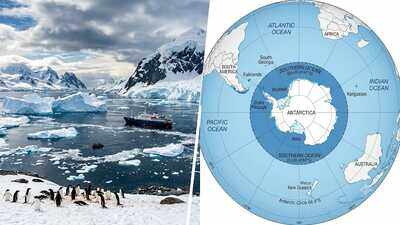
Left/Southern Ocean/Right/Southern Ocean on map/Image: AI Generated
As the world searches for ways to remove carbon dioxide already accumulating in the atmosphere, ocean iron fertilisation (OIF) has emerged as one of the most debated climate intervention strategies.
The idea is deceptively simple: adding tiny amounts of iron to iron-poor parts of the ocean stimulates the growth of phytoplankton, microscopic marine organisms that absorb carbon dioxide during photosynthesis. If some of this organic carbon sinks into the deep ocean, it can remain stored for years or even decades. However, scientists have long questioned whether the climate benefits outweigh the ecological risks.
A new Nature study finds that the answer depends largely on where fertilisation takes place. While some ocean regions could remove carbon efficiently with relatively limited ecological disruption, others may experience significant and long-lasting impacts on marine ecosystems.
Scientists compared climate benefits and ecological risks across the world's major ocean regions
The findings come from the Nature study ‘Climate Benefit and Ecological Cost Trade-offs for Ocean Iron Fertilisation’ by Jun Yu, J. Keith Moore, Francois W. Primeau, Anthony F. Michaels, Amy G. Nuno, Kristen M.
Krumhardt, Michael N. Levy, Keith Lindsay, Hui Wang, James T. Randerson and Adam C. Martiny.Using a process-rich ocean biogeochemical model incorporating validated representations of marine biodiversity and ocean chemistry, the researchers simulated 60 years of ocean iron fertilisation across ten major ocean biomes. Rather than measuring only how much carbon dioxide could be removed, the study also examined changes in biological productivity, oxygen availability, marine food webs and ecosystem recovery after fertilisation stopped.The results revealed that regions capable of removing similar amounts of atmospheric carbon dioxide can experience dramatically different ecological consequences.
The Southern Ocean delivered the strongest balance between carbon removal and ecosystem protection
Among all the regions examined, the Southern Ocean consistently offered the most favourable balance between climate benefits and ecological risk.The researchers found that fertilisation in this region produced highly efficient carbon dioxide removal primarily through downstream carbon export, where carbon captured by phytoplankton is transported and stored beyond the fertilised area.
Importantly, the surrounding marine ecosystem remained comparatively resilient, with fewer long-term disruptions observed after fertilisation ceased.In contrast, the equatorial Pacific achieved similarly high carbon-removal efficiency through a different mechanism. Here, phytoplankton blooms consumed large quantities of available macronutrients within the fertilised waters, reducing the nutrients carried to downstream ecosystems.
This suppressed biological productivity elsewhere, demonstrating that local interventions can generate consequences far beyond the fertilised region.
Some regions experienced high ecological costs despite removing carbon efficiently
The study shows that maximising carbon removal does not necessarily minimise environmental impacts. According to the researchers, fertilising the equatorial Pacific reduced the flow of energy to higher trophic levels, leading to declines in macrozooplankton biomass.
The simulations also showed an expansion of oxygen-minimum zones (OMZs), areas where dissolved oxygen becomes so scarce that many marine organisms struggle to survive.By comparison, similar ecological disturbances were substantially lower in the Southern Ocean, suggesting that relocating fertilisation efforts to higher latitudes could avoid many of the environmental costs identified in lower-latitude oceans.The researchers therefore grouped potential deployment areas into three broad categories:
- Southern Ocean: Higher carbon-removal efficiency with lower ecological risk.
- Equatorial Pacific and global fertilisation: High carbon-removal efficiency but substantially higher ecological impacts.
- Subtropical oceans: Lower carbon-removal efficiency accompanied by moderate ecological risks.
Much of the captured carbon eventually returns to the atmosphere
The study also challenges assumptions about how permanent ocean-based carbon removal may be.Across the 60-year simulations, ocean iron fertilisation produced a net atmospheric carbon dioxide reduction of between 1.1 and 5.3 parts per million (ppm). However, the researchers found that more than half of the captured carbon was re-emitted to the atmosphere within decades after fertilisation stopped.Additional recovery tests further emphasised regional variations. Ecosystems in the Southern Ocean usually restored themselves following the conclusion of iron fertilisation, while those in the equatorial Pacific continued to be disturbed because iron stayed within the regional cycle longer, thus sustaining ecological disturbance.This shows that the success of iron fertilisation in oceans is not simply determined by the amount of carbon sequestered but by how long it stays sequestered.
Carbon removal alone cannot determine whether ocean fertilisation should be used
However, it can be concluded from the research that evaluation of ocean iron fertilisation is dependent upon considering the impacts of both climatic and ecological dimensions rather than only taking into account the carbon removal dimension.This is due to the fact that ocean currents have a role of moving nutrients and biological variations over large distances, which means that actions taken at one place would influence the ecosystem thousands of kilometres away from there.Rather than identifying a universal solution, the study demonstrates that the success of ocean iron fertilisation depends on where it is deployed. As Jun Yu, J. Keith Moore and their co-authors conclude in ‘Climate Benefit and Ecological Cost Trade-offs for Ocean Iron Fertilisation,’ the Southern Ocean currently offers the most promising balance between meaningful carbon removal and comparatively limited ecological disruption, although significant scientific, regulatory and ethical challenges remain before any large-scale deployment could be considered.