2 months ago
45
2 months ago
45

 Satellite image of the Red Sea, the Bab el-Mandeb strait being at the bottom right opening. Credit: Wikimedia/NASA
UNITED NATIONS, July 24 (IPS) - With regional friction between Iran and the Gulf monarchies escalating, Houthi leadership in Yemen has proclaimed a total maritime blockade against all vessels linked to Saudi shipping. While this declaration does not constitute a verified military obstruction of the Bab el-Mandeb Strait, it significantly heightens the risk of volatility at the Red Sea’s southern gateway, potentially severing the primary arterial link to the Suez Canal.
The embargo is already being framed as more than a simple ban on Saudi-flagged vessels. In messages sent to shipping companies navigating the Strait, the Houthis warned against any activities at Saudi ports, including by non-Saudi-flagged ships, saying that vessels could be targeted “in any location.” This is significant as Saudi Arabia’s maritime infrastructure managed 331 million tonnes of freight in 2024—a volume roughly equal to 12 million fully laden 20-foot containers.
Within days of these threats being made, five ships have been recorded turning around after heading towards the Bab el-Mandeb passage. Among these ships, the Xin Long Yang, a VLCC loaded at Yanbu and bound for Qinzhou, China, carrying 2 million barrels of Saudi crude, initially reversed north towards the Suez Canal. The vessel later reversed course again, choosing to resume its original route heading south towards Bab el-Mandeb.
Additionally, Houthi military spokesperson Yahya Saree said that two Saudi oil tankers, named Encelia and Layla, were targeted for their “violation of the blockade decision issued by the armed forces.”
Jeddah Islamic Port, the Kingdom’s principal commercial gateway on the Red Sea, received 3,805 vessel calls in 2024, more than any other Saudi port. Yanbu has become Saudi Arabia’s critical Red Sea oil-export network, where crude is moved from eastern fields using the East–West pipeline before being loaded onto tankers. With the Strait of Hormuz severely disrupted, the Red Sea corridor is no longer simply an alternative route: it is Saudi Arabia’s critical remaining maritime outlet to Asian markets.
Saudi Arabia’s Yanbu port was loading approximately 4 million b/d in mid-July, close to 4 percent of daily global oil demand. Disruptions at Bab el-Mandeb would also affect the Suez Canal, which carried approximately 22 percent of global seaborne container trade in 2023 and acts as the link between European and Asian markets. Of the cargo which transits through Bab el-Mandeb, 3.97 million b/d of crude passed through its gates in March, according to Kpler.
If the Houthis can continue to enforce their threat and create enough uncertainty, even selective attacks on some vessels can increase wartime insurance costs and undermine security guarantees, which could push carriers to reroute around the Cape of Good Hope at the southern tip of Africa.
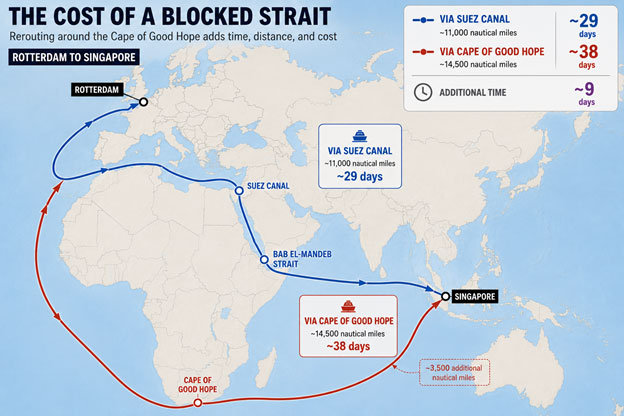
For an Asia–Europe container voyage, rerouting around the Cape of Good Hope can add roughly 3,000 to 3,500 nautical miles and approximately seven to ten days of sailing time. This also increases the cost of the voyage, heightening fuel costs, requiring more vessel capacity to maintain scheduled services, and exposing cargo to higher insurance premiums. The World Bank has estimated that the additional fuel bill alone could reach USD 1 million for a round trip. Analysis by the OECD put the wider cost increase at USD 1.7 million for a medium-sized container ship on an Asia–Europe round trip—roughly an increase of USD 272, or 19 percent, for one standard 40-foot container.
In late 2023, similar Houthi threats, which led to selective attacks against commercial vessels, led major carriers to avoid the Red Sea passage and use the alternative route around the Cape of Good Hope. In just three months, by mid-February 2024, UNCTAD had recorded 586 container vessels taking the longer route around Africa, while container tonnage moving through the Suez Canal had simultaneously fallen 82 percent. Spot rates—the price of booking a container on short notice—also rose by 256 percent during the same period on voyages from Shanghai to Europe.
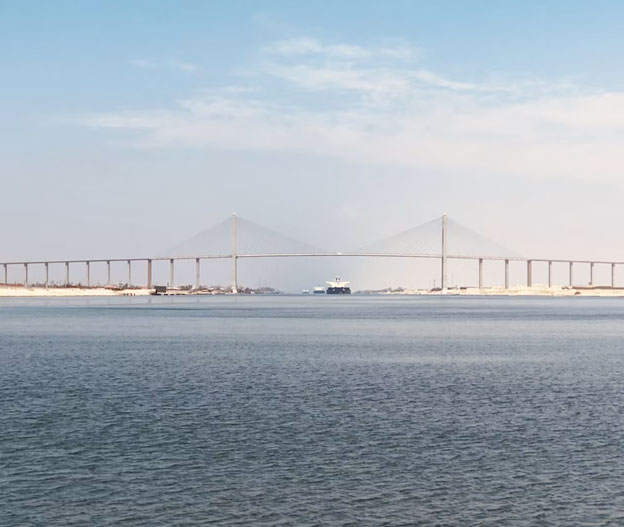 The Suez Canal in Egypt. Credit: Unsplash/Samuel Hanna
For Yemen, the consequences could be especially severe. The country relies on imports for more than 90 percent of its staple foods, including about 90 percent of its wheat and all of its rice requirements. Much of that supply enters through the ports of Aden and Hodeidah. The World Food Programme estimates that 18.2 million people in Yemen require humanitarian aid, being in dire need of humanitarian assistance and protection services.
Even considering that the Houthis formally exempt humanitarian cargo from the embargo, an escalation of insecurity can delay vessels and raise freight and insurance costs, deterring commercial shipping lines from calling at Yemeni ports. Humanitarian aid will not be nearly enough to replace the normal commercial flow of food and fuel, which affects Yemeni civilians first, who are already facing hunger and economic collapse.
The central question is not whether the Houthis can permanently seal Bab el-Mandeb. It is whether they can make the route risky enough that insurers, carriers, and oil traders abandon it themselves.
IPS UN Bureau Report
© Inter Press Service (20260724051830) — All Rights Reserved. Original source: Inter Press Service