1 hour ago
4
1 hour ago
4

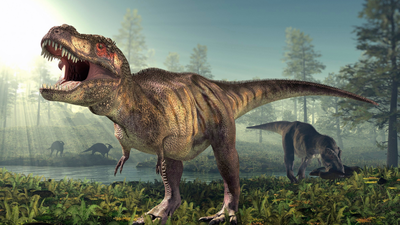
Representative Image via Canva
For 66 million years, the body temperature of Tyrannosaurus rex (T.rex) lived only in speculation. Now, a new study has taken the dinosaur’s temperature using chemistry locked inside its fossilised teeth, finding an average of about 36.3°C (97.3°F), strikingly close to the human norm.
The research, published in Science Advances, offers one of the first direct measurements of an extinct animal’s core temperature and strengthens the case that T. rex was a warm-blooded, high-energy predator capable of thriving across diverse climates, from ancient floodplains to cooler high-latitude regions.A thermometer hidden in tooth enamelThe breakthrough rests on a technique called clumped isotope analysis, which reads temperature signals preserved in the enamel of growing teeth.
Inside enamel, rare heavy isotopes of carbon and oxygen form chemical bonds with one another at rates that depend on body heat. Cooler temperatures produce more of these bonds, while warmer temperatures produce fewer. By drilling out a few milligrams of enamel from three T.
rex teeth and measuring the abundance of these isotope pairs, researchers could calculate the temperature at which the enamel formed, effectively using the tooth as a fossil thermometer.
The teeth came from a well-known T. rex specimen nicknamed Thomas, housed at the Natural History Museum of Los Angeles County, and were originally unearthed in Montana. Analysis indicated a body temperature of 97.3°F (36.3°C), with a margin of error of about 2.5°C. That places the king of dinosaurs in the same thermal neighbourhood as modern humans and elephants, and firmly within the range of warm-blooded, or endothermic, animals.What this says about how T. rex livedA stable, human-like body temperature reshapes how we imagine T. rex moving through its world. Rather than a sluggish, sun-basking reptile, the animal likely maintained a high, steady metabolism that supported fast growth, sustained activity and powerful bursts of hunting or scavenging. Warm-blooded physiology would have allowed T. rex to remain active across a wide span of environmental conditions, including cooler regions such as parts of ancient Alaska, where other dinosaur fossils suggest some species endured long, dark winters.The temperature reading also helps explain the predator’s ecological dominance. Maintaining an internal thermostat near 36°C means T. rex could have ranged across much of prehistoric North America without being constrained by external heat sources, expanding its hunting grounds and prey options. At the same time, such a metabolism would have demanded substantial food intake, fitting with estimates that adult T.
rex needed large quantities of meat to fuel its massive body.Why the number surprised some scientistsWhile many researchers already suspected T. rex was warm-blooded, the precise figure was not a given. Some paleobiologists expected a higher temperature, closer to that of modern birds, which are living descendants of dinosaurs and often run several degrees hotter than mammals. The new result suggests T. rex occupied a middle ground, warmer than cold-blooded reptiles like crocodiles but cooler than many birds, aligning more closely with large mammals such as elephants.This does not settle every debate about dinosaur metabolism, but it provides a concrete data point where there was once only inference from bone structure, growth rates and ecological modelling. Jasmina Wiemann, a paleobiologist at Johns Hopkins University who was not involved in the study, noted that the method opens the door to measuring temperatures in other charismatic species, potentially rewriting chapters of dinosaur biology one tooth at a time.Implications for the end-Cretaceous worldThe finding also nudges long-standing ideas about why some animals survived the asteroid impact that ended the Cretaceous period. If T. rex and other large dinosaurs were already warm-blooded, their extinction cannot be simply blamed on an inability to cope with cold or darkness after the impact. Instead, factors such as ecosystem collapse, food-web disruption and the sheer scale of the catastrophe likely played larger roles in their demise, while smaller, more flexible endotherms such as early mammals found niches to persist.A new chapter in reading fossil chemistryThe study showcases how advances in geochemistry are turning fossils into archives of physiology, not just shape. Clumped isotope analysis has been refined over the past decade to improve accuracy and reduce the amount of material needed, making it feasible to sample precious specimens like T. rex teeth without causing major damage. As the technique is applied to more dinosaurs, from giant sauropods to small feathered theropods, scientists expect to build a thermal map of the Mesozoic, revealing which lineages ran hot, which ran cool, and how metabolism influenced evolution.(With inputs from AP News)