44 minutes ago
4
44 minutes ago
4

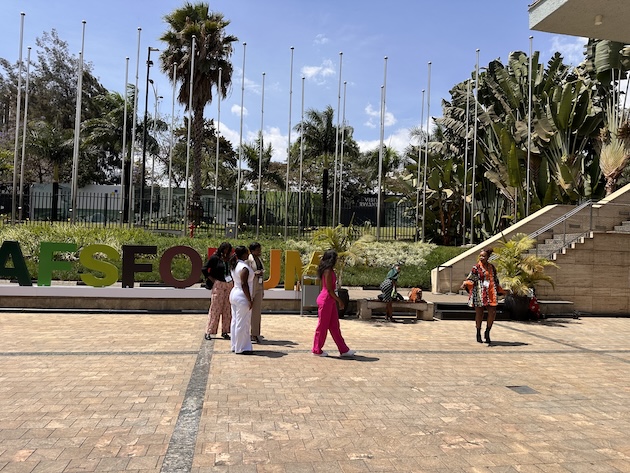 Delegates networking at the Kigali Convention Centre in Rwanda's capital during the Africa Food Systems Forum. Credit: Farai Shawn Matiashe/IPS
KIGALI, September 3 (IPS) - As climate disasters frequent across the African continent, governments have been promoting climate-smart innovations, including the development of drought-resistant crops.
Drought-resistant and nutritious staples such as millet and sorghum and drought-tolerant maize varieties are some crops helping farmers survive dry seasons.
But there has been a decline in the adoption of these drought-tolerant crops on the continent.
This is partly because of poor access to information, counterfeit products and weak distribution networks.
The need to encourage the adoption is even more urgent, as the World Meteorological Organization (WMO) this week announced that El Niño is strengthening rapidly in the Pacific Ocean, raising the prospect of months of extreme heat, floods, drought, and disruptive weather around the globe.
The phenomenon, already firmly established, is expected to become “very strong” and peak around the end of the year, the WMO said.
The likelihood that El Niño will persist through February 2027 is now close to 100 per cent, it said, issuing an unequivocal forecast for the weather phenomenon.
Slow Adoption of Drought-Resistant Crops
A report released in August titled Requiem for Africa’s Green Revolution: An Updated Assessment of a Failing Agricultural Productivity Strategy, by agricultural policy researcher Timothy Wise of Tufts University in the United States, shows that there has been a decline in the adoption of climate-resilient millets compared to maize.
Maize is the staple for many countries in Sub-Saharan Africa, feeding over 300 million people. Millet and sorghum’s share of cropland has since fallen from 25% to 17% between 2006 and 2024 in Africa.
Speaking during the official opening of the Africa Food Systems Forum in Kigali, Rwanda, on 2 September, Moses Vilakati, head of the Agriculture, Rural Development, Blue Economy and Sustainable Environment (ARBE) department at the African Union, says seeds are important because they are the starting point of agriculture.
“They still remain a foundation for agriculture, production, productivity, objective business, and food security across the country,” he told delegates.
Speaking at a side event organised by the International Maize and Wheat Improvement Center (CIMMYT), a non-profit research-for-development organisation that develops improved varieties of wheat and maize, Evelyne Lusenaka of Alliance for Green Revolution in Africa (AGRA)’s Center of Excellence for Seed Systems in Africa said weak distribution is one reason for slow adoption of some seed varieties in Africa.
“Africa has made significant progress in developing improved varieties and local seed enterprises, but farmers still struggle with inadequate early-generation seed, counterfeit products, weak distribution networks and poor access to information,” she said.
Delivering seeds to the last mile
Drought has become more frequent in Africa. It has escalated into a severe humanitarian and environmental crisis.
In the 2023/2024 agriculture season, the southern Africa region was hit by an El Niño-induced drought, with millions of people facing acute water scarcity, crop failures, widespread livestock deaths, and critical food insecurity.
WMO confirmed El Niño, and this will affect the 2026/2027 farming season in Africa.
“El Niño means ‘little boy’ in Spanish, but it has the potential to deliver a massive blow to communities and economies around the world,” Celeste Saulo, head of WMO, said. “We are already seeing the disruption and devastation caused by droughts and floods, and we expect these impacts to worsen as El Niño intensifies.”
An estimated 167 million Africans faced acute food insecurity in 2025 – a record high, according to the Africa Center for Strategic Studies, a US government-affiliated research institution.
This represents the sixth consecutive annual increase in the number of Africans experiencing acute food crises.
Lusenaka said research must connect with seed companies, finance, distribution networks, farmers and markets.
Speaking at the same side event, Bram Govaerts, CIMMYT director general, said the continent must close the gap between scientific discovery and delivery if it is to stop repeatedly falling back into emergency response.
He said the “missing middle” is the financing, seed systems, markets, extension services, policies, businesses and delivery networks needed to move innovations from research institutions into farmers’ fields.
CIMMYT and its partners deployed drought-tolerant maize seeds in countries like Zambia, Malawi and Tanzania ahead of the 2023/2024 El Niño to reduce the impact of the drought.
Govaerts said there is a need for stronger delivery systems over the next two years and longer-term investment over the next five years to reduce the need for repeated emergency interventions.
Innocent Musabyimana, coordinator of the African Development Bank’s Technologies for African Agricultural Transformation (TAAT) initiative, said technologies are available, but reaching millions of farmers remains a major challenge.
He said the AfDB’s $1.5bn African Emergency Food Production Facility, which supported 35 African countries after the recent global food and fertiliser shocks, supported access to quality and climate-resilient seeds.
This shows what becomes possible when science connects with investment and national delivery systems.
Mel Oluoch of Sasakawa Africa Association, an organisation that supports smallholder farmers along the agricultural value chain, headquartered in Japan, said that agricultural extension must also become a first line of resilience rather than a mechanism that activates only when projects arrive.
“Extension systems should help farmers interpret climate information, select appropriate varieties, manage soil and water, access finance and connect with markets while also feeding farmers’ experience back into research,” Oluoch said.
Mutande Kosta Tembo of Afriseed, a Zambia-based seed company, said a poor agricultural season can disrupt seed availability well beyond a single harvest.
She said seed companies therefore need resilient varieties, working capital, insurance, reliable distribution networks and stronger partnerships if they are to prepare for shocks before planting windows close.
IPS UN Bureau Report
© Inter Press Service (20260903090428) — All Rights Reserved. Original source: Inter Press Service