
 2 months ago
34
2 months ago
34

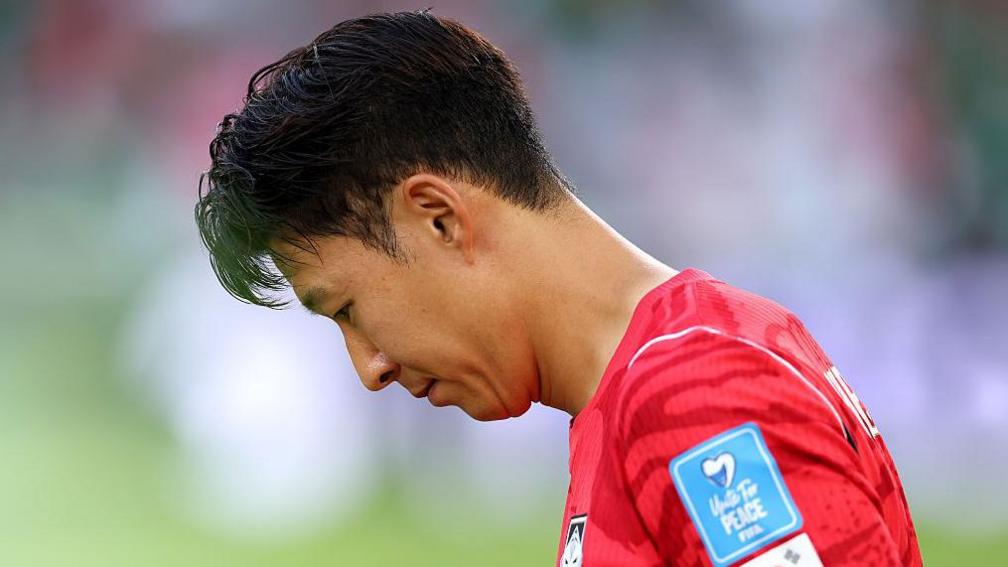 Image source, Getty Images
South Korean captain Son Heung-min after the loss to South Africa knocked his side out of the World Cup
ByYuna Ku
BBC News Korean Reporting fromSeoul
South Korean football is dead - those words on the sign floating above the angry crowd said it all.
Fans had gathered outside Seoul's Incheon airport to confront the national team as they returned home after being knocked out of the World Cup in the group stage.
Their ire was directed at one man in particular: coach Hong Myung-bo, a former captain and footballing hero now faulted for his team's unimpressive run on the biggest sporting stage.
And they couldn't have made that clearer. Supporters beat drums and shouted, "Hong out!", some even following him all the way to his car, even as others cheered for the players walking behind Hong. One football fan told the BBC that ahead of the World Cup, people talked less about the team and "kept saying Hong should step down".
His appointment was met with opposition right from the start, embroiling the Korea Football Association (KFA) in a drawn-out controversy. Critics have long accused it of lacking transparency and fairness, saying coaches and key figures were often picked because of personal connections rather than a merit-based process - an allegation the KFA has denied.
"At the heart of the problem is KFA's incompetence," said sports critic Choi Dong-ho.
Those charges and questions resurfaced after an earlier-than-expected exit from this World cup, triggering what some say is a long overdue reckoning in South Korean football.
Hong apologised and resigned - saying the responsibility "rests entirely with me" - while President Lee Jae Myung called for an investigation.
"When favouritism and cronyism take precedence over competence in selecting a commander, the result is as clear as day," Lee wrote on X, adding that it "appears to be the result of organisational and personnel failures".
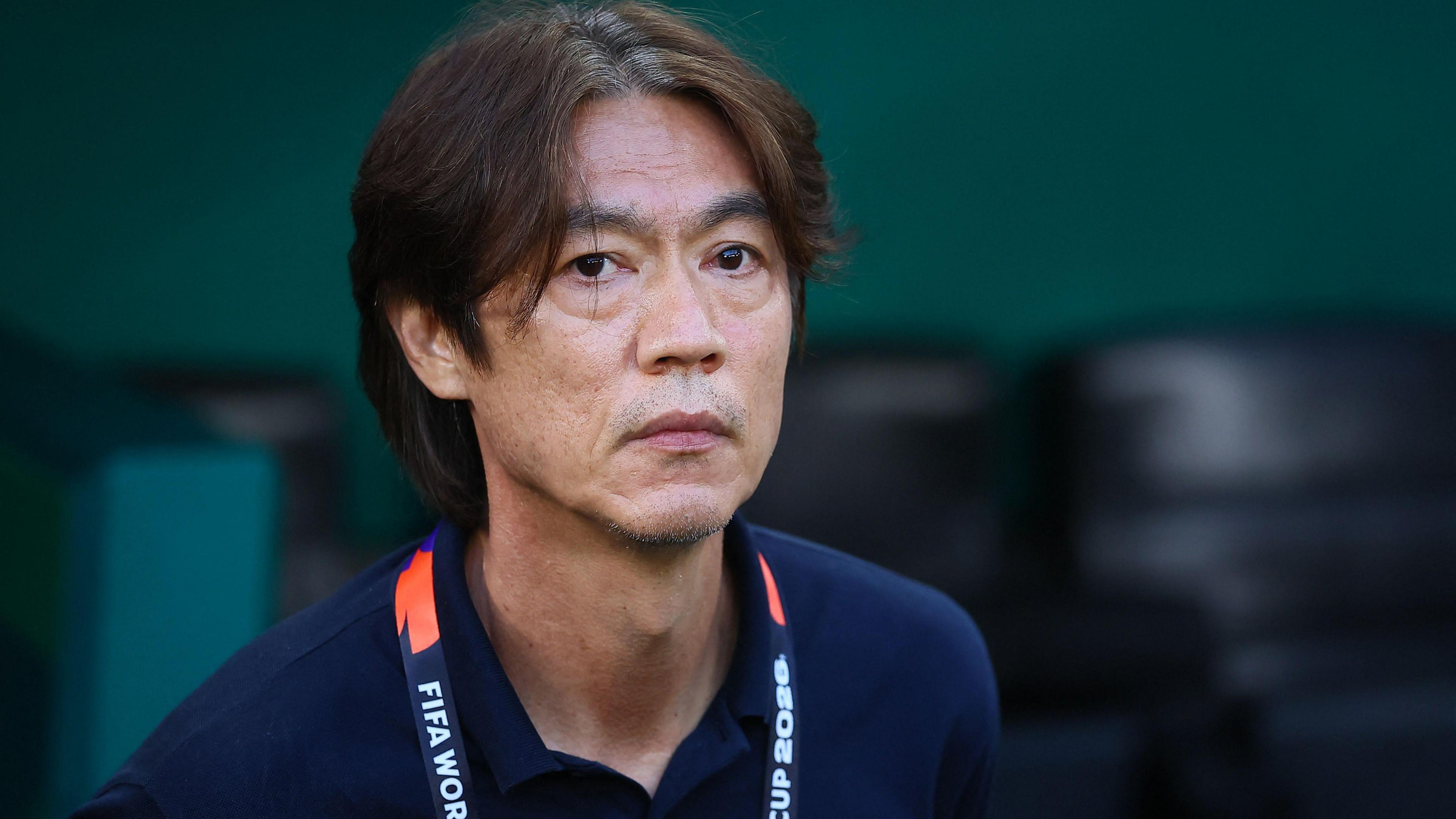 Image source, Reuters
This is Hong's second stint as head coach of team South Korea
Hong, who captained the national side to a historic fourth-place finish at the 2002 World Cup, used to be one of South Korea's most celebrated footballers.
He started off his coaching career on a successful note - under him, South Korea reached the quarter-finals of the FIFA U-20 World Cup in 2009 before winning the bronze medal at the 2012 London Olympics.
And yet when he was picked as the national team's head coach in 2024, the backlash was swift.
This was his second stint, and many fans still blamed him for what happened the 2014 World Cup. The team was thrashed 4-2 by Algeria in what is remembered by many South Korean fans as one of the worst World Cup performances - until the 1-0 loss to South Africa in this year's tournament.
The 'cartel' inside the KFA?
Hong wasn't supposed to lead South Korea this time. His predecessor, Jurgen Klinsmann, who had been in charge for just under a year, was sacked following a disappointing run to the semi-finals of the 2023 AFC Asian Cup.
Several high-profile names were reportedly under consideration, including Jesse Marsch, who is now coaching the Canadian team and was widely seen as a strong candidate.
Hong was chosen, it was alleged at the time, because senior KFA officials, including chairman Chung Mong-gyu, a South Korean businessman from the Hyundai family, favoured him personally. Some even claimed one of the reasons was that they had attended the same university.
The questions intensified after former Park Joo-ho, a former player and a member of the KFA committee that recommended coaches, alleged that Hong's appointment had not followed procedure. "Nothing was done as part of the process," Park said in a YouTube video, claiming that the candidates were denied a fair selection process.
The KFA rejected Park's claims, insisting Hong's appointment followed due process, and warned him that it was considering legal action. But his allegations drew support from some fans and even prominent figures in Korean football. Among those backing Park was Park Ji-sung, a national footballing legend and former Manchester United midfielder.
"I think people have lost trust in the KFA, and it will take a long time for the association to regain that trust," he told local media. "I don't expect things to change after this interview. But I felt I should at least express my thoughts."
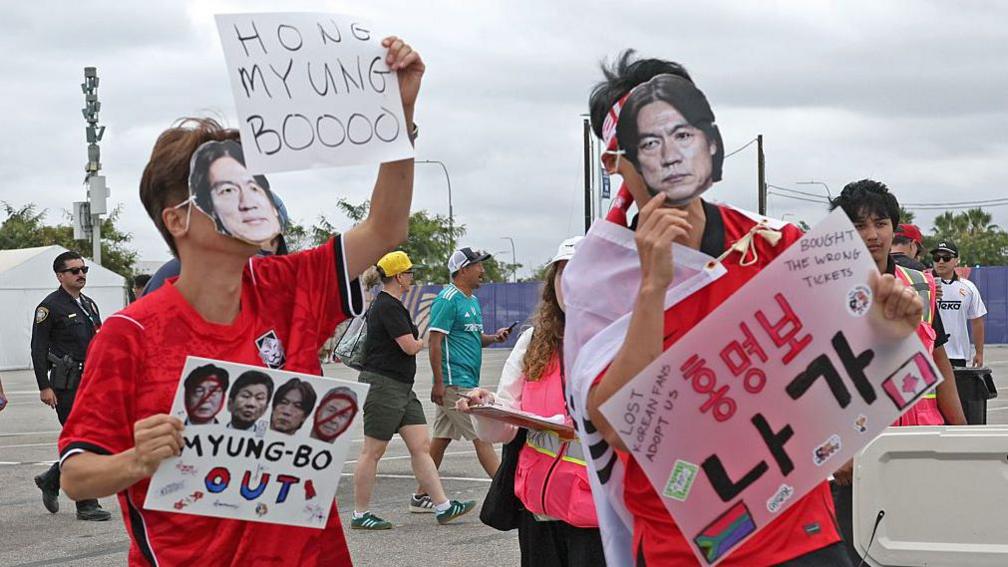 Image source, Getty Images
South Korean fans protesting against Hong outside a World Cup stadium in California
Then came a government audit in late 2024 which concluded that Klinsmann's removal and Hong's appointment both lacked transparency.
It found that "the KFA's Technical Director, who was not authorised to do so, interviewed Hong at the president's (Chung's) instruction without a fair or transparent process", and also said that he was "effectively been chosen before the appointment was presented to the board, which was later asked to approve the decision in writing, making its role little more than a formality".
Parliament summoned Chung for questioning twice in 2024 and Bae Hyun-jin, a lawmaker from the governing People Power Party, told Chung of "rumours" that inside the KFA was "a cartel based on alumni ties to a specific university".
The government recommended disciplinary action against three KFA executives, including Chung, and called on the KFA to address the audit's findings, which could include restarting the process to appoint a new head coach. But the KFA challenged the decision and secured a suspension of its enforcement, allowing Chung to remain in the job.
The following year Chung began his fourth consecutive term. Hong remained in charge under a cloud of doubt and criticism as the world cup drew closer. Fans were jubilant when the team won its opening match for the first time in four World Cups, coming from behind to defeat the Czech Republic 2-1.
But then came the lacklustre losses, first to Mexico and then to South Africa. In the latter match, they remained largely defensive throughout, even after conceding a goal. Commentators and fans attributed the defeat to a lack of tactical strategy.
Especially shocking was the decision to exclude the captain and the team's biggest star, Son Heung-min, from the starting line-up, fuelling speculation about Hong's tactical judgement and even his relationship with a player beloved by much of the country.
Hong often seemed seemed to keep Son, the first Asian player to win the English Premier League's golden boot, at a distance, frustrating the striker's fans. He left Son out of the squad for the 2012 Olympics before selecting him for the 2014 World Cup. Ahead of this World Cup, Hong caused a stir by hinting at the possibility of appointing a new captain.
"Hong didn't know how to get the best out of Son," said Choi, adding the captain was often left isolated up front with too little support to influence the game. "Instead of changing the team's tactics or style of play, Hong simply tried to solve the problem by substituting players.
When South Korea was knocked out, the backlash against Hong, and the KFA, returned.
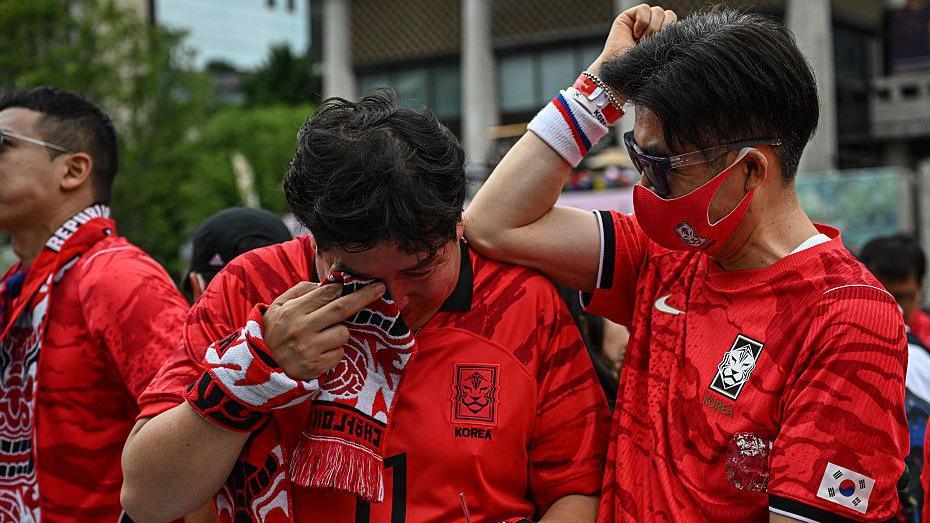 Image source, Getty Images
South Korean fans were devastated by the country's early exit from the World Cup
For many supporters, the result especially stung given the calibre of the squad, which boasts Son, a former Tottenham Hotspur captain, Paris Saint-Germain midfielder Lee Kang-in and Bayern Munich defender Kim Min-jae, along with other players in top leagues.
"I don't know where to start," Son posted on Instagram on Tuesday, apologising to fans. "To be honest, it's hard to accept the reality… I believe what the fans are feeling wouldn't be all that different from what I'm feeling."
South Korea's love of football kicked into full gear in 2002, when the country co-hosted the World Cup with Japan. The team's remarkable run to the semi-finals thrilled millions as they cheered into the streets and lifted the spirits of a nation still recovering from the Asian financial crisis.
But in the years since, Japan has raced ahead. South Korea fell to 32nd in the Fifa rankings, its lowest position in four years, after the World Cup exit, while Japan climbed to the 17th spot to become the highest-ranked Asian team.
The two sided have long been rivals but this time many South Korean fans had little confidence in their own team's chances against Japan.
Some South Koreans mocked their own team after Japanese media reported that Japan had a strong chance of reaching the quarter-finals if it faced South Korea in the last 16. "That's very kind of them to assume South Korea will even make it to the knockout stage," one fan wrote on social media.
"It seems the Japanese national team has found a clear answer to the fundamental question of what the team should strive for," said sports critic Choi, explaining that Japan has built strong teamwork over a long period.
"By contrast, it feels as though South Korea starts from scratch every four years," he added, pointing to more than 10 coaches who have come and gone since 2002.
All of this, he said, "makes it difficult for the national team to build experience or develop a consistent long-term strategy. The KFA has failed to establish a clear footballing identity rooted in a long-term philosophy".
Many fans, including President Lee, seem to agree that the KFA needs sweeping reform. A fan who didn't want to share his name said he hoped that the current backlash will spark that change because that is their demand - transparency and greater focus on long-term strategy.
Younger people are increasingly sensitive to unfairness as they struggle to compete in the world, he said. But now "even in sport - where fairness should matter more than anything else - we've watched football administrators ignore that principle. People can no longer accept that."
Why are South Korean fans so angry at their football coach?


