1 hour ago
3
1 hour ago
3

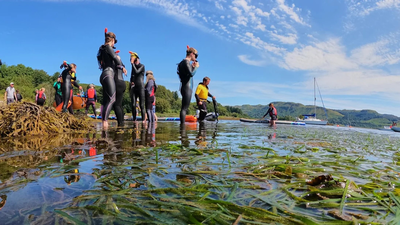
Britain's seagrass meadows have suffered decades of decline, but a community-led project on Scotland's west coast is showing that restoring them may not always require starting from seeds.
Seawilding, a Scottish marine restoration charity, has been experimenting with transplanting mature Zostera marina shoots from healthy donor meadows into areas where seagrass has been lost. The approach has produced striking early results at Loch Craignish in Argyll, including a 97% survival rate in a 2025 trial. In another restoration plot, seabed coverage increased from 10% to more than 70% within 15 months.
Together, the trials have created about 0.3 hectares of new seagrass habitat, offering a promising alternative for restoring an ecosystem that supports marine life, stabilises sediments and stores carbon.
Scotland's disappearing seagrass gets a new restoration approach
Seagrasses are flowering marine plants that form underwater meadows in shallow coastal waters. Scotland has two native species, Zostera marina and Zostera noltii, with Z. marina, commonly known as eelgrass, occurring widely along the country's coastline.
These habitats provide nursery and feeding areas for marine organisms, help stabilise sediments and contribute to coastal protection and blue-carbon storage.
Yet seagrass beds are vulnerable to physical disturbance, poor water quality, disease and other pressures. NatureScot notes that modelled estimates for Britain indicate a general decline of at least 44% in seagrass beds, although it also cautions that historical and Scottish data are incomplete and that the extent of change is difficult to establish precisely.Seawilding began its community-led restoration work in Loch Craignish, Argyll, with earlier efforts concentrating on collecting and planting seagrass seeds. The organisation says that, over roughly a decade, UK restoration efforts have focused largely on seed-based approaches, but establishing large areas of new meadow has often proved difficult. From 2024, Seawilding began testing a different strategy by taking adult shoots from existing healthy meadows and transplanting them into suitable restoration sites.
Instead of waiting for seeds, the team moved mature plants
The key difference in Seawilding's newer approach is that the restoration team starts with living adult seagrass shoots rather than relying entirely on seeds to germinate and establish new plants. Tens of thousands of shoots have been transplanted from donor meadows into restoration areas at Loch Craignish. The idea is relatively straightforward: establish living plants immediately in suitable seabed rather than waiting for seeds to germinate, survive their early development and eventually develop into mature plants.The technique is not entirely unprecedented. NatureScot's Scottish seagrass restoration guidance notes that transplantation has been used elsewhere and can offer advantages where restoration needs to overcome physical problems that make establishment from seed difficult. However, transplantation can also require considerably more labour because plants have to be collected and replanted. The Scottish guidance therefore stresses that restoration success depends on choosing an appropriate technique for the environmental conditions rather than assuming one method will work everywhere.Seawilding's project also grew out of several years of experimentation. The organisation says it trialled multiple restoration methods before the adult-shoot approach began producing the results reported in 2025. That history is important because the 97% figure did not come from a single attempt that immediately succeeded. It followed repeated trials to determine how best to collect, transport and establish the plants.
A 2025 trial recorded 97% survival
The strongest result came from a new transplantation trial conducted in 2025. Seawilding reported that 97% of the transplanted shoots survived, while the trial area also recorded an average fourfold increase in seabed coverage within six months. This result is separate from another restoration plot where coverage increased from 10% to more than 70% over 15 months. Taken together, the results indicate that transplanted adult plants can establish rapidly under the conditions tested at Loch Craignish.The longer-running plot began receiving transplanted shoots in July 2024. By the following 15 months, the proportion of seabed covered by seagrass had risen from 10% to more than 70%. Across the reported restoration work, Seawilding says the intervention has resulted in approximately 0.3 hectares of newly created seagrass habitat. The organisation describes the results as among the most successful establishments of seagrass habitat in the UK to date, although those claims should be understood as project-level results rather than evidence that Britain's seagrass decline has been reversed.The project also investigated what happened to the original donor meadow after shoots were removed. Seawilding reports that harvesting 25% of shoots from a trial area had a limited apparent effect, with shoot density returning to near-natural levels within about five months. This is particularly important because a restoration technique would be difficult to scale if collecting plants simply damaged existing healthy meadows.
Local people are helping rebuild the underwater habitat
The Scottish project is notable not only for its restoration technique but also for its community-led structure. Seawilding describes itself as Scotland's first community-based marine habitat restoration charity, and local volunteers have been involved in monitoring, planting and other stages of the work. The organisation's earlier Loch Craignish project was developed with technical support from Project Seagrass and research and environmental monitoring from the Scottish Association of Marine Sciences.Community participation has also been important for understanding the condition of the existing meadows before restoration begins. NatureScot's case study describes local residents surveying Loch Craignish using transects and quadrats to record seagrass coverage, while snorkellers and paddleboarders have helped with field observations and seed collection. The earlier project also held public restoration events where residents could learn about seagrass and participate in collection and planting activities.This community involvement fits a wider body of research showing that restoration projects can benefit when local communities are involved in designing and delivering conservation rather than being treated simply as observers. A 2025 peer-reviewed study of a major UK seagrass restoration project in Wales found that changing the approach towards co-production helped rebuild trust between the restoration team and local stakeholders.
The study also found that the restored site had begun showing positive ecological development, although large-scale continuous meadow recovery remained incomplete.
The results are promising but the method still needs wider testing
The Loch Craignish results are encouraging, but they do not yet establish that transplanting mature shoots will work everywhere in Britain. Seagrass survival depends on factors including depth, sediment, exposure, water movement, light and local ecological conditions.
NatureScot also identifies significant knowledge gaps around Scottish seagrass, including habitat suitability, connectivity, disease and the ecosystem benefits of restoration.Seawilding is now taking the next step by testing the technique at additional locations along Scotland's west coast. Supported by the Blue Carbon Trust, trials are planned at Ganavan Bay near Oban, Loch na Cille and Port na Carraigh on the Isle of Gigha.
Each site is intended to test how transplanted shoots perform under different environmental conditions and whether using locally sourced plants produces different results from shoots originating at Loch Craignish.
Monitoring is planned through 2027.The significance of the project therefore lies less in the claim that one Scottish community has solved seagrass restoration and more in the evidence that a relatively simple change in strategy can produce striking early results. Rather than waiting for seeds to establish naturally, the team is moving mature plants into suitable habitat and monitoring whether they survive and expand. If the approach continues to work at different sites without damaging donor meadows, it could become another practical tool for restoring Britain's fragmented underwater meadows.