2 hours ago
4
2 hours ago
4

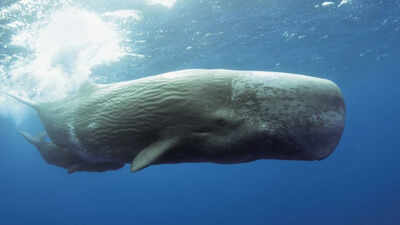
Sperm whales communicate by making clicks
Scientists using artificial intelligence (AI) have uncovered a complex communication system among sperm whales, identifying a kind of phonetic alphabet. The discovery comes as experts also found sperm whales living in the eastern Mediterranean Sea have developed a distinct regional dialect that separates them from populations living in the west.Together, the twin breakthroughs are shifting how biologists view non-human communication. Researchers used powerful computer programmes to study thousands of whale clicks and found patterns that work in ways similar to parts of human language, such as accents, syllables and word-like combinations.
The building blocks of whale language
Sperm whales are highly social, deep-diving marine mammals that live in close family units. While hunting for prey like giant squid thousands of feet below the surface, they maintain constant contact by emitting rapid bursts of clicks called codas.
Historically, scientists viewed these sounds as basic acoustic labels.However, a massive data analysis led by Project CETI (Cetacean Translation Initiative) has revealed an underlying complexity. Researchers analyzed recordings of a clan of roughly 400 sperm whales in the Eastern Caribbean captured between 2005 and 2018, capturing the voices of at least 60 individual whales.The computer models identified that the animals alter their vocalizations through specific structural adjustments.
While a single coda contains between three and 40 individual clicks, whales deliberately manipulate the tempo and rhythm, a feature researchers called rubato. They also frequently append an extra click to the end of a sequence, termed ornamentation.
By mixing and matching these traits, the team mapped out 156 distinct codas, each defined by unique combinations of rhythm, tempo, rubato and ornamentation.“We’re now starting to find the first building blocks of whale language,” says study co-author David Gruber, a marine biologist and the founder of Project CETI.The structural variation means that sperm whales can generate a massive array of unique vocal signatures from a small set of basic sounds.“Once you have this combinatorial basis, it allows you to take a finite set of symbols [and] compose them to create an infinite number of symbols by following a set of rules,” says study lead author Pratyusha Sharma, a computer scientist at MIT.
Mediterranean sperm whales having different dialect by region
While Caribbean whales are demonstrating how complex these basic linguistic blocks can be, sperm whales in the Mediterranean Sea are showing how these sounds change over geographical distances.A study published in the journal Proceedings of the Royal Society B: Biological Sciences analyzed 5,291 codas recorded between 2003 and 2021. For decades, marine biologists assumed that all Mediterranean sperm whales belonged to a single cultural group. This subpopulation, which is endangered and numbers between 250 and 2,500 mature individuals, descended from a single group that entered the sea through the Strait of Gibraltar roughly 20,000 years ago.Scientists believed all of these whales used an identical vocal signature known as the 3+1 coda, consisting of three rapid clicks, a brief pause, and a final fourth click.“I’ve always thought of them as the weirdos of the sperm whale world,” says study co-author Taylor Hersh, a biologist at the University of Bristol.The data analysis showed that geography has fractured this unique group into separate acoustic communities. Whales living in the western Mediterranean, near Spain's Balearic Islands, strictly maintain the traditional 3+1 pattern. However, the population residing in the eastern Mediterranean, near the Hellenic Trench off Crete, utilizes a sped-up version of the exact same sequence.The separation is not entirely rigid. While western whales never used the eastern variation, researchers caught eastern whales switching to the western dialect on four separate occasions across the multi-year dataset. This indicates that the eastern whales possess the ability to code-switch between regional accents depending on context or contact.
A shared cultural history
Sperm whales can live up to 60 years, meaning their traditions are passed down through generations over long spans of time. Biologists believe the eastern dialect represents an evolutionary midway point, showing how language slowly drifts over thousands of years as populations migrate away from their ancestral roots. The divergence is similar to how the English phrase "How do you do?" eventually compressed into the regional greeting "howdy."“The whales in the east remember the old ways, but they’re moving on, and they’ve got a slightly different version of what is clearly the same [general type of coda], but they’ve evolved it a little bit; they’ve changed it,” says study co-author Luke Rendell, a biologist at the University of St. Andrews.The timeline suggests that while early human civilisations were establishing their own unique languages and customs across the Mediterranean basin, the local whale pods were simultaneously preserving and modifying their own vocal lineages.“This finding reminds us that the cultural history of the Mediterranean does not belong exclusively to humans,” says study co-author Txema Brotons, a biologist with the Tursiops Association. “The Mediterranean is … a space of shared cultural diversity, where the evolution of human culture and animal culture has coexisted for thousands of years.”
Communication or composition?
Despite mapping out these phonetic patterns, researchers are cautious about labelling the clicks as a direct equivalent to human speech.
The precise meaning of the 156 Caribbean codas and the underlying purpose of the Mediterranean dialect shift remain unknown.One prevailing theory is that the vocalizations function less like descriptive language and more like music. Under this framework, variations in rhythm and tempo may communicate emotional states, strengthen social hierarchies, or reinforce group identity without translating into specific words or phrases.“Changes in the rhythm might be a very feasible and meaningful way for coda signals to start to diverge,” says Ellen Jacobs, a marine biologist at Aarhus University who was not involved in the Mediterranean dialect study.Taylor Hersh, who also works as a bioacoustician at Oregon State University and was not involved in the Caribbean AI project, agrees that the sounds could mirror musicality. Music can "have a strong influence on emotions without it actually conveying information," Hersh notes.
Using acoustics for conservation
The ultimate goal for initiatives like Project CETI is to cross-reference these newly discovered phonetic building blocks with observed physical behaviours. If researchers can link specific click patterns, rubatos, or dialect shifts to actions like cooperative foraging, parenting, or distress, they will come closer to a functional translation of whale communication.Achieving this level of understanding is increasingly critical for the survival of the species.
Though commercial whaling has been banned for decades, sperm whale populations are still struggling to recover from the historical impact of 19th and 20th-century hunting. Today, they face severe modern pressures, including ship strikes, entanglement in heavy commercial fishing gear, rising ocean noise levels, and changing marine ecosystems driven by climate change.Unlocking their communication system could alter how human conservation programs protect these vulnerable populations.
Understanding their social structures and warnings could allow authorities to design more effective marine sanctuaries and shipping lanes.Furthermore, demonstrating that these marine mammals possess distinct cultures, dialects, and structured communication systems could alter the public's relationship with ocean conservation.“When we can talk about whales and how important their grandmothers are, or how important being a good neighbour is, or the importance of cultural diversity in society, that really resonates with people and can drive change in human behaviour in order to protect the whales,” says study co-author Shane Gero, a biologist at Carleton University and founder of the Dominica Sperm Whale Project.