1 month ago
47
1 month ago
47

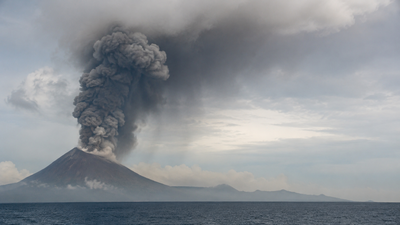
The Pacific Ring of Fire, the horseshoe-shaped belt of volcanoes circling the Pacific Ocean, may have played a far bigger role in shaping Earth's past climate than previously understood.
Findings show that some of the largest volcanic eruptions of the past 12,000 years, many originating from this seismically active region, align closely with major glacial advances and centennial-scale cold spells during the Holocene. According to the study published in Nature, titled “Evidence for volcanic forcing of Holocene cold events”, over 80% of Holocene glacial advances occurred within chronological uncertainty of at least one large eruption of magnitude 7 or higher in the northern hemisphere.
How researchers linked Holocene volcanic eruptions to glacial advances
The research team compiled data on the largest known Holocene eruptions occurring north of 20°S, alongside a separate dataset of 22 major glacial advances drawn from moraine records across 17 regions worldwide. According to the study, the timing of each glacial advance was determined from radiometric ages acquired from moraines, marking the point at which glaciers stabilised after a sustained period of positive mass balance, which offers a near-direct record of centennial-scale temperature and precipitation change.
To test whether this pattern could be down to chance, the researchers ran a statistical comparison using Monte Carlo simulations. The analysis showed that all known exceptionally large eruptions of magnitude 7 or above fell within chronological uncertainty of a glacial advance, with 72% of these eruptions showing evidence of a corresponding glacial advance in both hemispheres, a relationship found to be significant at the 99% confidence level.
This statistical strength held even when a wider set of smaller, though still substantial, eruptions was included in the analysis.
Pacific Ring of Fire volcanoes produced the largest Holocene eruptions
Several of the eruptions identified as most significant in the study originate from volcanoes situated along the Pacific Ring of Fire, a zone of intense seismic and volcanic activity that circles the Pacific Ocean basin. Eruptions such as Kurile Lake and Tao-Rusyr in the Kuril Islands, along with the Kikai-Akahoya (K-Ah) eruption in Japan, are ranked among the largest sulphur-releasing events of the entire Holocene, with the study noting that Samalas, K-Ah and the caldera-forming eruption of Kurile Lake all released more than twice as much sulphur into the atmosphere as the 1815 Tambora eruption.Eruptions such as Aniakchak II and Okmok II in Alaska, and Mazama in the western United States, all located along the Ring of Fire, whose tephra deposits have been traced in Greenland ice cores. This cross-matching between geological eruption records and ice-core sulphate data was underscored by events whose tephra deposits have been identified in the Greenland ice cores, including Aniakchak II, Mazama and Okmok II, reinforcing confidence that these Pacific-region eruptions had a hemispheric, rather than purely local, climatic footprint.
How volcanic eruptions cause long-term climate cooling
The study explains that the scale of an eruption's climate impact is governed largely by how much sulphur is driven into the stratosphere rather than by the eruption's size alone. Volcanic sulphur oxidation in the atmosphere forms sulphate aerosols that scatter incoming solar radiation, reducing the amount of energy reaching Earth's surface and producing rapid cooling, an effect that can arise from a single large eruption or from a cluster of eruptions occurring over short periods.Beyond this immediate radiative effect, the researchers describe a chain of feedbacks that can prolong cooling long after volcanic aerosols disperse. Rapid expansion of sea ice in the North Atlantic following an eruption increases surface reflectivity, which sustains colder conditions conducive to further sea ice growth, while reduced oceanic heat loss beneath the ice creates a subsurface heat anomaly that weakens deep ocean convection.
This sequence, the paper argues, can extend an eruption's cooling influence across centuries rather than years.
How Pacific Ring of Fire volcanoes intensified the 8.2 ka cold event
The paper singles out the 8.2 ka event, a well-documented Holocene cold interval, as an example of how closely spaced eruptions may have combined with other climate stresses to produce a prolonged downturn. Two of the largest known high-latitude eruptions of the Holocene, Kurile Lake and Tao-Rusyr, occurred at the onset of the peak 8.2-kyr cooling, both Pacific Ring of Fire events situated in the Kuril Islands region.The researchers note that this timing challenges the long-held view that a single meltwater flood from the Laurentide Ice Sheet was solely responsible for the cold spell. The weight of evidence very strongly suggests that volcanic perturbations can trigger self-sustaining cryospheric-oceanic feedbacks that extend well beyond aerosol lifetimes, positioning large Ring of Fire eruptions as a key, and previously underappreciated, driver of the event's severity and duration.