55 minutes ago
3
55 minutes ago
3

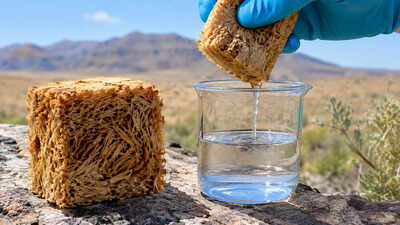
Image: AI-generated representation of a wood-based sponge that pulls water from air as dry as 15% humidity
Water vapour is present almost everywhere, even in places where rivers, lakes and groundwater are scarce. The challenge has always been turning that invisible moisture into usable freshwater efficiently enough to make atmospheric water harvesting practical.
Now, researchers have developed a wood-based material that can capture water from remarkably dry air. The sponge continued absorbing moisture at relative humidity as low as 15%, while a larger system built from the material produced as much as 1.72 litres of freshwater per kilogram of sorbent per day during outdoor testing.The technology combines a porous sponge made from balsa wood with lithium chloride, a moisture-attracting salt, and a separate layer designed to capture and store solar heat.
This allows the material to absorb water vapour from the atmosphere and then release the collected water even when sunlight becomes weak or disappears.The work, published in Nature Communications under the title ‘Hygroscopic wood sponge with dual phase change function for enhanced all-weather atmospheric water harvesting,’ was led by Xinyao Ji, He Shan, Jiazuo Zhou and colleagues. The researchers are affiliated with Northeast Forestry University and Shanghai Jiao Tong University in China.
Wood sponge captures moisture from air at 15% humidity
The researchers started with a material that already has a useful natural architecture, i.e.,
wood. Ordinary wood contains long, aligned channels that move water through the plant, but its original structure is not optimised for rapidly drawing water vapour from the air. The team chemically modified balsa wood by removing lignin and part of its hemicellulose. This opened up the structure while retaining the cellulose framework, producing what the researchers call a wood sponge.
The resulting material had an open porosity of 94.60% and an average macropore diameter of 10.84 micrometres, giving water vapour more direct pathways into the material.The lower section was then loaded with lithium chloride, a hygroscopic salt that strongly attracts water molecules. In tests, the resulting material could absorb moisture across a relative-humidity range of 15% to 90%. At 15% humidity, the best-performing composition absorbed 0.59 grams of water for every gram of sorbent. As humidity increased to 90%, its water uptake rose to 3.03 grams per gram. The material also reached equilibrium within 360 minutes, addressing one of the major problems that has limited practical atmospheric water harvesters, slow moisture uptake.
Researchers combined the wood sponge with a solar heat store
Capturing moisture is only half of the problem. Once water has been absorbed, the material must be heated so the trapped water can be released and collected. Relying entirely on sunlight can make this step intermittent, particularly when clouds pass overhead or after sunset. To solve that problem, the researchers added a second layer above the moisture-catching wood sponge. This section contains a phase-change-material-based photothermal hydrogel that converts sunlight into heat and stores some of that energy as latent heat.The stored heat can then be released gradually, allowing water desorption to continue under weak sunlight and even in darkness. According to the study, the PCM hydrogel had a heat-storage enthalpy of 155.51 joules per gram and a solar-to-thermal energy-conversion efficiency of 90.80%. The result was a hybrid device in which the two layers perform different jobs. The wood sponge and lithium chloride concentrate on pulling moisture from the atmosphere, while the upper layer manages the energy needed to turn that captured moisture back into liquid water.This dual approach is central to the study by Ji, Shan, Zhou and their colleagues because atmospheric water harvesting is not simply a question of finding a material that can absorb lots of water. The material also has to absorb and release it quickly enough, repeatedly and with an energy input that makes sense outside a laboratory.
The wood-based system produced up to 1.72 litres of water per kg
The researchers tested the technology outdoors rather than relying solely on controlled humidity chambers.
Large-scale arrays were demonstrated in Harbin and Xiamen, representing different climatic conditions and seasons. In a one-day outdoor experiment in Harbin, the system produced 1.72 litres of freshwater per kilogram of sorbent. The test was conducted during summer, when the average temperature was 29.24°C and average relative humidity was 62.95%, and the system completed four sorption-desorption cycles.The collected water was also analysed for metals and was reported by the researchers to meet World Health Organisation drinking-water standards for the parameters tested. The performance was not limited to that single test. In Xiamen, the system produced 1.37 litres per kilogram on the first outdoor day, followed by 0.96, 1.07 and 1.18 litres per kilogram on the next three days. Across longer outdoor experiments, the PHW array achieved an average production of 1.26 litres per kilogram per day.The researchers also modelled how the system could perform under different climates. Their calculations suggested that many regions could produce roughly 0.65 to 1.50 litres per kilogram per day, although output varied considerably with humidity, temperature and available sunlight. Humid regions such as Malaysia were estimated to exceed 1.6 litres per kilogram per day, while the estimate for Saudi Arabia was around 0.30 litres per kilogram per day.
Northeast Forestry University researchers designed the sponge for all-weather water harvesting
The work brings together expertise in wood materials and atmospheric water harvesting. Most of the researchers, including Xinyao Ji, Jiazuo Zhou, Chengyu Wang and Haiyue Yang, are affiliated with the Key Laboratory of Bio-Based Material Science and Technology of the Ministry of Education at Northeast Forestry University in Harbin. He Shan and senior researcher Ruzhu Wang are affiliated with the Engineering Research Centre of Solar Power and Refrigeration at Shanghai Jiao Tong University.
The choice of wood is significant because the researchers argue that it provides several advantages over more complex synthetic sorbents. Wood is naturally abundant and renewable, while its cellular structure can be modified without constructing an entirely artificial network from scratch.The study, therefore, focuses not only on increasing water uptake but on making the complete process more continuous.
The authors combined rapid vapour transport, hygroscopic salt, solar heating and thermal storage into one system. The technology is not yet a replacement for conventional water infrastructure, and its output depends heavily on local weather conditions. The researchers' own global assessment found that extremely arid environments can deliver substantially less water because there is simply less atmospheric moisture available to capture.Still, the experiment demonstrates how an ordinary biological material can be redesigned into a sophisticated water-harvesting system. Instead of waiting for clouds, rain or groundwater, the device draws from a resource that is already suspended invisibly above the ground, and the researchers showed that even air with just 15% relative humidity can contain enough moisture for a carefully engineered wood sponge to collect.