1 hour ago
1
1 hour ago
1

'An army of sheep led by a lion is better than an army of lions led by a sheep'
In May 1940, the British Expeditionary Force was trapped on the beaches of Dunkirk, facing destruction from the advancing German army. By every visible measure of military equipment, battlefield position, and numbers, the Allied forces were defeated.
Yet, the later rescue effort involving hundreds of civilian boats and the refusal to surrender turned a possible disaster into one of history’s greatest evacuations. The soldiers on the beach did not suddenly receive better weapons or stronger forces. The change came from leadership that united their purpose.This turning point is the central idea behind a famous saying: “An army of sheep led by a lion is better than an army of lions led by a sheep.”The quote challenges the common belief that success depends only on talent or collective strength. Instead, it suggests that a group’s true ability is either limited or multiplied by the quality of its leader. Even a highly skilled team can fall apart under weak leadership, while an ordinary group can achieve remarkable results when guided by a brave and determined commander. The idea remains powerful because history repeatedly shows that ability without direction is defeated by confusion.
The myth of the Macedonian origin
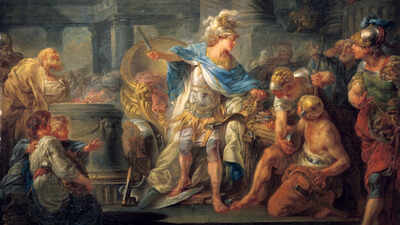
For centuries, popular culture, leadership books, and online sources have credited this powerful comparison to Alexander the Great, the ancient Macedonian ruler who built one of the largest empires in history before turning thirty. The connection seems believable. Alexander often led armies that were smaller in number against much larger Persian forces, fighting at the front lines alongside his soldiers.However, historians and classicists have found no evidence of this exact phrase in the ancient writings about Alexander, including works by Arrian, Plutarch, and Quintus Curtius Rufus.The real history of the quote is older and more complex than a single speech by Alexander. Similar comparisons appear in ancient Greek stories, especially in Aesop’s Fables. In the story of The Deer and the Lions, a group of deer struggles with fear until a single lion steps forward to lead them, changing their confidence. Later, Roman writers helped shape the modern version of the saying. The second-century Roman writer Polyaenus, in his book Stratagems, recorded Athenian general Chabrias saying that an army of stags led by a lion was stronger than an army of lions led by a stag.
Over thousands of years of translation and storytelling, the nervous stag became the modern sheep, and the quote developed into its current form.
Is there a psychology behind shared courage?
The lasting power of this quote comes from a simple psychological truth: Courage and fear spread easily, and both begin with leadership. In nature, social animals look toward a dominant figure during danger to understand how serious a threat is. If the leader runs away, the group follows, even if individual members are capable of fighting.From a philosophical view, this connects with the ideas of Niccolò Machiavelli in The Prince. He argued that a leader’s virtù, meaning determination, ability, and strength of character, is the main force that allows people to control fortuna, or unpredictable events. Machiavelli noted that many well-trained armies failed because their commanders lacked personal commitment and strong motivation.When a leader shows confidence and clear direction, they change how followers view risk.
The individual “sheep” stops focusing only on personal survival and begins acting as part of a larger mission, a bigger, more whole collective. On the other hand, a weak or uncertain leader creates doubt among even the most talented people. Doubt encourages self-protection, which destroys the unity needed for success.
Leadership in the age of advanced technology
This ancient military lesson remains highly relevant in 2026, especially in the unpredictable worlds of technology and business.
Modern companies have teams filled with elite software engineers, financial experts, and market analysts — people who are clearly the intellectual lions in this world. Yet, Silicon Valley history is full of heavily funded startups that failed despite having exceptional talent because their leaders lacked a clear strategy.A famous example is Apple’s transformation in 1997. When Steve Jobs returned to the company, Apple was close to collapse despite having some of the world’s best designers and engineers.
The company had become an army of lions trapped by complicated management and an unclear product strategy. Jobs brought the focus of the proverbial lion. He cut around 70 per cent of Apple’s products, reduced the engineering focus to four main machines, and started the development of the iMac. The employees did not suddenly become more intelligent; instead, their existing skills were focused by a leader willing to make difficult and risky decisions.Sports show the same pattern. In European football, the arrival of managers like Pep Guardiola or Jürgen Klopp has transformed average teams into championship-winning sides within a short period, using many of the same players. The manager’s tactics, discipline, and belief completely change how athletes perform under pressure.In everyday organizations, the quote also warns against avoiding responsibility through endless teamwork. When decisions are controlled by large committees trying to remove personal risk, groups behave like a cautious herd. Real progress requires someone willing to take responsibility if a decision fails, allowing the team to work with confidence.In 1805, during the Napoleonic Wars, French Marshal Michel Ney described this same idea after watching an experienced Russian regiment collapse during a sudden cavalry attack. He observed that the courage of ordinary soldiers often reflects what they see in their commanders. When the people in charge show fear, the entire line can break.