1 hour ago
5
1 hour ago
5

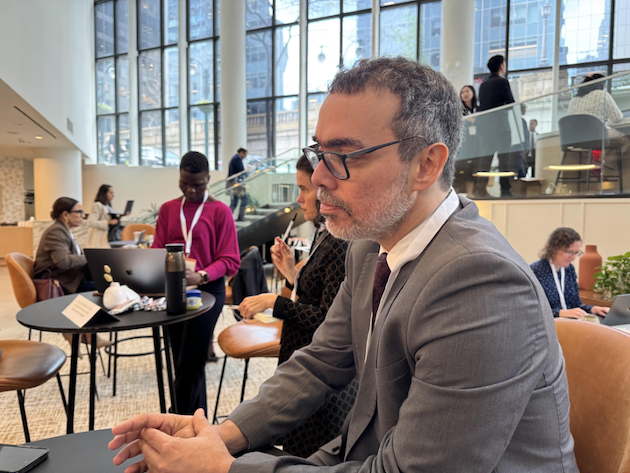
UNITED NATIONS, October 6 (IPS) - Seven months into the Iran War, threats of further military escalation and stalled efforts to reopen the Strait of Hormuz have heightened fears of worsening humanitarian suffering and wider regional instability.
Pedro Abramovay, Vice President of Open Society Foundations (OSF), told IPS that the international community should empower local actors and middle powers to work together toward a peaceful resolution to the conflict.
“One of the things we are on the brink of right now is one of the largest food security crises in the world,” Abramovay said, describing the prospect as “particularly alarming.”
He spoke to IPS on the sidelines of the United Nations General Assembly (UNGA 81).
“It is a consequence of three elements: Hormuz being closed, the availability of fertilizers, and the cost of food,” he said.
Abramovay said the war in Ukraine has already had a lasting impact on wheat and grain production, while expectations of a strong El Niño, which could bring severe weather disruptions and extreme heat, were adding to economic risks.
These pressures are particularly acute for developing countries, where higher fuel and fertilizer costs could reduce crop yields and threaten the livelihoods of smallholder farmers.
“We need to find specific solutions that would allow fertilizer to pass the blockade in the Strait of Hormuz on both sides, we need to find solutions also on the Black Sea to allow for grains to float, and we need to protect small farmers in different parts of the world from the El Niño shocks,” Abramovay said. “These are examples of issues that only multilateralism can solve.”
He expressed concern that the conflict’s wider geopolitical dimensions could trigger further instability.
“It is hard to imagine that a conflict—which is entangled with such geopolitical tensions far beyond Israel, Iran, and the U.S.—won’t generate new ones,” said Abramovay. “That brings the duty of the international community to empower local actors to work together toward peace.”
UN Secretary-General António Guterres has repeatedly stressed the importance of diplomacy, adherence to the UN Charter, and the reopening of the Strait of Hormuz as priorities for the international community.
Michael Fuchs, Director for U.S. Foreign Policy at OSF, has argued that sustained U.S. military force in Iran will not produce lasting security and has called on Washington to reconsider its long-term role in the wider Middle East.
Abramovay echoed these concerns, telling IPS that President Donald Trump’s unilateral approach had “failed” to de-escalate the conflict, aggravating geopolitical tensions and weakening U.S. influence in foreign affairs.
“People understand that the U.S. is paying a price internally. It is showing that not only is unilateralism morally wrong, but pragmatically tragic,” he said.
He argued that a sustainable solution should be driven by middle powers and local actors rather than Washington alone. He said the growing U.S. debate over the conflict demonstrated the political difficulties of pursuing unilateral military action and could prompt a broader reassessment of American foreign policy.
“What we really hope …is that the U.S. rethinks its foreign (policy) approach …and abandons the delusional perspective that it was possible to unilaterally solve global problems.”
Abramovay warned that Iran and the wider region’s ability to “rebuild itself and create prosperity” ultimately depends on a timely international effort to resolve the conflict.
He also expressed hope that the election of a new UN Secretary-General—potentially the organization’s first woman to hold the post—could generate “new momentum” for multilateral approaches to resolving global conflicts.
IPS UN Bureau Report



© Inter Press Service (20261006174243) — All Rights Reserved. Original source: Inter Press Service