2 hours ago
2
2 hours ago
2


Teacher Katrina Crickett says intensive reading lessons are vital to ensure children who lack literacy skills do not fall further behind their peers
Primary school teachers have been hired to work in Glasgow's high schools to address the growing number of new starts who are unable to read properly.
The primary teachers run intensive catch-up classes for first-year secondary school pupils without basic literacy skills.
Glasgow's education director, John McGhee, said fixing the problem was a "moral imperative".
Scotland's ranking in the latest Pisa international education study, external did not change significantly between 2022 and 2025 but a long-term decline in reading standards has not been reversed.
There are currently primary-qualified teaching staff working in 14 of Glasgow's 30 secondary schools to improve literacy and numeracy standards.
The majority of children who are getting support as part of the project have English as a first language.
Katrina Crickett carries out the role at St Andrew's High School and utilises the systematic synthetic phonics method of matching letters and sounds to help pupils, who can be taught to read in a matter of months.
"Some young people when they're coming in, they can't read," she said.
"They've got reading ages of maybe five or six-years-old - they can't recognise basic words that we take for granted.
"They can't break those words down and sound them out to work out what they mean."
Katrina says her maximum class size of 15 - nearly half the size of some of the primary school classes she used to teach - allows her to focus on getting pupils up to speed.
She added: "It's making a difference, being able to strip it back and actually sit with them and find out what it is they don't like about reading and working on that.
"It's actually quite disheartening when they come to me because they have so much passion and so much knowledge, but they just don't have the confidence to show that.
"So a big part of my job is to give them the tools and confidence to access the rest of the curriculum."
'Moral imperative' to improve literacy rates

John McGhee, director of education for Glasgow City Council, says pupils coming to high school with barely any reading ability was not something you would see a decade ago
The number of pupils reaching expected levels of literacy in Scotland's schools are at a record high, external.
But despite this the latest data, external shows one in four primary school-age children across the country are still struggling with basic literacy skills.
In Glasgow, 68% of P1,P4 and P7 pupils were achieving the expected levels of literacy in 2024/25 - the joint lowest rate in Scotland.
The man tasked with improving this is John McGhee, who hired a primary school teacher to work on literacy levels in his previous role as head teacher of St Andrew's High School.
"As a head teacher I was seeing, increasingly, a number of young people coming in with very basic literacy skills - some young people who simply couldn't read," he said.
"There is no way, as a moral imperative, that we should have young people leaving school not able to read.
"Our success as a country will be largely dependent on the skills of young people leaving our schools.
"My sense of it is we kind of lost touch a bit with some of the basics."
McGhee added: "Our target is that all young people in Glasgow, by the time they leave primary school, will have a minimum reading age of about nine-and-a-half.
"It's a very high target but to set it means they can access most of the literacy that they need to access an adult life."
How did Scotland do in the Pisa rankings?
The international study, external records the knowledge and skills of more than 760,000 15-year-olds from 91 countries and is co-ordinated by the Organisation for Economic Co-operation and Development (OECD).
Scotland has taken part in every cycle of the study since 2000 – with 115 schools and colleges, and 3,066 pupils across the country taking part in Pisa 2025.
The latest rankings show performance in Scotland's high schools has improved in science but slipped in maths and reading since the 2022 study.
The Scottish government said the changes in results between the two studies were not statistically significant.
Scotland's score in the 2025 Pisa assessment for reading was 488.
This is down from 493 in the 2022 assessment, and also a drop from 504 in 2018 and 526 in 2000 - when the Pisa study started.
The reading performance was above the OECD average of 461 points.
Scotland's reading score is ahead of Wales (459) and Northern Ireland (482) but behind England (497), which saw its performance improve since the last study.
For maths, the score in Scotland was 467, down from 471 in 2022 and just above the OECD average of 463 points.
The latest score for maths continues the trend of worsening performance in Scotland as the score in 2018 was 489 and in 2015 it was 491.
Compared with other UK nations, Scotland is behind Northern Ireland (473) and England (492), but ahead of Wales (456).
In science, Scotland's score was 491 points, which is above the 483 score recorded in 2022 and the 490 result in 2018.
The Scotland score is ahead of Wales (476) and the OECD average (482), but behind Northern Ireland (492) and England (516).
In the new category of computational problem-solving performance, Scotland's score was 515.
This is ahead of Wales (501) and Northern Ireland (513), but behind England (525) in the rankings.
Although the raw numbers have changed in all three of the main categories since the last Pisa study, Scottish government data scientists have concluded that the 2025 performance was not statistically significantly different from the 2022 study.
That is because the changes are not beyond the level of uncertainty associated with estimating performance from a sample of pupils and assessment questions in a study as large as the Pisa project.
But longer-term trends, such as the decline in reading standards compared with when the study launched in 2000, remain.
The new data also found that pupils from more advantaged socio-economic backgrounds continued to perform better on average.
However, the relationship between pupils' socio-economic background and performance was weaker than in 2022 in science and maths, and significantly weaker in reading than in every previous Pisa cycle.
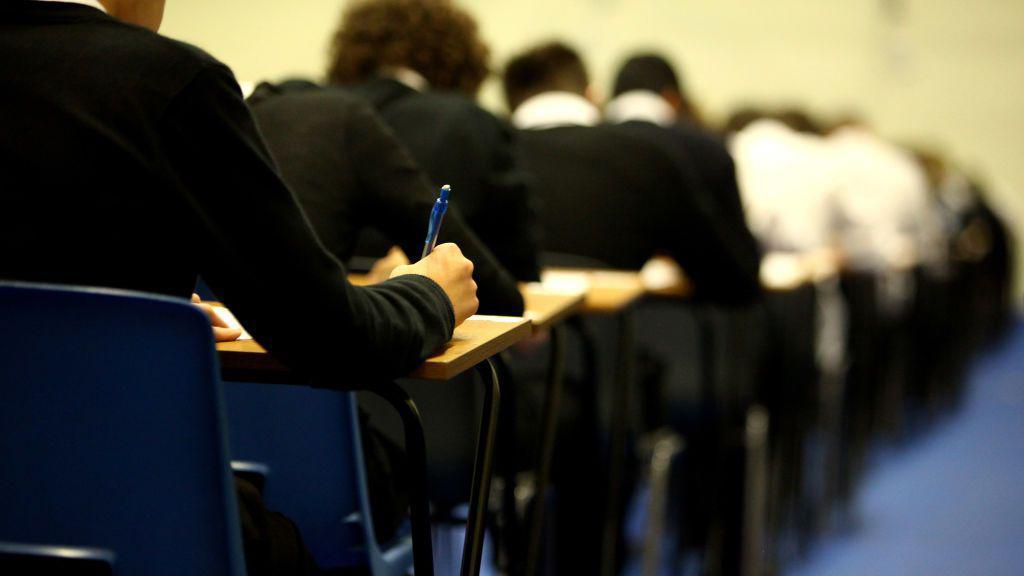
The Pisa study is just one way of measuring standards in Scotland's high schools.
Last month's annual exam results showed pass rates had increased, with the pass rate for Highers up 0.8% to 76.7% while Advanced Highers rose by 0.9% to 77.6%.
Education Secretary Mairi McAllan said: "Pisa 2025 shows real strengths in Scottish education, as well as areas we're already working to improve.
"While recognising the positives, these results also underline the need for change in certain areas – change that I intend to lead in the coming period to ensure excellence and equity for all Scotland's young people."
Scottish Labour's education spokesperson Katherine Sangster said: "Things have flatlined since 2022's historically poor results and we are alarmingly far from where we were in before the SNP came to power, when Scotland was ahead of our neighbours in reading and maths."
Scottish Liberal Democrat MSP Duncan Dunlop said: "Under the SNP, our education system has tumbled down the rankings, lagging behind England on every measure of performance. This report makes for brutal reading."