6 months ago
71
6 months ago
71

Chris ClementsScotland social affairs correspondent

 BBC
BBC
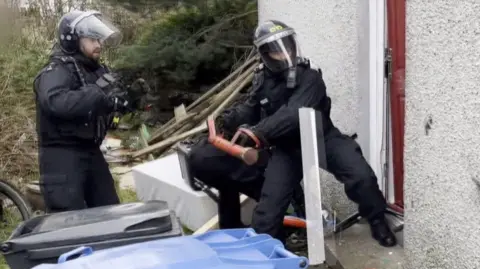
A door frame flies off as police force entry into one property
Police have made 43 arrests as part of a month-long crackdown on so-called 'county lines' gangs in Scotland.
Drugs worth £900,000 were seized during the operation, including crack cocaine, heroin and ketamine.
Officers also 'safeguarded' 38 vulnerable people who they say were being exploited by England-based crime groups.
The activity included Operation Silentridge in Inverness, aimed as disrupting gangs from Liverpool, London and the Midlands operating in the area.
The BBC joined detectives as they targeted those vying for control of the drug trade in the Highlands.
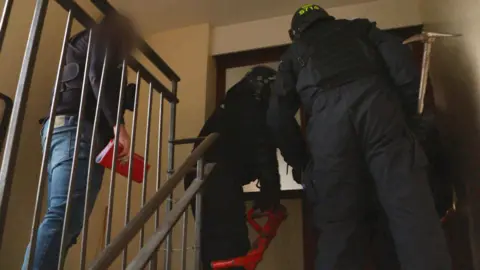
Officers force entry to a property during a crackdown on 'county lines' dealers in Inverness
It took officers in protective gear about 30 seconds to force their way in - longer than they had anticipated.
The flat - not far from Inverness city centre - had its own private entrance on the ground floor.
The door had been barricaded - reinforced with planks of wood and bricks - making entry more difficult.
Inside, there was a man from London but, it turned out, no drugs.
The Londoner went free and detectives left empty-handed.
We later asked - why would the door be reinforced?
It wasn't just about the police, officers told us. It could also be the threat posed by rival drug gangs.
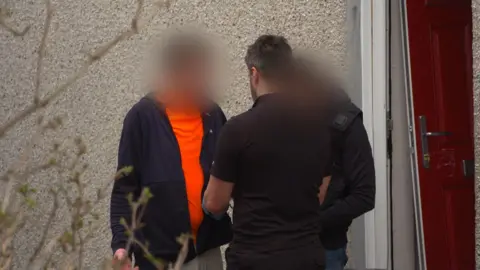
Police search a passerby on suspicion of carrying drugs during a raid
The morning raid in Inverness was one of more than 50 carried out as part of a Scotland-wide blitz on 'county lines'.
It's a specific model of drug dealing - the "counties" are local communities and the "lines" are the phone lines used to deal drugs.
The perpetrators, meanwhile, come from outside the elsewhere.
"In Inverness, we have seen a rise in groups from a number of areas across the UK," said Ch Insp Craig Still, area commander for the city.
"They'll target Inverness because there is a relatively small community here of people who have experience of substance abuse.
"They come with records of violence, they may have weapons, they use intimidation and they use children in terms of exploitation.
"Because we are the end of the line in Inverness, there is unfortunately an opportunity for them to establish a foothold and to deal drugs in the local community."
According to police, there are 12 crime groups involved in county lines dealing in Inverness.
They run drugs including crack, heroin and ketamine from Liverpool, London and the Midlands to a city of less than 50,000.
"Highland Cops, is it?" asked one local man, who spotted our camera after his property was raided by detectives.
He was referring to the BBC docuseries, in which the issue of English drug gangs setting up shop in Inverness is a recurring theme.
Detectives told us the man was found intoxicated when they broke down his door.
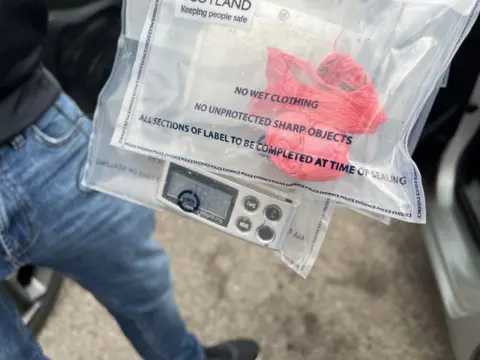
Police seized more than £900,000 of illegal drugs across Scotland
Inside, they seized white powder believed to be cocaine, cannabis, sets of scales, a wad of cash and a mobile phone.
Showing us the haul, a detective - who asked not to be identified - said the phone would be analysed for links to organised crime.
The crackdown included the Inverness-specific Operation Silentridge.
Throughout February and March, police raided 32 properties in the city and arrested 16 people. Seven of them were charged with drug supply.
Among the haul was heroin, cocaine and cannabis, and more than £13,000 cash.
Police seized 22 mobiles - three of them used for county lines - alongside two machetes and a lock knife.
'People can be really vulnerable'
On another raid in Merkinch, it took three officers nearly a minute of sustained hammering before they broke down the door to a cottage flat.
As before, the entrance was barricaded - this time with bed slats wedged against the stairs to the first-floor property.
Within, police said they found a local man in some distress but no drugs.
Before long, the man's family appeared at the front gate.
Officers listened as they were told of the vulnerabilities and the mental health struggles of the man whose flat they just raided.
A friend also appeared and - after being searched by police - spoke himself of appearing on Highland Cops when his flat was raided.
Police left the man in his family's company and told the BBC they would later conduct a welfare check.
"These guys wouldn't be making any money from this," remarked one departing officer.
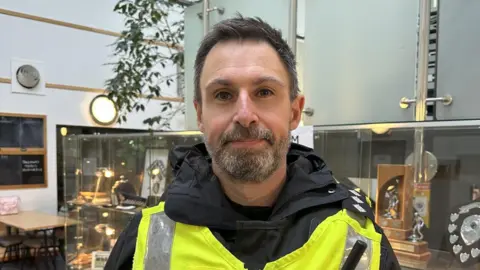
Chief Inspector Craig Still led Operation Silentridge in Inverness
It echoed words by Ch Insp Still, who told BBC Scotland News it is those with mental health or addiction issues, survivors of abuse, and young people that find themselves most vulnerable to the gangs.
"Quite often we see grooming-type behaviours," he said.
"People who are vulnerable and experiencing loneliness through these conditions actually see the people that are coming into their homes as a positive influence on their lives."
But, he said, things go wrong.
"They will be asked to facilitate for other 'lines', which will then bring them into direct feud and conflict between the groups.
"That is when we see those instances of violence and vandalism. Overall people can be really vulnerable."
While the operation made 43 arrests across Scotland in total, police were keen to highlight work done to help those they say were being exploited.
Of the 38 vulnerable people safeguarded and referred to agencies, nine of them were children.
Four people went on to be referred to the Home Office as potential victims of human trafficking and modern slavery.
Lesley Gordon, of Action for Children, described the use of young people in crime as "child abuse".
She continued: "The impact of criminal exploitation, including 'county lines', on the lives of children and young people is utterly devastating.
"We continue to see the serious harms inflicted by the exploiters on children, their families and their local communities.
"Through our criminal exploitation intervention services across Scotland and the UK, we support children, young people and families affected by exploitation working closely in partnership with police and other agencies."
Assistant Ch Con Stuart Houston, head of organised crime and counter terrorism, said: "Organised criminals don't care about the people they harm, they only care about power and money.
"This is simply not welcome or tolerated in Scotland."
He added: "But we can't do it alone. If something doesn't look or feel right, trust your instincts and report it.
"Even a small bit of information can make a significant difference and help protect our communities."