6 months ago
46
6 months ago
46

Emma Pengelly, Shayan Sardarizadehand Jake Horton

 Facebook
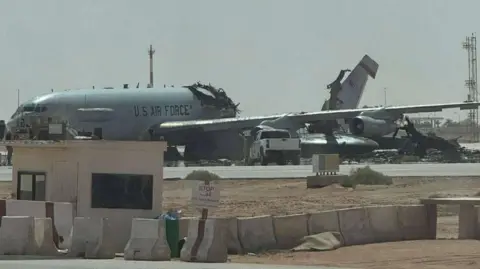
Verified pictures show a US command and control aircraft has been destroyed at an air base in Saudi Arabia.
The pictures appear to have been first shared by a Facebook page carrying US military news. They show the E-3 Sentry aircraft appears to have been split in two.
We've confirmed the photos were taken at the Prince Sultan air base about 100km (62 miles) south-east of the Saudi capital Riyadh. Features seen in the pictures, including pylons, storage units and markings on paved areas, matched with satellite imagery.
US Central Command has not yet publicly commented on the incident. The BBC has asked for comment.
On Friday a US official told Reuters that 12 US personnel had been wounded, two of them seriously, in an Iranian military attack on the air base. The Wall Street Journal newspaper reported that at least two US refuelling aircraft were also damaged.
On Sunday Iran's IRGC-linked Fars news agency said a Shahed drone had struck the E-3 aircraft.
BBC Verify has also seen an E-3 in this location in a satellite image captured on 11 March. We cannot say if they are the same aircraft.
In one of the verified pictures the aircraft's tail number is visible. Using this we checked flight-tracking site Flightradar24 which showed it was airborne near the base on 18 March.
A satellite image taken on Friday appears to show a fire on the air base apron, about 1,600m (5,200ft) east of the E-3. It is not clear whether this was part of the same attack in which the aircraft seen in these pictures was damaged.
The Boeing E-3 Awacs - the acronym stands for Airborne Warning and Control System - is based on a Boeing 707 airliner and has a distinctive rotating radar disc mounted on the rear of its fuselage.
This radar allows it to detect and track potential targets at long ranges to provide an early warning of possible threats during combat operations.
The aircraft gives "information for commanders of air operations to gain and maintain control of the air battle", according to the USAF website.
The first of the type entered service in 1977 and it has been reported that the E-3 is expected to remain operational with the USAF until 2035.