1 hour ago
1
1 hour ago
1

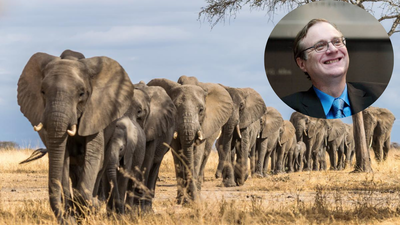
In 2013, Microsoft co-founder and philanthropist Paul G Allen committed $7 million to one of the largest efforts ever undertaken to determine how many African elephants remained in the wild.
Known as the Great Elephant Census, the project was led by Elephants Without Borders and involved scientists, conservation organisations, pilots and wildlife authorities across the continent. Aerial surveys were conducted between 2014 and 2016 across 18 countries, producing an estimate of 352,271 savanna elephants. More alarming than the total was what the census revealed about their decline. In 15 countries where reliable historical comparisons were possible, savanna elephant numbers had fallen by about 30% between 2007 and 2014, with researchers estimating that populations were continuing to decline at roughly 8% each year.
Paul Allen's $7 million investment launched a continent-wide count
Allen announced the Great Elephant Census in December 2013 after becoming increasingly concerned about the lack of reliable, standardised information on Africa's elephant populations. The initiative was funded with $7 million from his philanthropic organisation and was designed to provide conservationists with a consistent baseline of elephant numbers across much of Africa. Elephants Without Borders led the project, working with a network of conservation organisations and researchers.
At the time, it was described as the largest coordinated survey of African savanna elephants since the 1970s. The purpose was not simply to produce a headline figure but to establish where elephant populations were concentrated, where they were declining and where conservation resources were most urgently needed.
Scientists surveyed 18 countries from the air
The census used standardised aerial survey methods to count elephants across 18 African countries.
Survey teams flew systematic transects over large areas, recording live elephants and elephant carcasses and collecting information that could later be compared across countries. The project involved 90 scientists, six major NGO partners and numerous local researchers, pilots and wildlife officials. Teams used 81 aircraft and flew approximately 294,517 kilometres of survey transects, spending about 9,700 hours in the air.
The survey covered approximately 218,238 square kilometres, representing about 24% of the areas included in the study. The scale was intended to make the resulting estimates more consistent and scientifically robust than fragmented counts carried out using different methods.
The 352,271 figure covered savanna elephants
When the results were published in 2016, researchers estimated that 352,271 savanna elephants were living across the 18 countries included in the census.
The estimate had a statistical standard error of 9,085, with a 95% confidence interval of approximately 334,464 to 370,078 elephants. The census was estimated to have accounted for at least 93% of the savanna elephants in those countries. This distinction is important because the figure does not represent every African elephant.
The study focused on savanna elephants, which can be surveyed more effectively from aircraft than forest elephants living beneath dense tropical vegetation.
The researchers therefore presented the result as a comprehensive assessment of the savanna elephant populations covered by the project rather than a complete count of every elephant on the continent.
The real shock was a 30% population decline
The census revealed a far more serious situation than the headline population figure alone suggested. In the 15 countries where sufficient historical data existed for comparison, researchers estimated that savanna elephant numbers had declined by approximately 30% between 2007 and 2014.
That represented an estimated loss of around 144,000 elephants during the period. Researchers also estimated that populations were continuing to decline at roughly 8% per year, with poaching identified as the main driver of the decline.
The findings showed that the crisis was not limited to a handful of isolated areas. Large-scale losses were occurring across multiple elephant populations, threatening the long-term survival of one of Africa's most iconic species.
Poaching emerged as the dominant threat
The researchers linked much of the decline to the illegal killing of elephants for ivory. The survey recorded both living elephants and carcasses, allowing scientists to assess mortality patterns across the surveyed landscapes. High proportions of carcasses in several areas indicated substantial levels of recent elephant deaths, while the geographical pattern of the declines corresponded with regions experiencing serious poaching pressure.
The researchers concluded that poaching was the primary factor driving the observed decline in savanna elephant numbers. The findings arrived during a period of intense international concern over the illegal ivory trade, which had created strong incentives for organised poaching in parts of Africa.
Protected areas were not always enough
One of the census's important findings was that most of the elephants counted were already within areas designated for protection.
Approximately 84% of the elephants surveyed were inside protected areas, while 16% were outside them. Yet elephant carcasses were still found in protected landscapes, showing that legal protection alone did not necessarily guarantee safety. Rangers and wildlife authorities needed adequate resources to prevent poaching and respond to organised ivory trafficking.
The results therefore highlighted the difference between having a protected area on a map and having the capacity to effectively protect wildlife within it.
Some elephant populations were holding steady
The census did not produce uniformly negative results. Researchers found populations that were stable or increasing in several locations, demonstrating that effective conservation could make a measurable difference. Countries and regions including South Africa, Uganda, Kenya and parts of Malawi provided examples of populations that were doing better than those experiencing severe declines. The survey also documented elephant populations in Ethiopia and Kenya that had not been included in some earlier assessments and identified elephants in an area of Botswana where they had previously been thought to have disappeared.
These findings were important because they showed conservationists not only where the crisis was most severe but also where management and protection appeared to be producing more positive outcomes.
Botswana contained the largest surveyed population
The census revealed a highly uneven distribution of savanna elephants across the countries surveyed. Botswana accounted for about 37% of the elephants counted, while Zimbabwe accounted for roughly 23% and Tanzania about 12%.
Together, those three countries contained a substantial proportion of the animals included in the census. The information was valuable because conservationists could use it to understand where the continent's remaining large populations were concentrated and how those populations compared with areas experiencing rapid declines.
Knowing where elephants were most abundant also helped highlight the importance of protecting major strongholds while preventing isolated populations from disappearing.
The census created a baseline for future conservation
One of the project's most important achievements was establishing a much stronger baseline for monitoring elephant populations. Before the Great Elephant Census, information came from surveys of different ages and used different methodologies, making comparisons difficult. By using a broadly standardised aerial approach across multiple countries, the census provided a reference point against which future population changes could be assessed.
Conservationists could now ask whether elephant numbers in a particular region were increasing, remaining stable or declining, rather than relying solely on estimates or isolated observations. The resulting dataset therefore became a practical conservation tool, helping researchers and authorities identify population trends and determine where anti-poaching and habitat-protection measures were most urgently required.
Allen's investment changed what conservationists could see
The $7 million investment had significance beyond the number of elephants ultimately recorded. It allowed conservationists to undertake a coordinated survey on a scale that would have been difficult to finance through individual national programmes alone. The census exposed the difference between perceived abundance and measured population trends, providing evidence that many savanna elephant populations were declining far faster than previously understood.
By combining population counts, carcass observations and historical comparisons, researchers could identify areas where elephants were disappearing most rapidly. In that sense, Allen's contribution helped turn elephant conservation into a more data-driven effort, giving governments and conservation organisations information they could use to target limited resources.
The findings became a warning for Africa's elephants
The Great Elephant Census ultimately showed that counting wildlife can itself become a powerful conservation intervention.
The project did not directly stop poaching or restore elephant populations, but it revealed the scale and geography of a crisis that had previously been difficult to measure consistently. The estimate of 352,271 savanna elephants provided a continent-wide baseline, while the 30% decline recorded across 15 comparable countries showed how quickly populations were being lost.
At the same time, the areas where elephant numbers remained stable demonstrated that effective protection could work. Allen's $7 million investment therefore produced something more valuable than a single population figure. It gave conservationists a clearer picture of where elephants stood, where they were disappearing and where efforts to protect them had the greatest chance of making a difference.